
After decades of scientific head-scratching and a myriad of theories, the blood-red waterfall flowing from Antarctica’s Taylor Glacier—aptly named Blood Falls—has revealed its secrets. This eerie natural spectacle, first discovered in 1911 by geologist Griffith Taylor during the Terra Nova Expedition, has long puzzled researchers due to its vivid red color, which strikingly contrasts the surrounding icy landscape of one of Earth’s most inhospitable places, the McMurdo Dry Valleys.
The persistent question that has intrigued scientists for more than a century is this: What gives Blood Falls its hauntingly red hue? Thanks to modern scientific endeavors and collaborative research, the answer has been extracted from the glacier’s rusty tongue. A team of experts—including Johns Hopkins’ Ken Livi and University of Tennessee microbiologist Jill A. Mikucki—scrutinized samples from Taylor Glacier’s surfaces with powerful transmission electron microscopes. What rose to the surface of their inquiry were the surprisingly minuscule iron-rich nanospheres. These are particles that contain not only iron but a range of elements like silicon, calcium, aluminum, and sodium.
Ken Livi remarked on the revelation, “As soon as I looked at the microscope images, I noticed that there were these little nanospheres and they were iron-rich, and they have lots of different elements in them besides iron—silicon, calcium, aluminum, sodium—and they all varied.” Indeed, these factors contribute to the cascade’s rich coloration, much like rust occurs when iron is exposed to air. However, these nanospheres are not minerals per se, as they lack a specific crystalline structure, which is a defining characteristic of minerals. This peculiarity left them undetected by previous expeditions that had predicated the red color on the presence of red algae or believed it to be caused by iron from the subglacial brine.
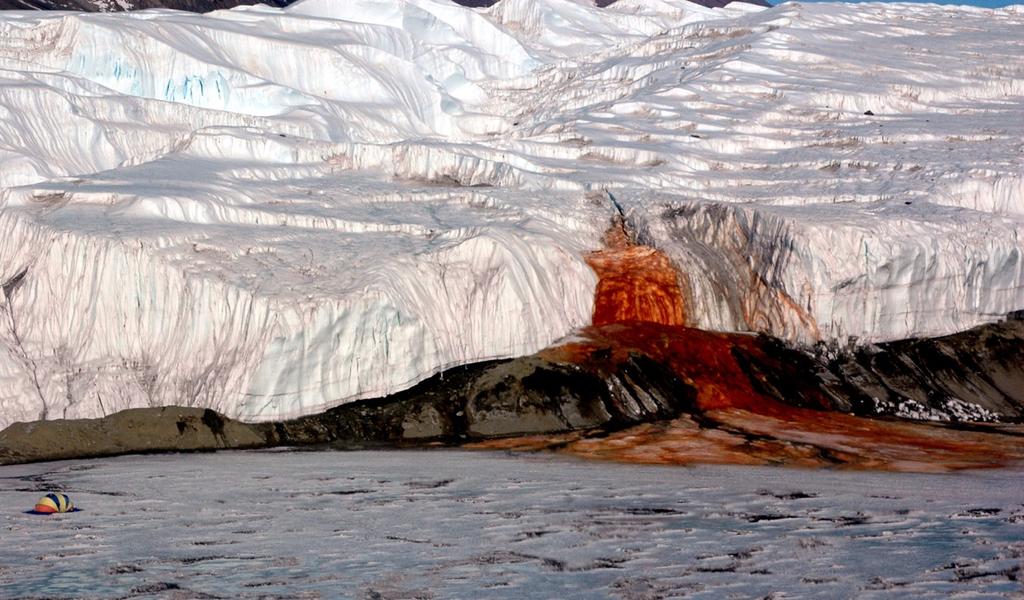
The Taylor Glacier not only poses interest for its strange coloration but also for the conditions underneath it, where a saline subglacial lake lies, rich in a primordial concoction of iron and salt, and teeming with ancient forms of bacteria. These extremophiles have persisted in darkness, without oxygen, and in heavily saline conditions for possibly millions of years. The microbial life found under such extremes highlights the sheer reach of biological diversity on Earth and the possibility that life may exist in similarly harsh, alien environments.
Erin C. Pettit, a key player in an earlier study, added richness to the narrative by using radar to map an intricate network of subsurface rivers and a subglacial lake filled with iron-rich brine. This brine remains liquid despite sub-zero temperatures due to its high salt content and heat released while freezing. The glacier surprisingly supports flowing water, which is so laden with iron that it stains the ice with its distinctive red color as it flows.
The findings not only illuminate the longstanding Blood Falls enigma but also highlight the limitations of current planetary exploration methods. Livi expressed a concern underscoring the inadequacy of the analytical tools carried by rovers to detect such nanoscopic evidence of life. He stated, “Our work has revealed that the analysis conducted by rover vehicles is incomplete in determining the true nature of environmental materials on planet surfaces, especially for colder planets like Mars where materials formed may be nanosized and non-crystalline.”
This research not only demystifies the color of Blood Falls but also encourages a reexamination of our methods of exploring other celestial bodies. To fully decipher the geological and potentially biological complexities of planets like Mars, Earth’s rigorous techniques—such as the electron microscopy that unveiled Blood Falls’ secrets—would be invaluable. Until then, the intriguing parallels between the isolated ecosystems beneath Earth’s frosty surfaces and those possibly beneath the icy crusts of moons and planets stoke the flames of curiosity and the possibility of life beyond our planet.

Antarctica’s Blood Falls stands as an emblem of scientific wonder—a veritable Rosetta stone for extreme life conditions. It demonstrates that even in the harshest environments, like the inhospitable landscape of the McMurdo Dry Valleys, life not only endures but thrives, painting an ancient canvas in shades of iron and blood. Such findings foster a profound appreciation for the robustness of life on our planet and hint at the potential for life elsewhere in the cosmos, keeping alive the quest for understanding life’s tenacity in the most extreme conditions.
FAQ
1. What makes the Blood Falls in Antarctica red?
The Blood Falls get their red color because water that has lots of iron in it comes out of the glacier and touches the air, which makes it turn red, just like a bicycle might rust. This water has been trapped under the glacier for a long time, and when it finally flows out, it looks like the glacier is bleeding.
2. What is the significance of the discovery of iron-rich nanospheres in the Blood Falls of Antarctica?
Scientists found tiny bits of iron in the Blood Falls, which tells us that tiny life forms can live in very cold, dark places under the ice. This is exciting because it means that planets or moons that are really cold or icy might have their own kinds of tiny life forms living there, too.
3. How can the discovery of the crimson secret of Blood Falls contribute to astrobiology and the search for life on other planets?
This discovery is especially exciting for scientists who study life in extreme environments, as it suggests that if similar conditions exist on other planets or moons, they could potentially harbor life as well. Consequently, places like Mars, with its iron-rich soil, or the icy moons of Jupiter and Saturn, which may have salty oceans beneath their crusts, become prime candidates for the search for extraterrestrial life.
4. What elements besides iron-rich nanospheres contribute to the crimson hue of the Blood Falls in Antarctica’s Taylor Glacier?
Besides iron-rich nanospheres, other elements contributing to the crimson hue of the Blood Falls include silicon, calcium, aluminum, and sodium, which together contribute to the cascade’s rich coloration.

