
A significant difference between humans and robots or prosthetic limbs is that they lack the skin’s ability to respond to trauma, like pain and bruises – but not anymore!
A team of engineers in Hong Kong has developed a new kind of artificial skin for robots and prosthetic limbs that bruises when it gets hit, like the real thing. The material, dubbed I-skin, could be used on artificial limbs to alert users if they’ve damaged their prosthetics, a valuable medical tool.
According to a recent report published in ACS Applied Materials & Interfaces, I-skin will activate a spiropyran-infused hydrogel that turns from beige to a blueish purple when subjected to physical trauma.
The Chinese University of Hong Kong team expects artificial skin to be beneficial for people who wear prosthetic limbs and aren’t provided with the sensory feedback to know they’ve potentially hurt themselves or damaged their limbs. In addition, the material could also be used on wearable electronics or soft robots to indicate damage or make them more ‘lifelike.’
The researchers tested I-skin out by taping a small strip of it to a volunteer’s fingers, hands, and knees and then bumped it against a wall repeatedly, demonstrating the ‘bruise’ would appear if enough force were used.
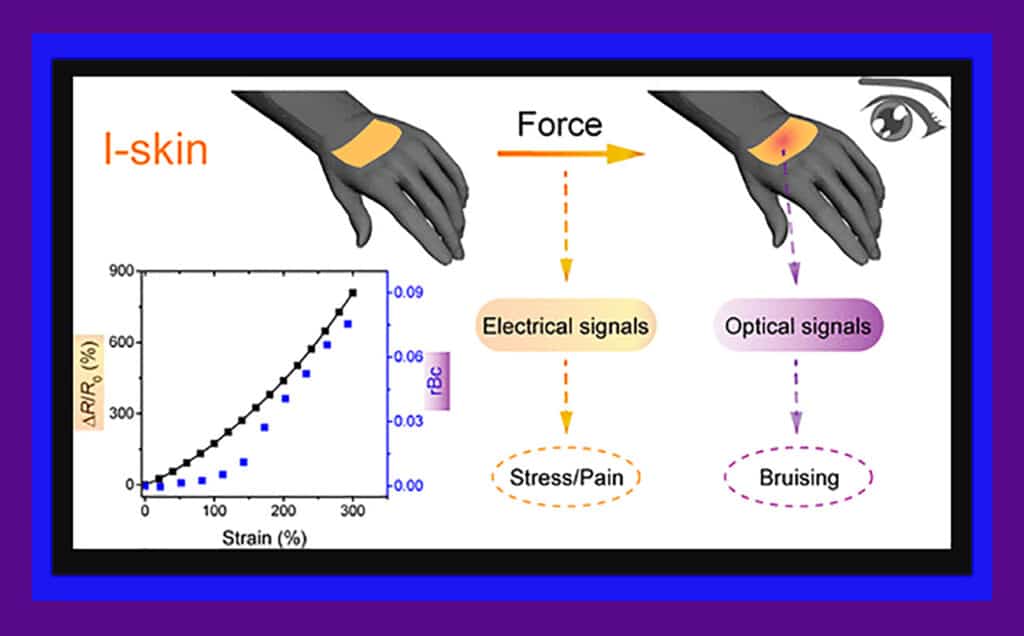
These experiments found that the I-skin could be stretched or bent without discoloring, though this did affect its electrical signals. On the other hand, violent or repeated hitting, pressing, or pinching did change its color, with the plum hue remaining visible for two to five hours before returning to its original color.
However, it’s unclear how well the yellowish beige artificial skin will work with different colored skin tones — for now, the engineers are more focused on getting it to work before moving on to proper customization.
While the skin is currently in the proof-of-concept phase, the findings offer an exciting example of how artificial skin or comparable material could be applied to the surface of prosthetics, wearable devices, or robots to reveal when it has undergone mechanical damage.


