
Bananas are one of the most famous and consumed natural products in the world. Over 100 billion are eaten annually, with many individuals consuming around 30 pounds of the fruit. That’s a lot of banana peels getting thrown away! Did you know one-third of the banana is the peel? That’s about 10 pounds of peel per banana consumer going to waste every year.
When banana peels are thrown outside, they can take several months to biodegrade, depending on the environmental conditions. Swiss-born planner and designer Sarah Harbarth saw an opportunity from this durable, plentiful material. She decided to use this sustainable fiber by transforming it into a developmental material for making products. She called the material KUORI.
Harbarth noted on her Instagram account:
During my undergraduate thesis this year, I wondered why we don’t create products that we can take from nature and put them back in the loop?
Her project with KUORI involved making four different items. Each is fully compostable, solves an environmental issue, and is produced from banana peels.
Item one is a pair of glasses. The frame is made of KUORI, replacing conventional plastic with an eco-friendly alternative.

Item two is a shoe sole made of KUORI, addressing the issue of microplastics flaking off onto the ground as we walk. Standard shoe soles made with plastic shed harmful microplastics when we walk. But not her KUORI shoes! They are durable and feed the ground, leaving behind nothing but harmless, biodegradable material.

Harbarth noted:
Did you know that we get rid of microplastics simply by walking? Yes. Most shoe soles are made of non-environmentally friendly plastic. Number one in microplastic abrasion is car tires, and number seven is occupied by the soles of our shoes.
My shoe sole concept consists of working with food residues (banana peels). The resulting shoe sole is very elastic and returns to its original position.
View this post on Instagram
Items three and four address the harmful practice of making leather goods. She used banana fiber to create a sustainable leather alternative for a watch strap and a phone case. These items combat the harmful and wasteful practices of producing leather goods from animal hides.
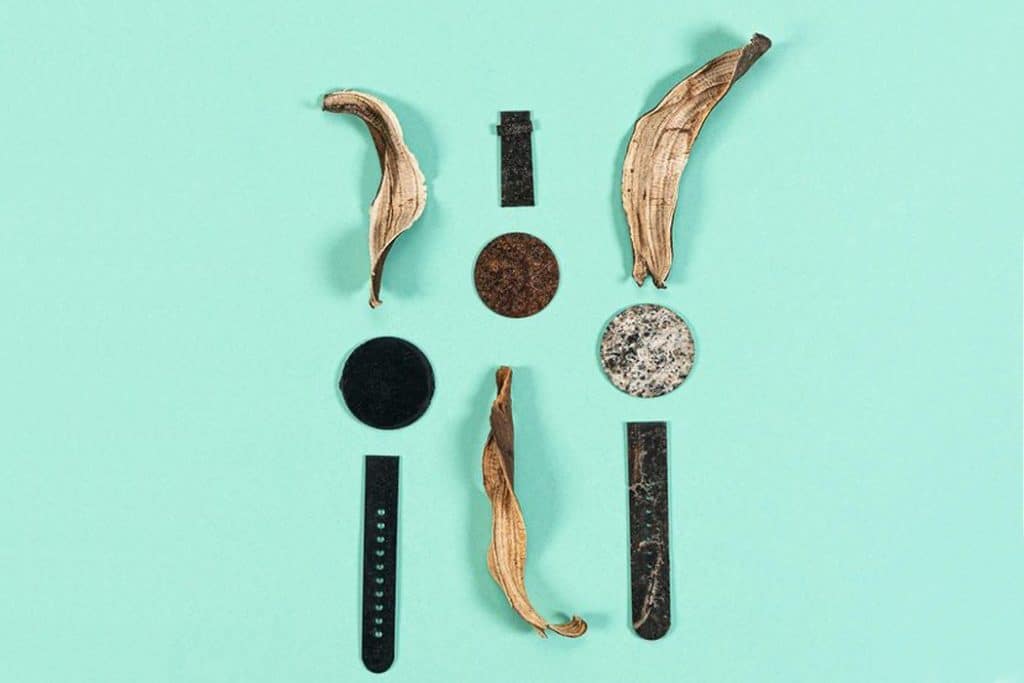
Harbarth’s goal now is to begin large-scale production of her products. She plans to distribute them directly to stores in her country.
Banana is a popular ingredient choice nowadays in the making of alternative sustainable materials and products. A few other projects include:
- Ugandan Company Is Turning Banana Waste Into Carpets And Textiles
- Brazilian Student Creates Award-Winning Sustainable Banana Fiber Tampons
- In-Flight Meal Tray Made From Coffee Grains, Algae And Banana Leaves
- How To Make Organic Fertilizer From Scratch Using Bananas, DIY
- Scientists Make Bio-Plastic From Banana Agri-Waste
- Peruvian Group Launch Compostable Plates Made Of Banana Leaves
- Thai And Vietnamese Supermarkets Are Using Banana Leaves Instead Of Plastic Packaging


