
Mudskippers are amphibious fish that spend as much as 90% of their time on land. They have spent so much time out of the water that they’ve adapted how they move, breathe, and see on land.
Mudskippers have adapted ‘shoulder’ joints and pectoral fins, which allows them to walk, jump, swim and even climb on trees. These fins enable mudskippers to leap as high as two feet into the air. Their eyesight has improved to see better in the air than in water. For this reason, mudskippers dance on land to catch a partner’s eye.
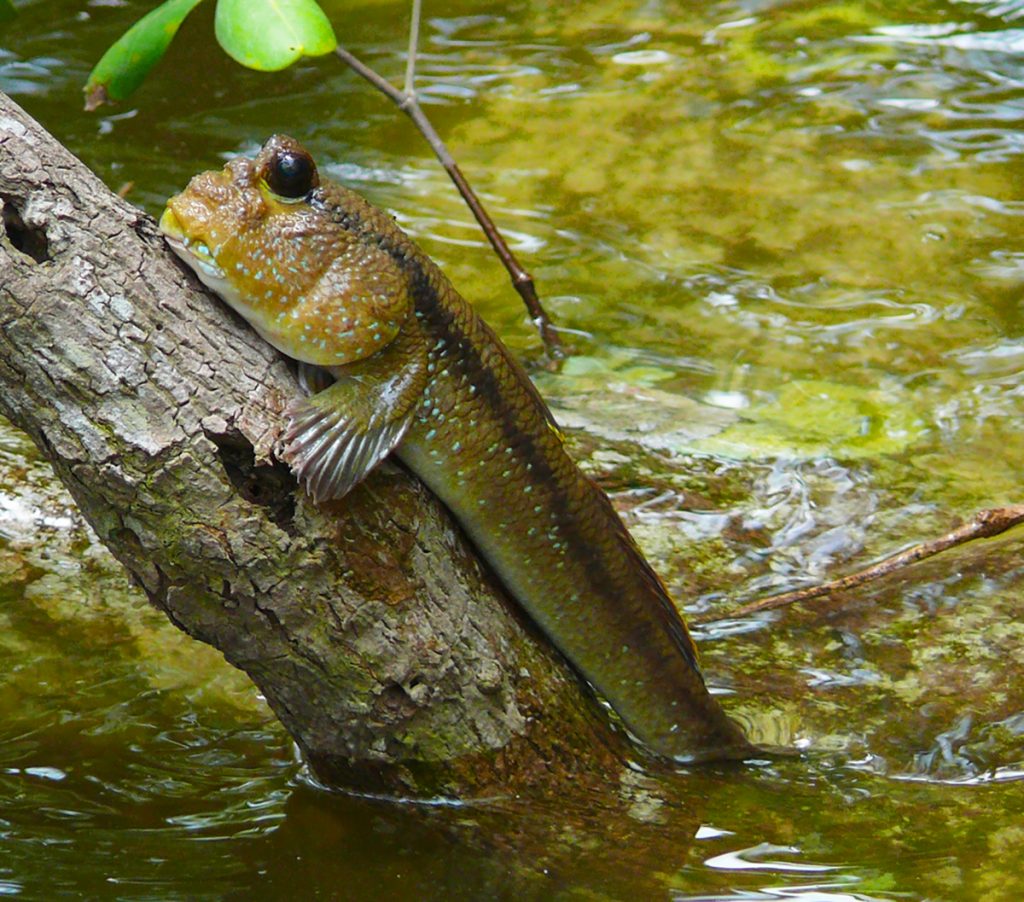
These odd fish are olive-brown colored, though some male species are covered with beautiful blue dotted markings. During the mating season, the males develop brightly colored spots on them to attract the females. The spots can be blue, red, and green.
Mudskippers also have frog-like, protruding eyes, that look like they disappear when they blink. When they blink, they keep their eyes moist by retracting their prominent eyes down into individual fluid-filled cups to prevent them from drying out. Mudskippers are actually the only known fish that can blink.


As the fish moves across the muddy surface, it eats worms, beetles, small fish, flies, mealworms, crickets, and small crustaceans. There are twenty-four species of mudskippers, and they are all distinctively adapted to live out of water. Some can spend as much as two days on land.
The amphibious fish can be found in mangrove ecosystems and mudflats of Southeast Asia to Northern Australia, East Africa, and Madagascar east through Bengal, southeast China, and southern Japan, to Samoa and Tonga Islands.
If you are interested in fish that walk on land, check out the Snakehead Fish that can breathe and move on land, while eating everything in its path.


