
A team of researchers from Norway and Switzerland has put forward a proposal for ‘Solar Methanol Islands’ that convert atmospheric carbon dioxide to fuel. The islands would have to be clustered together to create large-scale facilities. If enough of these facilities were built, they could eventually offset the total global emissions from fossil fuels and thus help protect our climate from global warming. The researchers’ proposal has been published in PNAS.
The researchers argue that although a massive reduction in carbon dioxide emissions from fossil fuel burning is required to limit the extent of global warming, the reality is that carbon-based liquid fuels will continue to be important energy storage media in the foreseeable future. Therefore, they propose a combination of mostly existing technologies to use solar energy to recycle atmospheric carbon dioxide into liquid fuel.
The researchers wrote:
Humankind must cease CO2 emissions from fossil fuel burning if dangerous climate change is to be avoided. However, liquid carbon-based energy carriers are often without practical alternatives for vital mobility applications. The recycling of atmospheric CO2 into synthetic fuels, using renewable energy, offers an energy concept with no net CO2 emission.
The making of these clusters of floating islands wouldn’t be too difficult, they say. Most of the technology to build these facilities already exists, and there are numerous acceptable locations worldwide where they could be placed. The researchers suggest floating islands similar to large-scale floating fish farms. They would use photovoltaic cells that could convert solar energy into electricity. This would then power hydrogen production and carbon dioxide extraction from seawater. The gases produced would then be reacted to form methanol that can be reused as a fuel, “which is conveniently shipped to the end consumer,” they wrote.
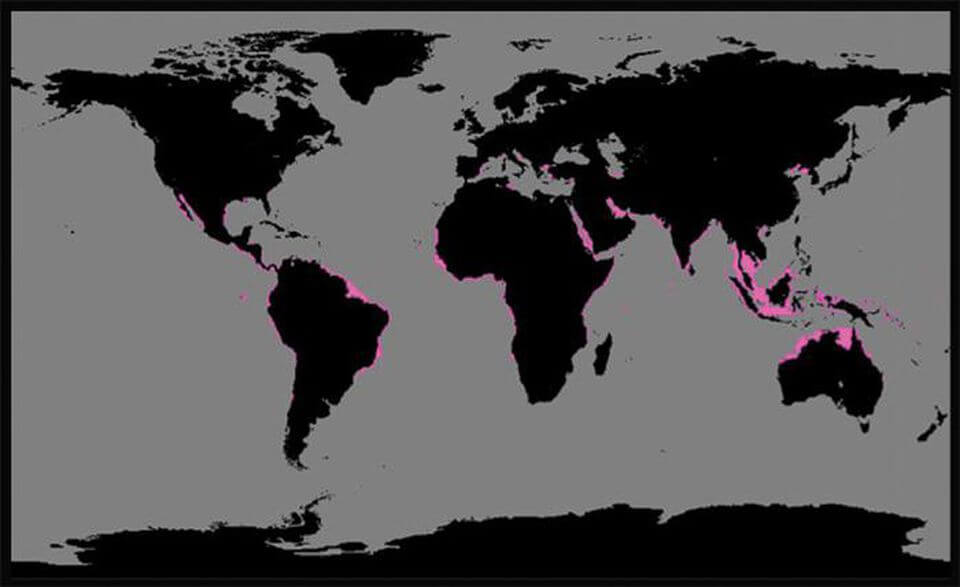
Facilities could be placed in areas that met the physical conditions: where wave height was less than seven meters, where there is a low probability for hurricanes and the water depth is less than 600 meters so that the islands can be adequately moored. Locations for facilities were found across the globe, with the coasts of Southeast Asia, northern Australia and the Arabian Gulf particularly suitable.
The team says 70 of these artificial islands would make up a single facility covering an area of approximately one-kilometer square, or 0.4 square miles. The team estimates that the output from 3.2 million floating islands would exceed the total global emissions from fossil fuels.
At the moment, they are working to develop prototypes of the floating islands. “[The] biggest challenge is the development of a large scale device to extract CO2 from seawater,” Study Author Andreas Borgschulte told Newsweek. “This process is the only one of the total system [that] has not yet been fully developed. All others exist already on an industrial scale.”


