
Scientists injected slightly developed stem cells into a pig embryo in hopes of creating a human-pig hybrid, a chimera.
Every 10 minutes another person is added to the national waiting list for organ transplants in the United States. Every day 22 people on that list die waiting for an organ that they need.
The purpose of the experiment is to see if human-compatible organs can be grown within an animal, such as a pig. These organs can then be used for future transplants into human beings, who may then also technically be part pig, a chimera.
There are 2 ways to create a chimera: The first is to transplant organs from one species to another, however, the risk of rejection is extremely high. The second is to transplant cells into an embryo and allow the embryo to grow together with the cells, as a hybrid.
A group of over 40 collaborators led by Juan Carlos Izpisua Belmonte of the Salk Institute’s Gene Expression Laboratory took 4 years of trial and error to enable the pig and human cells to grow together, surviving without rejection.
“We tried three different types of human cells, essentially representing three different times” in the developmental process, explains Jun Wu, a Salk Institute scientist, and the paper’s first author. They learned that naïve pluripotent stem cells didn’t survive as well as ones that had developed a bit more.
Pigs and humans have notably similar organs, however, the gestation period of a pig is significantly shorter, suggesting that the organs can be grown faster.
The human cells were injected into pig embryos and the embryos put into adult pigs for 4 weeks before they were removed and analyzed.
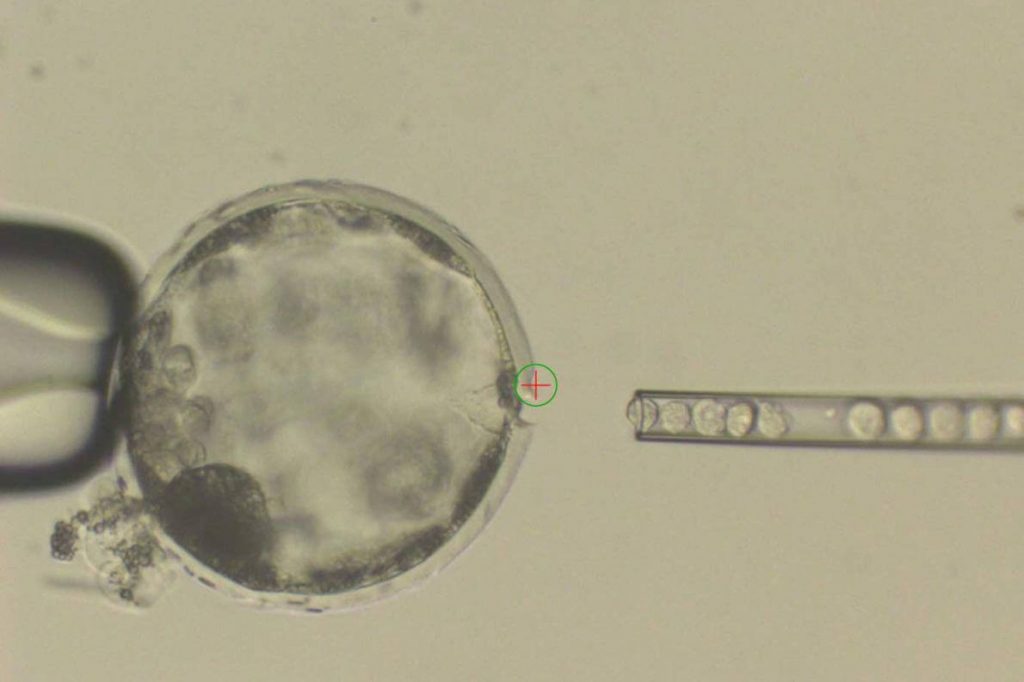
The team created 186 later-stage chimeric embryos that survived, says Wu, and “we estimate [each had] about 1 in 100,000 human cells.” In other words, the embryos were made up of 0.001% human cells. Not only is the percentage low but they found that the embryos took longer to develop, perhaps because pig embryos take longer to develop.
The percentage of human cells is much too low for transplantation into a human, however, the research shows how human cells can develop organs alongside pig cells. In the future Belmonte hopes to create fully functioning human-compatible organs, however, he admits that it could take years to develop.
If scientists aim to increase the percentage of human cells that survive in pig embryos, many ethical questions are raised. Once the percentage is high enough to not be rejected by a human, what is that percentage? How human will it be? Can they contain the cells to specific organs or will the cells be evenly distributed throughout the entire embryo?
In the meantime, they hope that the technique can be used to study the development of human embryo development and understand disease, which could be just as valuable as the ability to create human organs.


