
The mile-long Fred Schwengel Memorial Bridge that carries the I-80 across the Mississippi River is slated to be demolished, with a new road being built to handle the 42,000 cars and trucks that cross daily. But what if it could be transformed into a beautiful pedestrian walkway filled with American bison and other wildlife? That is what local Mississippi River advocate Chad Pregracke envisions when he looks at the old bridge.
On March 18, Pregracke unveiled ambitious plans for a Bison Bridge National Park to span the river and connect the Quad Cities spanning Illinois and Iowa. The creative concept immediately caught the attention of supporters and quickly earned endorsements and publicity. Only one month later, the Bison Bridge Foundation had attracted over 27,000 signatures towards a goal of 50,000.
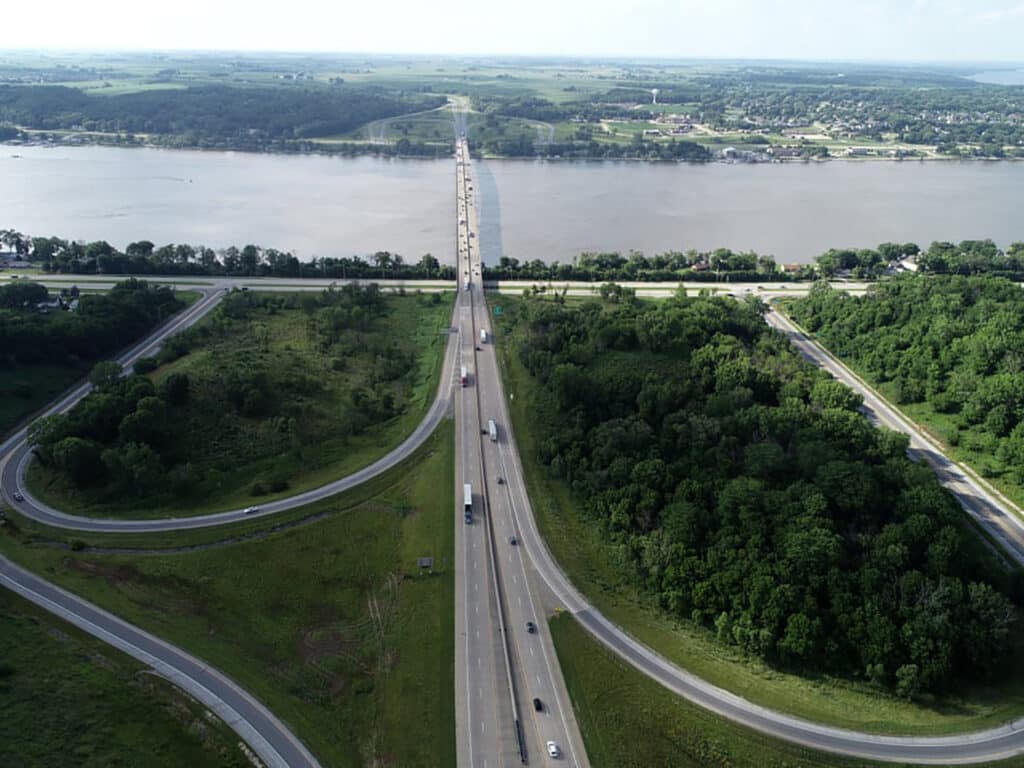
Besides providing safe passage for bison herds and saving Illinois millions in demolition costs, city authorities and regional planners hope the Bison Bridge will attract tourists to a part of the country where the population hasn’t risen in three decades. “It’s a fantastic idea, a heck of a vision. We’ve just got to keep pushing this until it comes to fruition,” said Kevin Marchek, who worked nearly 40 years for the Illinois Department of Transportation.
The Bison Bridge, which would be the longest wildlife crossing globally, will reconnect America’s most iconic animal (the bison) with its historic habitat in the most creative way. It would feature an enclosed strip of prairie running across it, with viewing stations where by-passers can observe the bison. In addition, the bridge would include guardrails in glass, with elegant cafes alongside them, providing a comfortable and clear view of the vast Mississippi and the animals roaming freely.

Jason Baldes, the tribal bison coordinator at the National Wildlife Federation, said:
The bison was known as the life commissary for my grandma’s and grandpas. It was food, clothing, shelter, and was also central to our cultural and spiritual belief systems.
Bison were also essential to the prairies as an ecosystem, acting as a “keystone species,” meaning they held all the bricks together, like the keystone in an arch. The massive herds, which once reached between 30 to 60 million, stampeded across the land, flattening the ground and spreading seeds along the way. As a result, a very diverse mix of plants grew, creating rich biodiverse soils. Interestingly, borrowing owls used to rely on their fur (once shed) and dung to make their nests.
The project offers a reconnection for the Eastern Shoshone, the heritage of the Plains Indians and other Americans. Bison are living history for the Native Americans, and the history of American conservation, which one could say started when reckless overhunting brought their numbers down to only 300. “It’s not only important to Native American tribes, but it’s important to the American people to at least have an opportunity to learn about this history,” added Baldes.

Illinois isn’t the only US state that envisions animals freely roaming along bridges. California has also unveiled plans to build the world’s largest wildlife bridge by 2023. However, unlike the Bison Bridge, which will involve pedestrians and cafes, the bridge in California will be primarily for mountain lions.
This $87 million bridge will extend over the busy 10-lane US Highway 101 to the northwest of Los Angeles. A particular stretch of freeway that 300,000 cars travel daily. Once the project is complete, the 165 ft. wildlife bridge will connect different parts of the Santa Monica Mountains, which is vital to the future of mountain lions and other species.
Surrounded by brush and trees, the bridge is specifically designed to blend into the organic scenery, giving the creatures a sense of wildlife, so they won’t even know they are on a bridge.


