
The coronavirus outbreak has led to city shutdowns all over China. Such efforts to limit the spread of the virus has resulted in industrial activity slowing down dramatically. NASA satellite images show how impressive the effect has been in regards to lowering China’s air pollution.
The space agency says that, according to the images, NO2 (nitrogen dioxide) concentrations over central and eastern China were 10-30% lower than what is usually observed over the same period. The reduction is “partly related” to the economic slowdown caused by the viral outbreak.
NASA’s Earth Observatory said in a statement:
There is evidence that the change is at least partly related to the economic slowdown following the outbreak of coronavirus.
The NO2 gas is a by-product of fossil fuel combustion in power plants, industrial facilities, and motor vehicles. NO2 emissions can cause respiratory problems, like asthma. Hubei province, where the epidemic first appeared, is a critical industrial region where much of this pollution comes from. When the Chinese authorities took drastic steps to contain the virus, they quarantined the center of Hubei province and shut down many factories there, then nationwide.

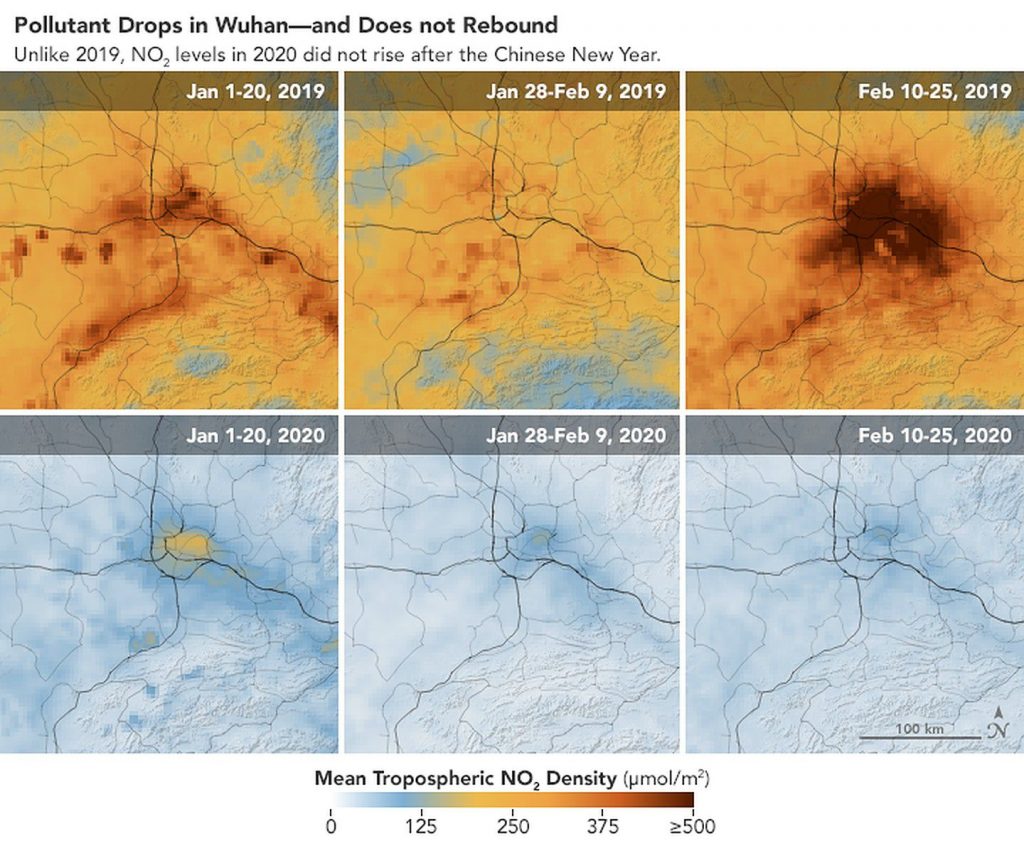
The NASA scientists who analyzed the data collected by their satellites and the European Space Agency satellites say the reduction in NO2 pollution was first evident near the epicenter of the outbreak, Wuhan. From there, it spread across China as more cities began to react to contain the coronavirus as well.
Fei Liu, a NASA Goddard Space Flight Center air quality researcher, said:
This is the first time I have seen such a dramatic drop-off over such a wide area for a specific event.
While other events, such as the 2008 global financial crisis, have caused a decrease in NO2 pollution, the drop always happened gradually over an extended period. This time it was sudden.
Also, it is common to see drops in NO2 levels during the Lunar New Year celebrations in China (and across much of Asia) because most businesses and factories close. However, once the holiday is over, the levels increase again right away. But this year the drop remained low for a longer time than the usual festival period and hasn’t yet rebound as it usually would.
Liu said:
This year, the reduction rate is more significant than in past years and it has lasted longer. I am not surprised because many cities nationwide have taken measures to minimize the spread of the virus.
A separate study was carried out by the Centre for Research on Energy and Clean Air in Finland in February that revealed how China’s carbon emissions had dropped 25% during the same period last year – at least 100 million metric tons in two weeks (almost 6% of global emissions). According to the researchers, the coronavirus outbreak led to a drop in demand for oil and coal, resulting in the emissions slump.


