
The intersection of neurological health and the digestive system—particularly concerning Parkinson’s disease—represents one of the most dynamic areas of contemporary medical research. While historical medical understanding placed the condition squarely in the domain of the brain, new evidence strongly suggests that the health and activity of the gut microbiome are deeply interconnected with pathology.
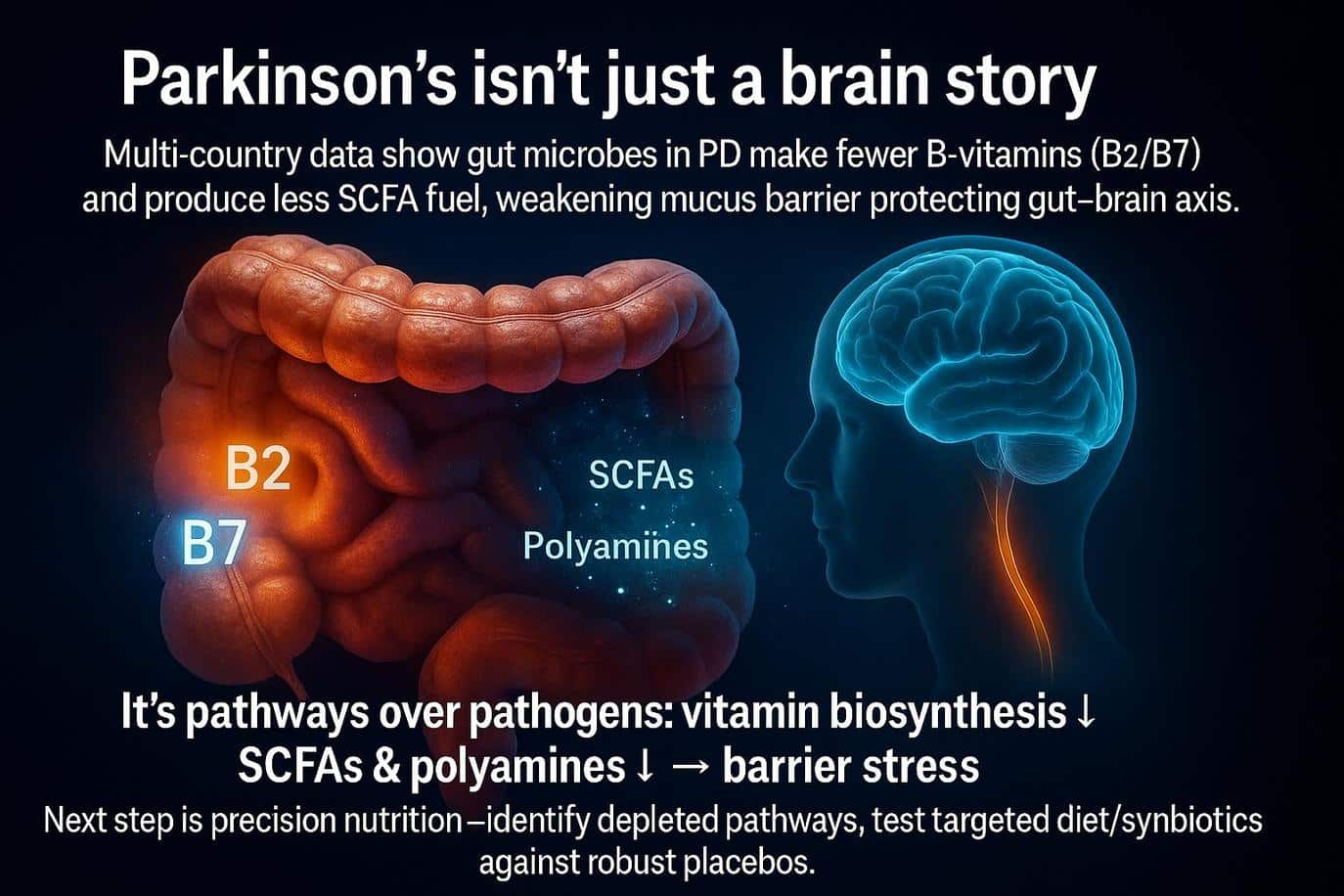
Across multiple international cohorts, researchers found that people with Parkinson’s tend to have gut microbiomes with fewer genes for making the B vitamins riboflavin and biotin, and those same communities often show lower short-chain fatty acids and polyamines that help support the intestinal mucus barrier. This technical picture comes from a multi-country shotgun metagenomics meta-analysis, which quantified both bacterial pathways and stool metabolites to map the pattern with unusual clarity.
This shift in perspective—moving from hunting a single ‘bad bug’ to identifying missing microbial pathways—is significant. It offers a clear, testable hypothesis about pathway-level nutrition without making any claims of therapy.
The connection between reduced capacity to synthesize B2 and B7 and lower barrier-supporting metabolites in stool is further noted in a Nagoya University explainer. This critical reframing of the research problem provides a more practical lens for future trials, focusing on the goal of restoring essential microbial functions rather than simply relying on eradication methods.
Many people wonder what this new data means for their daily lives. The current evidence provides plausibility, not definite prescriptions. While some past microbiome interventions in Parkinson’s have not yet produced clear clinical benefits, this study serves as a cautionary guide for researchers who are now designing better, precision-enriched studies.
For now, there are actionable lifestyle strategies that align with the science, particularly fiber-forward eating patterns that promote short-chain fatty acid production and a sensible approach to dietary B vitamins.
Key Findings: Microbiome, SCFAs, and B Vitamin Pathways
The following Quick Facts summarize the core scientific insights of the Parkinson’s microbiome research, providing a rapid overview of the latest findings and clinical context. These points emphasize the shift from focusing on single pathogens to investigating systemic microbial function and nutrition:
- Pathways over pathogens: Multiple international cohorts show reduced microbial genes for riboflavin and biotin biosynthesis in Parkinson’s, documented in npj Parkinson’s Disease, along with lower short-chain fatty acids and polyamines.
- Barrier context: The vitamin-pathway signal aligns with metabolites that help maintain the intestinal mucus barrier.
- Mechanistic plausibility: A bacterial amyloid called curli accelerates alpha-synuclein aggregation in mice, and a gut-restricted amyloid inhibitor blunted this effect, as shown in eLife mouse experiments.
- Desulfovibrio clue: Patient-derived Desulfovibrio strains increased alpha-synuclein aggregation and mortality in a C. elegans model compared with control strains, in a Frontiers study.
- Trial reality check: A modern double-blind randomized trial of fecal microbiota transplantation in Parkinson’s was safe yet showed no clinically meaningful benefit versus placebo, as shown in a randomized clinical trial in JAMA Neurology.
- Lifestyle context: Fiber-rich eating patterns support SCFA production and barrier integrity. Supplement regimens for Parkinson’s, however, remain unproven.
These concise points establish the foundational science that guides the remainder of our exploration into precision nutrition and therapeutic approaches.

Metagenomic Insights: Reduced B-Vitamin Pathways and SCFA Correlation
Vitamin B Pathways Down Across Countries
The meta-analysis combined shotgun metagenomics from multiple international cohorts, including those in Japan, the United States, and Western Europe, then paired the pathway data with measured stool metabolites. Two pathway signals ranked at the top across datasets: B vitamin biosynthesis for both riboflavin and biotin, both severely reduced in Parkinson’s relative to controls. The authors then quantified short-chain fatty acids and polyamines, finding lower levels in Parkinson’s. Furthermore, they observed positive correlations between vitamin-pathway capacity and these barrier-relevant metabolites.
The result reframes the question. Rather than focusing on which microbe to eliminate, the data suggest looking at what key functions are missing. That is a more practical lens for future trials, because researchers can restore function through diet patterns, targeted prebiotics and synbiotics, or carefully designed supplementation trials once the right patient subsets are identified.
SCFAs and Polyamines, and Why They Matter
Short-chain fatty acids (SFCAs), such as butyrate and propionate, are produced when gut bacteria ferment dietary fiber. These molecules help fuel colon cells, influence mucus production, and support epithelial barrier integrity. Polyamines participate in cell growth and tight-junction maintenance. The Parkinson’s datasets showed lower SCFAs and polyamines, which is consistent with a microbiome that is less capable of producing barrier-supporting metabolites.
The Nagoya team highlights the same pattern for general readers, connecting the vitamin-pathway deficits to mucus-layer health in accessible language. For those interested in how gut communities relate to behavior and cognition, a useful context is offered by research that details how healthy gut microbes shape loneliness and wisdom and the deeper link between gut bacteria and anxiety.
Mechanistic Evidence: Connecting Microbial Metabolites to Alpha-Synuclein
Curli and Alpha-Synuclein
The preclinical evidence helps explain why gut signals might matter to the brain. In mice, exposure to curli, a bacterial amyloid produced by some E. coli, accelerated alpha-synuclein aggregation, and worsened pathology.
When researchers gave an oral, gut-restricted amyloid inhibitor, it blocked the curli-driven acceleration of disease signals. These results establish a clear biological link from microbial products to protein misfolding, based on the animal evidence presented in mouse experiments.
Desulfovibrio Signals: A Cautionary Clue
Desulfovibrio bacteria, which are sulfate-reducing microbes found in some human guts, were examined in separate work. Strains isolated from people with Parkinson’s increased alpha-synuclein aggregation and mortality in a C. elegans model compared with strains from healthy controls. The finding is suggestive rather than causal for humans.
Nevertheless, the study strengthens the overall evidence that pathology begins in the gut and converges on the alpha-synuclein pathway in a patient-derived Desulfovibrio study. Some ingredients in ultra-processed diets appear to nudge the microbiome in unhelpful ways. The process can involve complex signaling pathways, such as the mechanism linking the gut’s sweet taste receptor to metabolic health.
Several studies suggest that artificial sweeteners disrupt the gut microbiome in ways that push ordinarily benign gut bacteria toward pathogenic behavior in cell studies. Diet quality shapes microbial function even outside disease contexts.

Evidence Check: What Interventions Have, and Haven’t, Done
Fecal Microbiota Transplantation in Parkinson’s
The largest modern randomized, double-blind study of fecal microbiota transplantation in Parkinson’s found that the procedure was safe yet did not produce clinically meaningful improvements in motor symptoms compared with a carefully controlled placebo.
The trial still shifted gut communities, which tells us that changing taxa alone does not guarantee a clinical effect; the timing, method, and patient selection of microbiome therapy likely matter more than a one-size-fits-all approach, particularly as research explores how fecal transplants address cognitive decline.
Where the B-Vitamin Hypothesis Sits Today
The pathway signal in Parkinson’s points to reduced microbial capacity to make riboflavin (B2) and biotin (B7), which is a testable idea, not an established therapy. Historically, a small open-label report of high-dose riboflavin combined with dietary changes suggested improvement signals, but the method lacks the rigor of modern randomized trials and is thus considered preliminary data from the original open-label riboflavin study.
Future trials will need to enrich for patients who actually show the vitamin-pathway deficit, track short-chain fatty acids and polyamines, and compare dietary support or targeted synbiotics with a true placebo. Crucially, these studies must also monitor both motor and non-motor outcomes.
Practical Lifestyle Guide: Dietary Context and Supplement Decisions
Fiber-First Eating Patterns and SCFAs
Dietary patterns rich in diverse fibers give gut microbes the raw materials to produce short-chain fatty acids, which help fuel colon cells and support the mucus barrier. Whole grains, beans, lentils, vegetables, fruits, nuts, and seeds all contribute different fermentable fibers. These diverse food sources provide the essential raw materials that microbial communities need to thrive.
Although no diet treats Parkinson’s, choosing meals that regularly include a variety of fiber is a low-risk, high-common-sense strategy to discuss with clinicians. For example, one study demonstrated that a low-cost prebiotic improved memory in older adults, showing how microbiome-linked metabolites can influence outcomes beyond the gut.
Sensible, Clinician-Aligned B-Vitamin Context
It is crucial to understand that overall vitamin and mineral deficiencies cause thousands of deaths annually, emphasizing the need for comprehensive nutritional intake. Riboflavin and biotin are present in ordinary foods such as eggs, dairy, leafy greens, legumes, nuts, and seeds. For those curious about how vitamins fit into everyday nutrition, a balanced primer on the topic of the essential nutrients can be helpful.
Parkinson’s-specific benefits from B-vitamin supplements have not been demonstrated in randomized trials. Consult a healthcare professional before making any supplement decisions, particularly when medications, absorption issues, or other conditions are involved. For a general approach to wellness, readers can explore things to do to support gut health.

Mapping the Future of Parkinson’s Research: A Focus on Precision Nutrition
The complex narrative surrounding Parkinson’s disease is rapidly evolving, moving away from a singular focus on neuronal loss toward a holistic model rooted in the gut. The conclusive result from recent metagenomic analysis pertains not to a singular antagonistic microbe but to the recognition of absent microbial functions, particularly the ability to synthesize B vitamins and barrier-enhancing metabolites such as short-chain fatty acids (SCFAs) and polyamines.
This body of work provides a robust framework for developing targeted interventions, shifting the effort from general treatments to specialized, pathway-level nutrition that addresses specific microbial deficiencies. Moving forward, the scientific community recognizes that successful clinical translation requires rigorous, precision-enriched trials. These future studies must screen participants for deficiencies in the B-vitamin pathway, monitor changes in SCFAs, and compare targeted dietary support or specialized synbiotics against a true placebo.
Until such definitive evidence emerges, the most practical approach for everyday life remains focusing on fiber-rich eating patterns that naturally support microbial diversity and SCFA production. This strategy, aligned with sensible clinical advice, provides readers with an immediate, low-risk lifestyle context to positively influence their overall health.
Frequently Asked Questions on Microbiome, SCFAs, and Parkinson’s
1. Is the Microbiome the Cause of Parkinson’s Disease?
Current research identifies a strong microbiome-linked signal and suggests a testable hypothesis, but it does not establish the gut as the definitive cause of Parkinson’s disease.
2. Which Specific B Vitamins Are Linked to the Microbiome Deficit?
The meta-analysis found a reduced microbial capacity to synthesize riboflavin (B2) and biotin (B7), both of which are crucial B vitamins.
3. What Role Do Short-Chain Fatty Acids (SCFAs) Play?
SCFAs are metabolites produced by fiber fermentation; they are vital for mucus barrier integrity and gut health, and their levels are reported as lower in the Parkinson’s cohorts.
4. Should I Take B Vitamin Supplements for Parkinson’s?
B vitamin supplements have not been demonstrated to offer Parkinson’s-specific benefits in randomized trials. Always consult a healthcare professional before starting any new supplement regimen.
5. Is Fecal Microbiota Transplantation (FMT) a Proven Treatment?
A large, modern randomized trial showed that FMT was safe but did not produce clinically meaningful improvements in motor symptoms compared with placebo.


