
Light can be used to analyze biological samples and physical objects. The practice is called spectroscopy. Where it gets fascinating is how spectroscopists use different kinds of light because each one provides different information. One type in particular—a subset of wavelength from the ultraviolet range called vacuum ultraviolet (VUV) light—is especially useful because it can aid scientists in a broad range of research fields. However, the generation of that light is costly and difficult.
But now, the University of Tokyo researchers have created a tabletop device consisting of an ultrathin film with nanoscale perforations that efficiently generates circularly polarized VUV light. The breakthrough development is dramatically more straightforward than the existing methods (which involve the use of laser-driven plasmas and particle accelerators) to produce VUV.
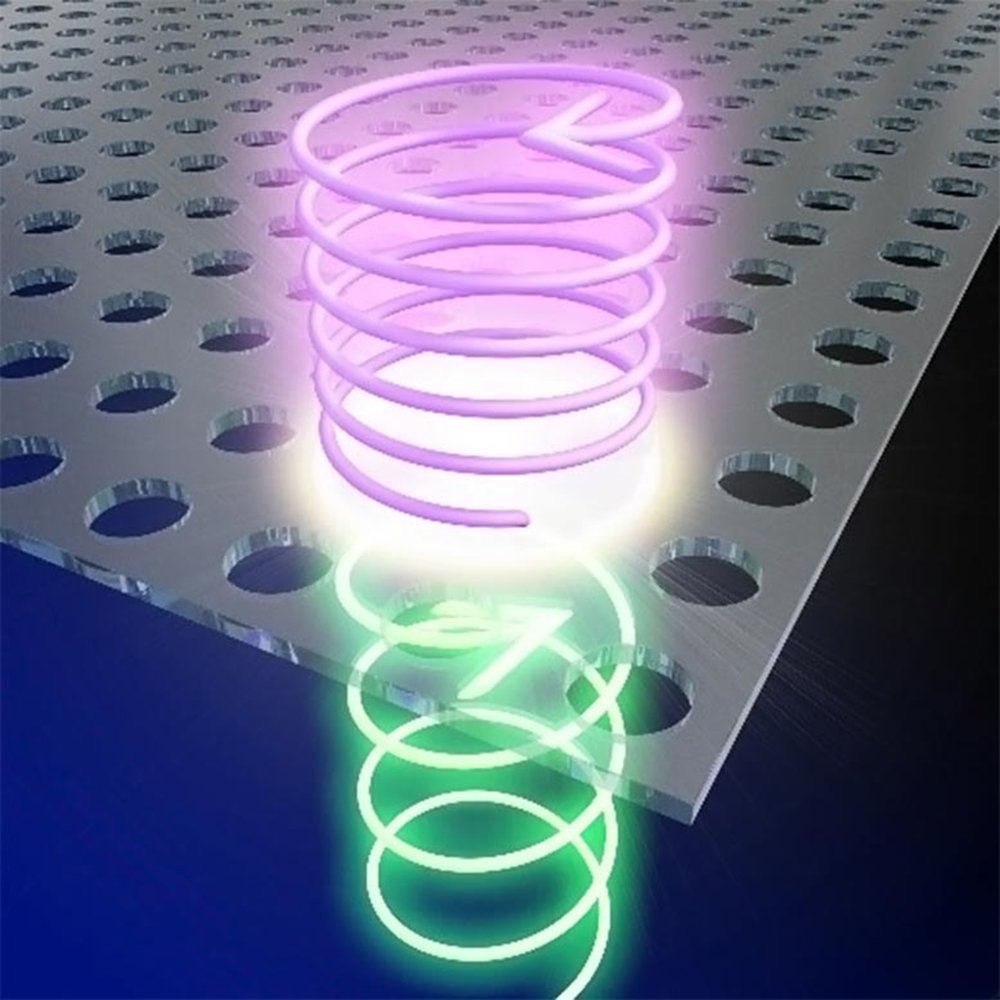
Assistant Professor Kuniaki Konishi, who was involved in the study, said, “We have created a simple device to convert circularly polarized visible laser light into circularly polarized VUV, twisted in the opposite direction. Our photonic crystal dielectric nanomembrane (PCN) consists of a sheet made from an aluminum oxide-based crystal (ℽ-Al2O3) only 48 nm thick. It sits atop a 525-micrometer-thick sheet of silicon, which has 190 nm-wide holes cut into it 600 nm apart.”
VUV wavelengths are easily absorbed by air but pass right through a vacuum. The ones in the region of around 120-200 nanometers (nm) are useful for chemical and physical analyses of different physical and biological materials. Circularly polarized light enables scientists and medical researchers to probe the structural and electric properties of matter—to observe the dynamics of biomolecules and electron spins in solids.
According to a press release, the team generated circularly polarized VUV coherent light by “…using third-harmonic generation in a dielectric square lattice photonic crystal nanomembrane (PCN). The PCN consisted of a sheet made from an aluminum oxide-based crystal 48 nm thick, placed on top of a 525-μm-thick sheet of silicon that had 190-nm-wide holes cut into it 600 nm apart. Under a microscope, the pattern of perforations resembles the holes in a showerhead.”
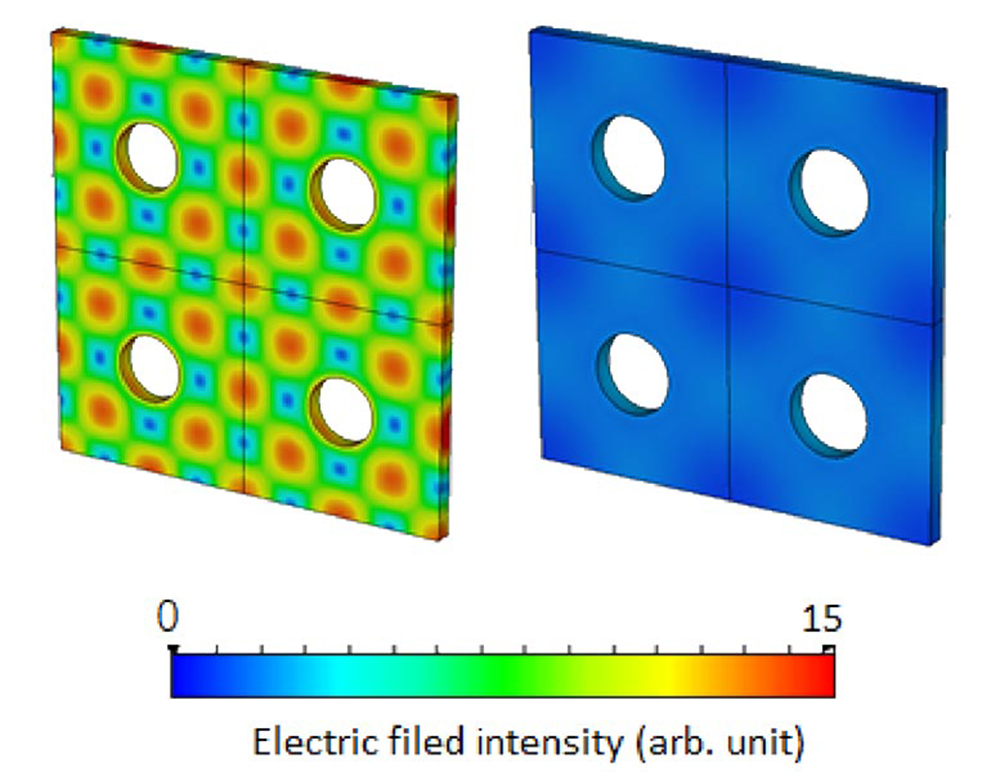
Konishi then explained what happens when the light interacts with the sheet: “When pulses of circularly polarized blue laser light with a wavelength of 470 nm shine down these channels in the silicon, the PCN acts on these pulses and twists them in the opposing direction. It also shrinks their wavelengths to 157 nm which is well within the range of VUV that is so useful in spectroscopy.”
Metal-based devices that generate VUV do exist, but they degrade rapidly in the presence of laser light. The PCN membrane doesn’t. The team’s prototype was able to withstand repeated bombardment throughout this study.
Konishi said, “I am pleased that through our study of PCN, we found a new and useful application for circularly polarized light conversion, generating VUV with the intensity required to make it ideal for spectroscopy. And it was surprising that the PCN membrane could survive the repeated bombardment of laser light, unlike previous metal-based devices. This makes it suitable for lab use, where it may be used extensively over long periods. We did this for basic science, and I hope to see many kinds of researchers make good use of our work.”
This new method to generate VUV can be useful to researchers in life sciences, medicine, solid-state physics, and molecular chemistry—anything that requires the observation of fast- or short-lived physical phenomena at the sub-micrometer scale.


