
A bachelor’s degree investment in the United States can cost $38,270 per student annually. In-state tuition averages $9,750, while out-of-state tuition averages $27,457. Non-profit university students also spend around $58,628 while living on campus each academic year, $38,768 of which is devoted to tuition and other fees.
Because of these expenses, many students and parents may exhaust their savings for college education alone. Fortunately, student loans can help you cover the costs of your college education. However, they have two types: private and federal.
So, which one should you choose? Explore their requirements, application processes, and pros and cons below.
Private Student Loans
Banks, credit unions, universities, state agencies, and other private lenders provide private or non-federal student loans. Most borrowers use these loans to cover the gaps in their college payments after exhausting federal aid or if federal aid is insufficient.
How to Apply
Ensure you meet the following criteria for private student aid:
- At least 18 years old (some private lenders require 19)
- Your high school diploma
- U.S. citizenship and a valid Social Security number
- You must be enrolled as a regular student in accredited universities
- Credit history and score (score must be at least mid-600s or higher)
Then, explore lenders’ offers and interest rates. Other terms to consider include:
- Repayment conditions
- Discounts
- Perks, e.g., benefits for on-time graduation
- Co-signer availability and release
After choosing a lender, prepare and submit the required documents. Once approved, your lender will transfer the funds directly to your university.

Federal Student Loans
The U.S. government backs the federal student assistance programs: Federal Direct, Direct PLUS (Parent Loans), and Health Professions.
Federal Direct
Federal Direct has subsidized and unsubsidized options.
Subsidized
Direct subsidized loans are only eligible for undergraduate students with monetary needs. In this aid, you must present evidence of financial hardships.
Your university evaluates the cost of attendance (COA)—textbooks, tuition, university fees, student housing, and other education-related expenses—to determine the amount you’ll receive.
Up to $5,500 can be received annually, depending on your grade level and dependency status. The amount generally doesn’t exceed your financial requirements.
The U.S. government will cover the interest based on the following conditions:
- You attended the university at least half-time
- A six-month grace period after graduation
- Deferment or postponement of repayments
Unsubsidized
Direct unsubsidized loans are available for undergraduate, professional, and graduate students. In contrast to the subsidized option, you are not required to demonstrate evidence of monetary setbacks.
Your university determines the amount based on the COA. You can receive up to $20,500 annually, depending on your grade level. If you receive subsidized amounts for the same period, these amounts will be subtracted.
However, the U.S. government won’t cover the interest rates. You must pay for them throughout the loan period.
Direct PLUS (Parent Loans)
Direct PLUS for parents, or Parent PLUS, is a federal student aid for parents of dependent undergraduates.
However, parents are responsible for paying all the interest because this loan is not subsidized. Still, they can opt to put off payments until the students they borrowed for leave school, graduate, or change their enrolment status to less than half-time.
Direct PLUS also has an option for graduate and professional students: Grad PLUS. You can use this aid to fund your career school.
Health Professions
HPSL, or Health Professions Student Loans, is a federal student aid for the following health-related degrees:
- Dentistry
- Optometry
- Pharmacy
- Podiatric Medicine
- Veterinary Medicine
How to Apply
To apply for federal student loans:
- Submit the FAFSA form—Free Application for Federal Student Aid. The academic year 2024 to 2025 submission deadline is June 30, 2025, 11:59 p.m. Central Time. Review the guidelines because some states and universities may have different deadlines.
- Review your Student Aid Report (SAR). This document may take up to three weeks to arrive. Thoroughly review the offers to determine whether you need private student loans.

Advantages and Downsides of Private and Federal Student Loans
Private and federal student loans’ benefits and pitfalls include:
Private loans are open for those who don’t qualify for federal aid.
You may qualify for private aid if you’re not eligible for federal student loans. You may qualify if you cannot demonstrate financial need, are a non-citizen without a green card but have a U.S. citizen co-signer, aren’t enrolled at least half-time, or you exceed the maximum federal borrowing limit.
Lenders will still evaluate your finances. However, private loans like the one SoFi offers can be helpful if you cannot qualify for federal aid. They offer zero fees from application to repayment as well as competitive interest rates. You’ll also enjoy flexible repayment plans and a six-month grace period to help you manage your finances better.
You don’t have access to federal repayment plans with private loans.
Federal student aid programs have repayment plans that can reduce your payments. These options are helpful for borrowers struggling to meet monthly payments.
These plans include:
- Income-driven repayment plans
- Direct consolidation
- Loan forgiveness
Most private lenders don’t have these plans. Sometimes, the only way to lower your repayments is through refinancing.
Private loans have higher borrowing limits.
If you’re attending an expensive university, you may not receive the required amount from federal student loans. Your grade level and dependency status will determine the amount you’ll receive.
However, private lenders can allow you to borrow the total COA minus any financial aid received. This flexibility gives you more funds to cover all the necessary costs.
Federal aid doesn’t require a credit history.
Most loans from private institutions require a credit history. Their minimum score threshold is usually between 650 and 680.
Conversely, federal student aid programs don’t require credit checks. These U.S. government-backed loans are ideal if you have an inadequate credit history.
Most students may also only qualify for private loans with co-signers. Fortunately, the federal government typically doesn’t require co-signers.

Private loans have faster applications.
Filling out the FAFSA form can be time-consuming. Although you can submit the form online, the processing time may take up to three weeks.
In contrast, private lenders like SoFi have streamlined application processes. You can apply online, upload the required documents, get approved, and receive the funds in just a few business days. You can even view your estimated rate to see how much you’ll potentially receive and repay.
Federal loans have fixed and lower interest rates.
Federal student aid programs have fixed interest rates. They can even be lower than private loans.
On the other hand, private loans can have fixed or variable interest rates. Depending on your circumstances and eligibility, these rates may fluctuate—higher or lower than federal loans.
Grace periods for private loans depend on the lenders.
Grace periods are the time frame you can wait before repaying federal student loans. Most federal aid programs have six-month grace periods.
Meanwhile, the grace periods for private loans depend on the lenders. Still, most offer six months. You must verify the details with your lender. If you must make small payments while enrolled, you may still have to continue them during the grace period.
Direct PLUS loans also don’t have grace periods. After loan disbursement, the repayment begins. However, parents can request a six-month moratorium to postpone the payment until their children leave school or fall below part-time status.
Refinancing is eligible for federal and private student loans.
You can combine all or some of your student debts into a single with refinancing. This merging helps extend your repayment schedule.
Refinancing is exclusive to private lenders but is eligible for federal and private loans. You can even combine them into one loan.
However, refinancing your federal loans may forfeit your access to repayment plans.
Private loans often have prepayment penalties.
Lenders charge prepayment penalties when you pay all or part of your student loans early.
Federal student loans don’t have these penalties. For private lenders, you must ensure they don’t have these fees. But if you’re considering a private loan with one, thoroughly review the fine print and understand the circumstances under which you’ll be required to pay.
All private and federal student loans may be tax deductible.
Depending on the conditions, private and federal loans may be tax deductible. You can use this benefit to reimburse some of the money you spend on tuition or loan interest.
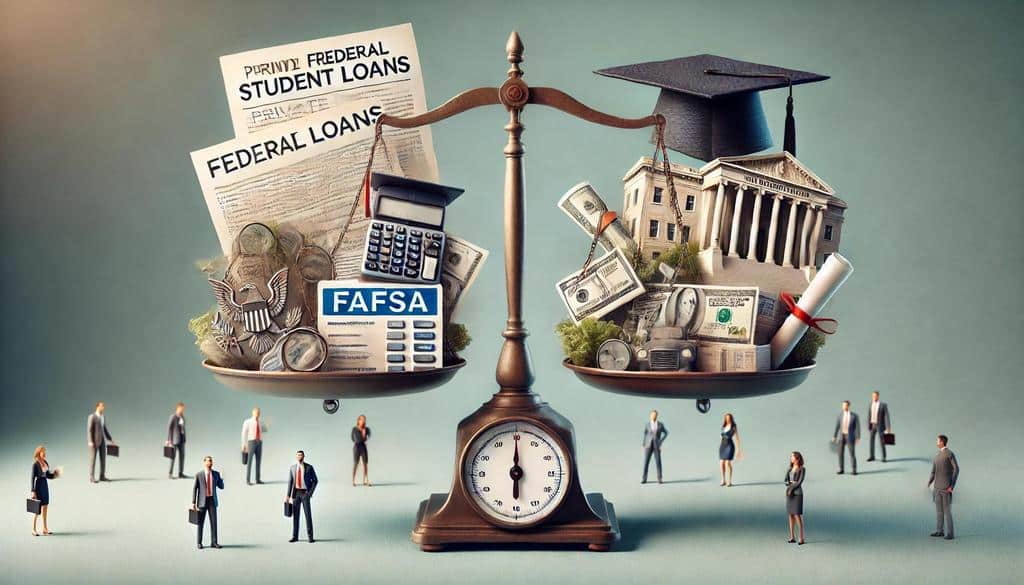
Make the Right Choice: Balance Benefits and Financial Responsibility
Deciding between private and federal student loans involves more than comparing interest rates and repayment terms—it’s about understanding how each option aligns with your financial situation and future aspirations. As student loans become integral in funding higher education, recognizing the nuances of each loan type empowers you to make a choice that supports your educational and financial goals.
Private loans can offer flexibility, especially when federal aid falls short, allowing you to cover additional costs or attend out-of-state universities. However, these benefits often come with higher interest rates and less forgiving repayment terms. On the other hand, federal student loans typically provide lower interest rates and multiple repayment options, making them attractive for those with less-than-perfect credit histories.
Before deciding on a loan:
- Assess your financial capacity and long-term objectives.
- Consider how much debt you are willing to assume and your degree’s potential return on investment.
- Reflect on the importance of flexible repayment plans and whether lower interest rates are essential to you.
By taking a comprehensive approach, you can choose the loan that best fits your needs and mitigates financial burdens.
Ultimately, the decision should feel comfortable, informed, and aligned with your career ambitions and life plans. A proactive and thoughtful approach will facilitate your academic journey and contribute to a healthier financial future, keeping your aspirations intact while managing your debt responsibly.

