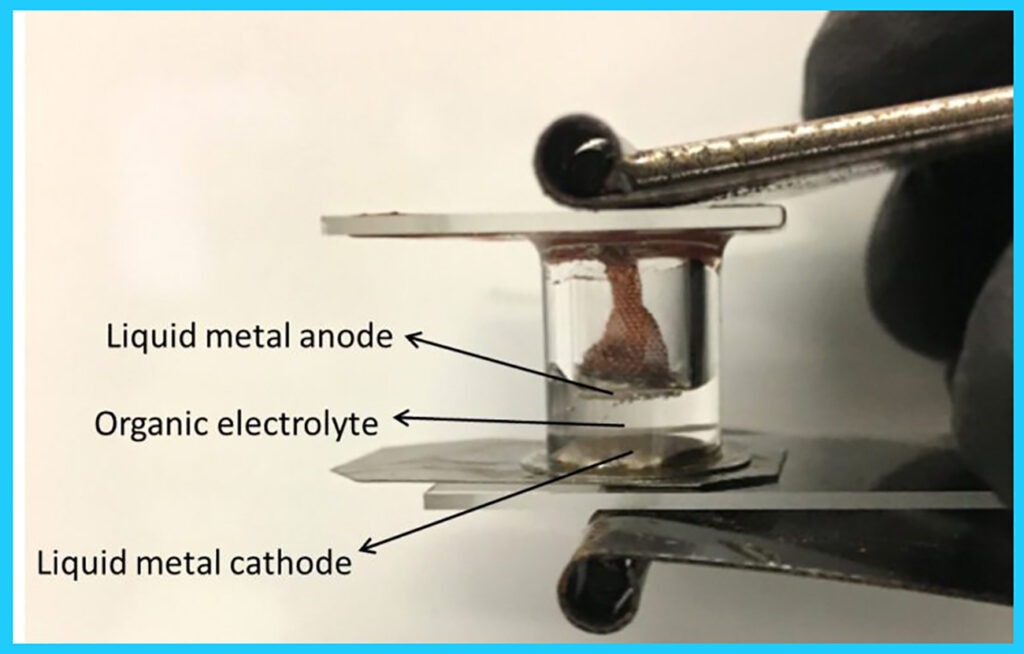
A team from the Cockrell School of Engineering at the University of Texas at Austin have developed a new kind of battery that mixes the best of both worlds of liquid- and solid-state batteries. The design is the first all-liquid metal battery that can work at room temperature and is claimed to outperform lithium-ion batteries.
Liquid metal batteries are less susceptible to wearing out than solid batteries because dendrites don’t form and damage the components. The only downside is, most of these batteries need to be heated to at least 240°C (464°F) to keep the metals liquid and the equipment required to do that is bulky and energy-consuming.
For the study, published in the journal Advanced Materials, the UT team examined alloys that could remain liquid at useful temperatures. They decided to use a gallium-indium alloy for the cathode and a sodium-potassium alloy for the anode, which was able to stay liquid at 20°C (68°F). The researchers say it’s the lowest operating temperature ever recorded for a liquid-metal battery.

An electrolyte in the center, which is also in a liquid form, separates the two liquid metal electrodes from each other. The new battery has higher energy and power density than lithium-ion batteries and can be charged and discharges much faster.
The team believes that when the temperature barrier is removed, the new liquid-metal battery could be used in powering anything from small wearables to grid-scale energy storage systems.
Yu Ding, the lead author of the study, said:
This battery can provide all the benefits of both solid- and liquid-state – including more energy, increased stability and flexibility – without the respective drawbacks, while also saving energy.
Since gallium is an expensive material, the team plans to explore other alloys made of more common, cheaper materials. Some of these different materials could potentially allow the battery to work at even lower temperatures and even help improve the power output.