
Tidal power is harnessed by converting energy from tides into electricity using various methods. While it’s not yet widely used, tidal energy has potential for future electricity generation because waves are more predictable than the sun and the wind. Among renewable energy sources, tidal power has suffered from high cost and limited availability of sites with sufficiently tidal currents or flow velocities, thus limiting its total availability.

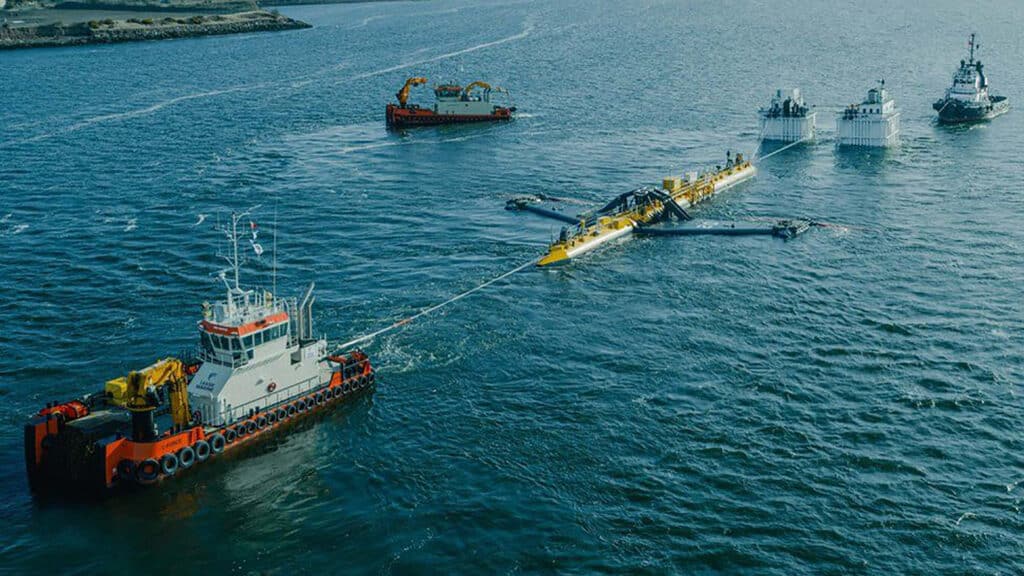
On April 22, Scottish company Orbital Marine Power launched the world’s most powerful tidal turbine, the Orbital O2, from the Port of Dundee. Two days later, the 2MW tidal turbine arrived in the Orkney Islands, an archipelago of Scotland’s north-eastern coast and home to some of the strongest tidal currents in the world. The O2 was hauled to Orkney by the 27.7-meter multi-cat vessel dubbed the C-FORCE, owned by Orbital’s project supplier Leask Marine.
The O2 was developed and constructed by Orbital Marine Power with partial support from the EU-funded FloTEC (Floating Tidal Energy Commercialisation) and OCEANERA-NET COFUND projects. The turbine will eventually be connected to the local electricity grid to provide clean and sustainable energy to the Orkney communities.
The turbine is being temporarily fixed at Deer Sound, an east coast bay on Orkney’s Mainland Island, where it will undergo commissioning. Then, it will be anchored at the Fall of Warness grid-connected tidal test site until 2040. This site, located off the northern Orkney Island of Eday, is leased by FloTEC project partner The European Marine Energy Centre Ltd and boasts tidal speeds of 4 m per second (around 8 knots.)
The O2 Turbine
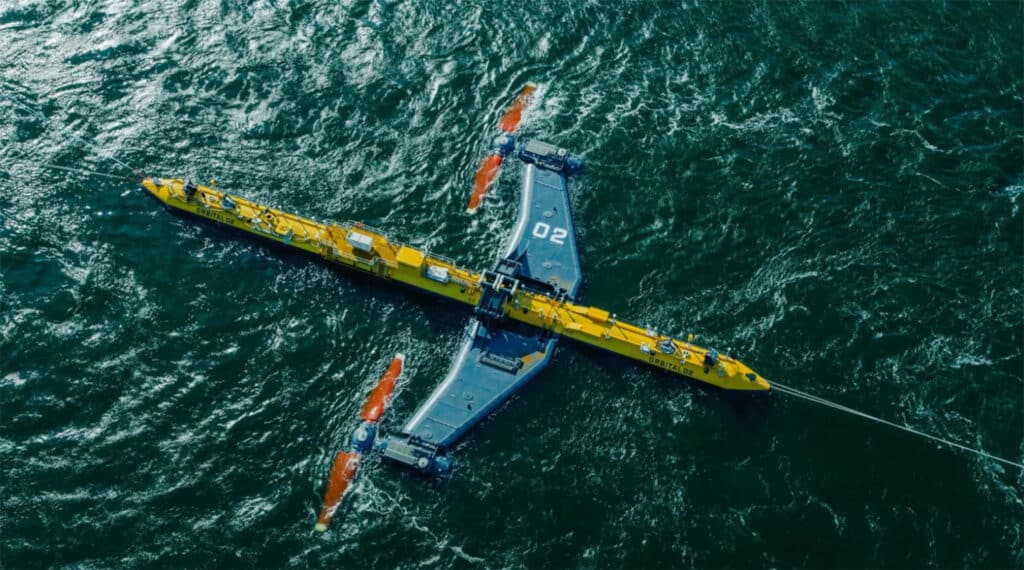
The turbine has a 74m long hull structure and weighs 680 tons. A couple of 1MW power generating nacelles are connected at the end of retractable leg structures to provide low-cost access to all significant turbine components for ongoing maintenance.
Ten-meter blades give the O2 over 600m2 of cleared area to capture flowing tidal energy. The floating structure is anchored on-site to the seabed with a four-point mooring system where each mooring chain can hold over fifty double-decker buses.
The electricity generated will move from the turbine to the seabed through a dynamic cable and then along the seabed to an onshore electricity network via a static cable. Once the O2 is connected to the local electricity grid at EMEC, it will generate enough electricity to power around 2,000 UK homes and offset approximately 2,200 tons of CO2 produced each year.
Orbital’s project supplier Hempel provided high-performance anti-corrosion coatings to protect the O2’s rotor blades against biofouling from barnacles and algae, as well as coatings for the turbine structure. “We’re proud to be playing a part in the development of the O2, a ground-breaking project with the potential to help make tidal energy a viable source of energy in the UK and overseas,” said Nick Frowen the Managing Director at Hempel.
Regarding the turbine’s launch, Orbital’s CEO Andrew Scott commented:
This is a huge milestone for Orbital; the O2 is a remarkable example of British cleantech innovation, and the build we have completed here is an inspiring display of what a UK supply chain can achieve if given the opportunity – even under the extraordinary pressures of a pandemic.
Scotland’s national economic development agency Scottish Enterprise is the coordinator for the OCEANERA-NET COFUND (Ocean Energy ERA-NET Cofund) project, ending in June 2022. The FloTEC project, which Orbital Marine Power coordinates, ends in August 2021.
Environmental Concerns
There are some environmental concerns with tidal energy, including blade strike and entanglement of marine organisms, as high-speed water boosts the risk of organisms being pulled near or through these devices. Similar to offshore renewable energies, there is also a concern about how acoustic outputs and electromagnetic fields may affect marine organisms. Since these turbines are in the water, the acoustic output can be far greater than those created with offshore wind energy. This acoustic output can affect marine mammals, particularly those who echolocate to navigate and communicate, such as whales and dolphins.


