
This year has been full of doubt and uncertainty, but through the madness, inspiration prevails. Time magazine started a ‘Kid of the Year’ – a similar recognition to its famous Person of the Year issue. The first Person of the Year was issued in 1927 to aviator Charles Lindbergh. Ever since, the title has been granted to any person, idea, group, or thing that has done the most to influence things (good or bad) that have happened that year. Realizing that the world’s future is in the hands of the young who are starting to but have yet to make their full impact, the magazine thought it fitting to appoint a Kid of the Year. It wants to recognize the rising leaders of the young generation.
The world belongs to those who shape it. And however uncertain that world may feel at a given moment, the reassuring reality seems to be that each new generation produces more of what these kids—five Kid of the Year finalists selected from a field of more than 5,000 Americans, ages 8 to 16—have already achieved: positive impact, in all sizes.
And the Kid of the Year chosen among those five finalists was 15-year-old Colorado high school student Gitanjali Rao. She stood out because she inspired thousands of other kids to pursue their goals by creating a global community of young innovators. On top of that, she also made several apps using artificial intelligence to tackle cyberbullying, contaminated drinking water, opioid addiction, and other social problems.
Rao told The Associated Press in a Zoom interview:
The prize is nothing that I could have ever imagined. And I’m so grateful and just so excited that we’re really taking a look at the upcoming generation and our generation since the future is in our hands.
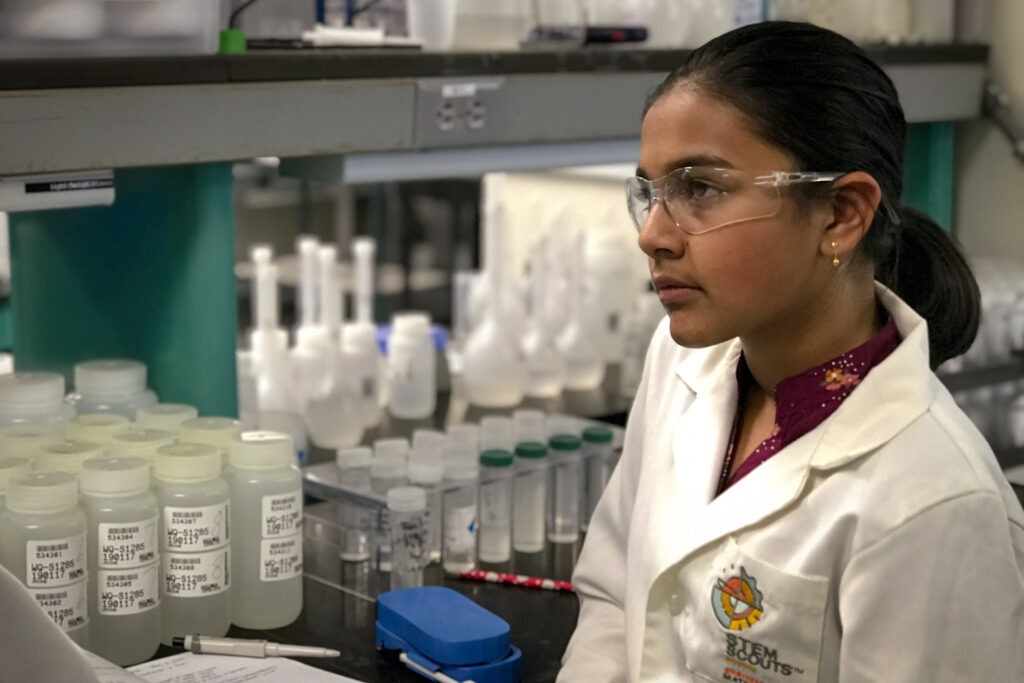
Rao insists that starting small is ok, as long as you’re passionate about it. Inspiration can come from anywhere too. She was inspired to develop a way to detect contaminants in water after hearing about the Flint, Michigan water crisis. The app she made sends the detection results to a mobile phone, so the user instantly knows if the water is ok to drink.
During the Zoom interview with actress and activist Angelina Jolie, Rao spoke about her use of technology to help solve problems worldwide and her mission to inspire people. She said:
My goal has really shifted not only from creating my own devices to solve the world’s problems, but inspiring others to do the same as well. Because, from personal experience, it’s not easy when you don’t see anyone else like you. So I really want to put out that message: If I can do it, you can do it, and anyone can do it.
Rao started innovating at a very early age as a way to improve social conditions. She told Jolie:
I was always someone who wanted to put a smile on someone’s face. That was my everyday goal, just to make someone happy. And it soon turned into, How can we bring positivity and community to the place we live? And then, when I was in second or third grade, I started thinking about how can we use science and technology to create social change. I was like 10 when I told my parents that I wanted to research carbon nanotube sensor technology at the Denver Water quality research lab, and my mom was like, “A what?” [Editor’s note: they are cylindrical molecules made of carbon atoms that are very sensitive to chemical changes, and thus are good for detecting chemicals in water, among other uses.] It was just that changing factor of, you know this work is going to be in our generation’s hands pretty soon. So if no one else is going to do it, I’m going to do it.

Rao partnered with museums, schools, organizations, and other institutions to run her innovation workshops. She teaches students her process during the sessions, which is “observe, brainstorm, research, build, communicate.” She says the main hurdle she helps students cross is knowing where to start. She said:
The students that I work with, they just don’t know where to start. I think that if you give them that spark that they can then build off of, then that changes everything. That means one more person in this world wants to come up with ideas to solve problems. At the end of every workshop, everyone has something that they can start working on.
In a world where science is increasingly questioned or challenged, its pursuit is an essential act of kindness, the best way that a younger generation can better the world. We have science in everything we’re involved in, and I think that’s the biggest thing to put out there: science is cool, innovating is cool, and anybody can be an innovator. Anybody can do science.
Rao recently hit her goal of mentoring 30,000 students. She hopes that the work they all do identifies innovation as a necessity for a better world. There are so many problems that need to be solved; and every effort or idea makes a difference, no matter how small.


