
The coronavirus pandemic caused an unprecedented global economic crisis. 2020 will likely hold the deepest global recession since WWII. To counter the decline in global economic output, countries invest massively in government spending to jump-start growth. The International Monetary Fund (IMF) estimates an unparalleled fiscal response – in the form of public investment in stimulus and recovery measures – of $11 trillion.
Some of the public investments have already gone out, and some are still being planned. The International Energy Agency (IEA) and leading economists recommend that world leaders funnel the government funds towards green measures to build the foundation for a zero-emissions future. They urged them to avoid the lock-in of existing fossil infrastructure at all costs possible. However, so far, few governments have given thought to this advice.
Of course, in the early stage of the pandemic, the first wave of stimulus measures had to go towards supporting the public health response and providing direct help to frontline workers, households, and businesses. As the immediate crisis recedes, the spending priorities will shift towards patching up the economic damage. At that point, there is an opportunity to build back cleaner.
Rhodium Group will be tracking the evolution of the economic crisis over the coming months – specifically the stimulus spending across the world’s largest economies and greenhouse gas (GHG) emitters: The European Union, the United States, India, and China. Those four economies combined make up two-thirds of global GDP and more than 50% of global GHG emissions. The analysis will focus on how much stimulus spending goes toward climate-related priorities.
The group has already put out initial estimates of spending announced to date. It found that the EU has used 20% (around $249 billion) of its stimulus on green spending. Meanwhile, the US has used 1.1% (around $26 billion) of its overall stimulus funds on green spending. And while the US has spent second-most in the world, it’s still a tiny percentage of the total it has spent on recovery. Next is China, with 1.9% ($1.43 billion), and then India, with 2.4% of its total stimulus ($830 million).
And here’s each country’s spending on discretionary stimulus (funds available for use at the discretion of the user) from largest to smallest:
- US: $2.44 trillion
- EU: $1.36 trillion
- China: $521 billion
- India: $35 billion
As you can see, the US spent the most on discretionary stimulus, but the least (in terms of the total spent) on clean energy.
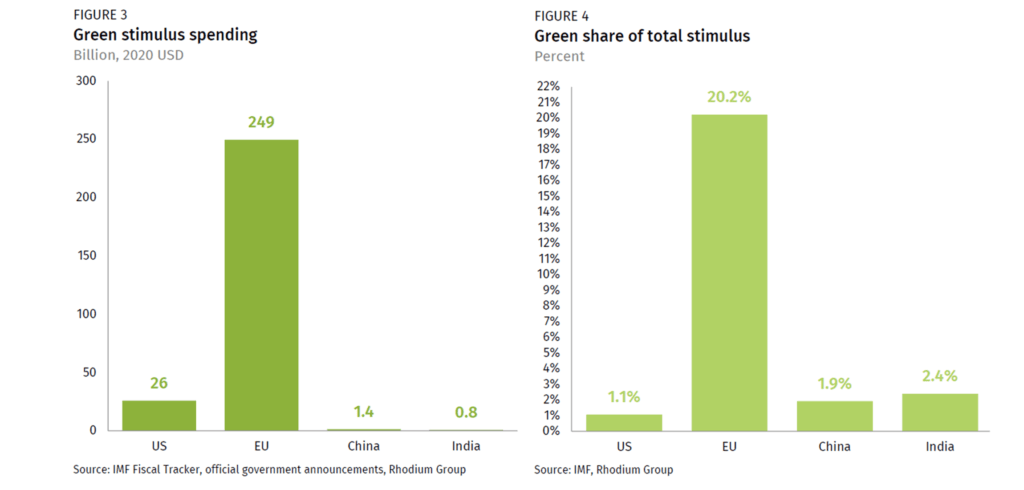
Achieving deep decarbonization in a post-COVID world will depend on the extent to which these major economies focus their recovery on green priorities. If done right, it could go a long way toward reaching climate goals.
Rhodium Group writes:
The potential for large-scale government investment presents an opportunity to both sustain green industries that have been harmed by the pandemic and economic crisis and increase the resilience and sustainability of the economy as a whole by prioritizing measures that help all industries transition to a greener future. The IEA and other experts argue that building back better, if done right, can create new jobs and even begin to address long-standing environmental injustices.
Many groups, including Rhodium, are tracking the scale of green (and fossil) investments worldwide to hold leaders accountable. Global GHG emissions took a plunge a few months back, dropping to 17% in April during the peak of lockdowns. However, that success was short felt. As economic activity started up again, the GHG emissions rebounded almost as fast as they fell.
According to the IEA’s Executive Director, Fatih Birol, the coronavirus crisis is a test for how committed governments are to the significant challenge of our time: climate change and the clean energy transition.


