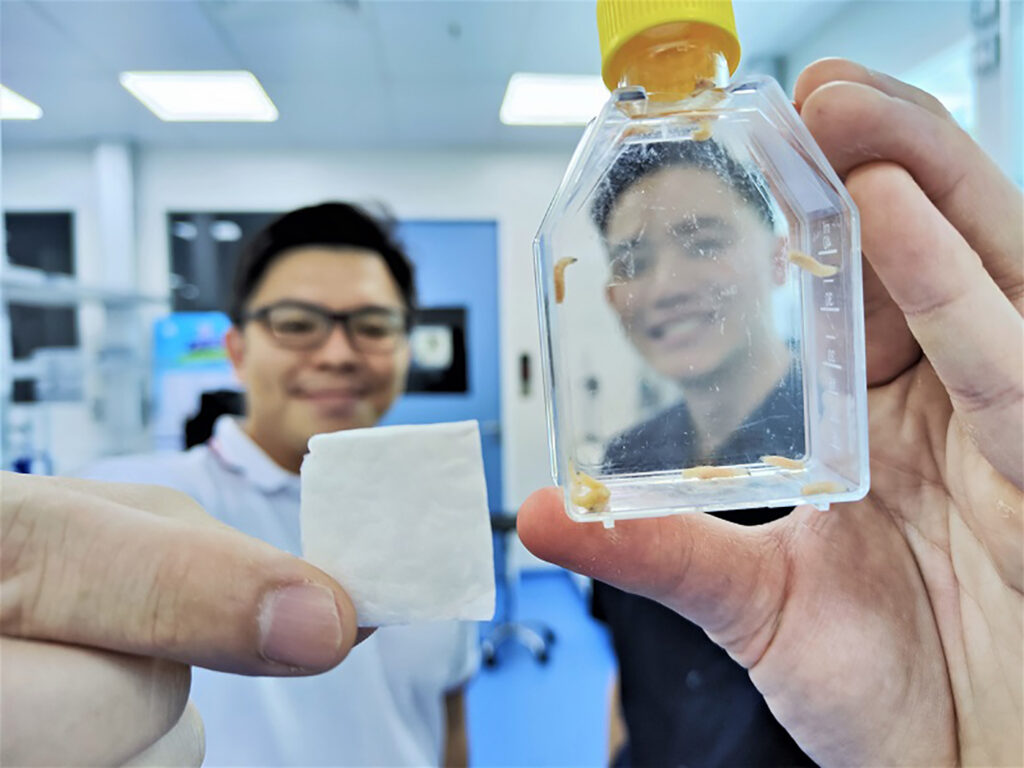
Scientists at Singapore’s Nanyang Technological University (NTU) are working to speed up the healing of chronic diabetic skin ulcers, which are notoriously slow to heal. They have created a new frog skin-derived wound dressing that promotes regeneration while reducing waste.
Frog flesh is a typical food in Singapore, despite being regarded in many other countries as an oddity, a delicacy, or both. However, the skins of the bullfrogs, which are primarily farm-raised, are generally discarded during processing.
A team from NTU, led by Associate Professor Dalton Tay, developed a technique for purifying frog skin, blending it into a paste, and extracting its pure collagen. Then, a biocompatible, biodegradable patch is made with that collagen.
The idea is that by offering a porous layer for white blood cells and other healing agents to coagulate inside, the patch may accelerate healing when placed on a chronic wound. Furthermore, it will be a barrier, keeping the wound wet and promoting healing even further.
The collagen should also serve as a scaffolding-like structure for neighboring skin cells to move onto during the later stages of healing. Finally, it should be entirely replaced by new skin as the patch ages and skin cells proliferate, replacing it entirely.

Prof. Tay thinks amphibian-derived collagen will offer superior biocompatibility with humans, even though the usage of collagen from cows has already been investigated for the same purpose. Last year, he revealed an experimental bone-repair substance from frog skin (and fish scales).
Typically, doctors use bone taken from another part of the patient’s body to patch in the gap left by a missing section of a bone caused by an accident or illness. In addition to being extremely intrusive, this treatment weakens the area from which the replacement bone is removed, often in the hips, ribs, or leg.
The medical technology company Cuprina Wound Care Solutions in Singapore, which already produces a product that uses live maggots to remove dead tissue from wound sites, is working with researchers to develop the frog skin wound dressing. It will conduct human clinical trials using both technologies within the next two years.