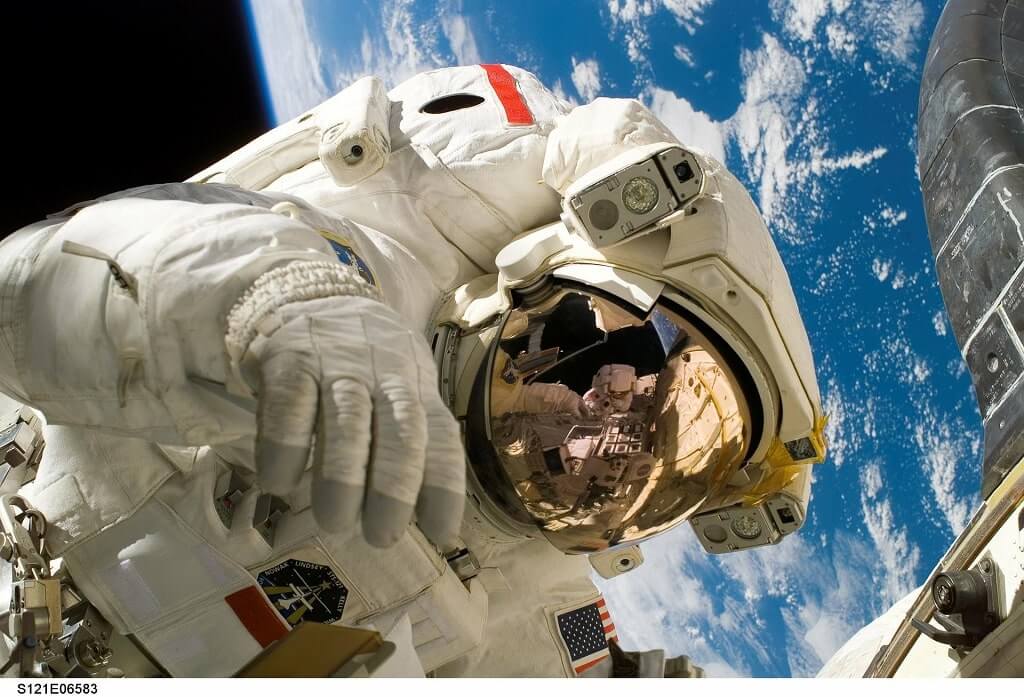
Engineers at Texas A&M, led by Ana Diaz Artiles, are creating soft robotic technology that could ultimately make “SmartSuit” spacesuits safer, more comfortable, and more energy-efficient.
Spacesuits must evolve into the twenty-first century if people are to be more than tourists in space gazing out the windows. Today, astronauts can choose between two types of spacesuits. One is a collection of flight suits designed to protect pilots from depressurization during takeoff and landing. The other is American and Russian full-pressure suits used for ExtraVehicular Activities (EVAs) that haven’t been altered since the early 1980s.
Though Boeing and SpaceX have built new emergency suits, the EVA suit technology is still a long way from the suits worn by Aldrin and Armstrong when they first set foot on the Moon in 1969.
Despite their bulky appearance, modern spacesuits are extraordinary pieces of equipment. A spacesuit is a human-shaped spacecraft. It keeps its wearer alive and protects them from radiation, heat, cold, vacuum, and some even feature propulsion systems, just like a spacecraft. And on top of all this, the suit features mobility.

However, spacesuits still have a long way to go before they are genuinely comfortable or efficient. Spacesuits must have enough air pressure to keep the person alive. Unfortunately, this transforms the suit into a starfish-shaped balloon as stiff as a car tire to bend. The suit’s joints are built up of a system of constant volume bellows to overcome this issue. When these ring-shaped components bend, air shifts from one side to the other, allowing the joint to bend.
So, the joints can bend. This is good. However, these joints are a pain to bend, and they want to snap back to their original position as soon as the astronaut stops pushing. With this in mind, the Texas A&M team intends to replace the bellows with soft robotic actuators that conduct most of the work, hold the joint in the appropriate position, and make the suit more comfortable to wear.

Currently, the engineers are developing a prototype robotic knee and comparing its mobility to a regular suit and a bare body. They discovered that using such actuators during a Mars journey might save many calories and allow astronauts to operate with less sweat.
The ultimate goal is to combine these soft robotic actuators with integrated sensors in a self-healing full-body suit. This new suit would provide additional mechanical counterpressure (MCP). To put it another way, it presses against the user. This would allow the suit to operate at half the air pressure of a standard suit. This would make the suit more pleasant to wear, but it would also lessen the risk of decompression sickness and the requirement to pre-breathe pure oxygen before wearing it.

Logan Kluis, a Ph.D. student in the Department of Aerospace Engineering at Texas A&M University, explained:
“Imagine wearing really tight Under Armour or really tight leggings. That pressure pushing down on your body would be in replacement of or in addition to gas pressure. So, the idea with the SmartSuit is that it would use both mechanical pressure and gas pressure.”
Last July, the Texas A&M team published their research in Aerospace Medicine and Human Performance.