
On August 26, 2026, a team at the Chinese Academy of Sciences did something no other nation had done since the United States more than a decade ago. They fired a laser from Earth, hit a satellite more than 400,000 kilometers away in lunar orbit, and downloaded data at 100 megabits per second. Then they turned the laser around and sent commands back up at 1.25 Mbps. The two-way “Earth-Moon information highway” was officially open, and it rewrites what is possible for crewed lunar missions, robotic exploration, and the looming race to build a lunar internet.
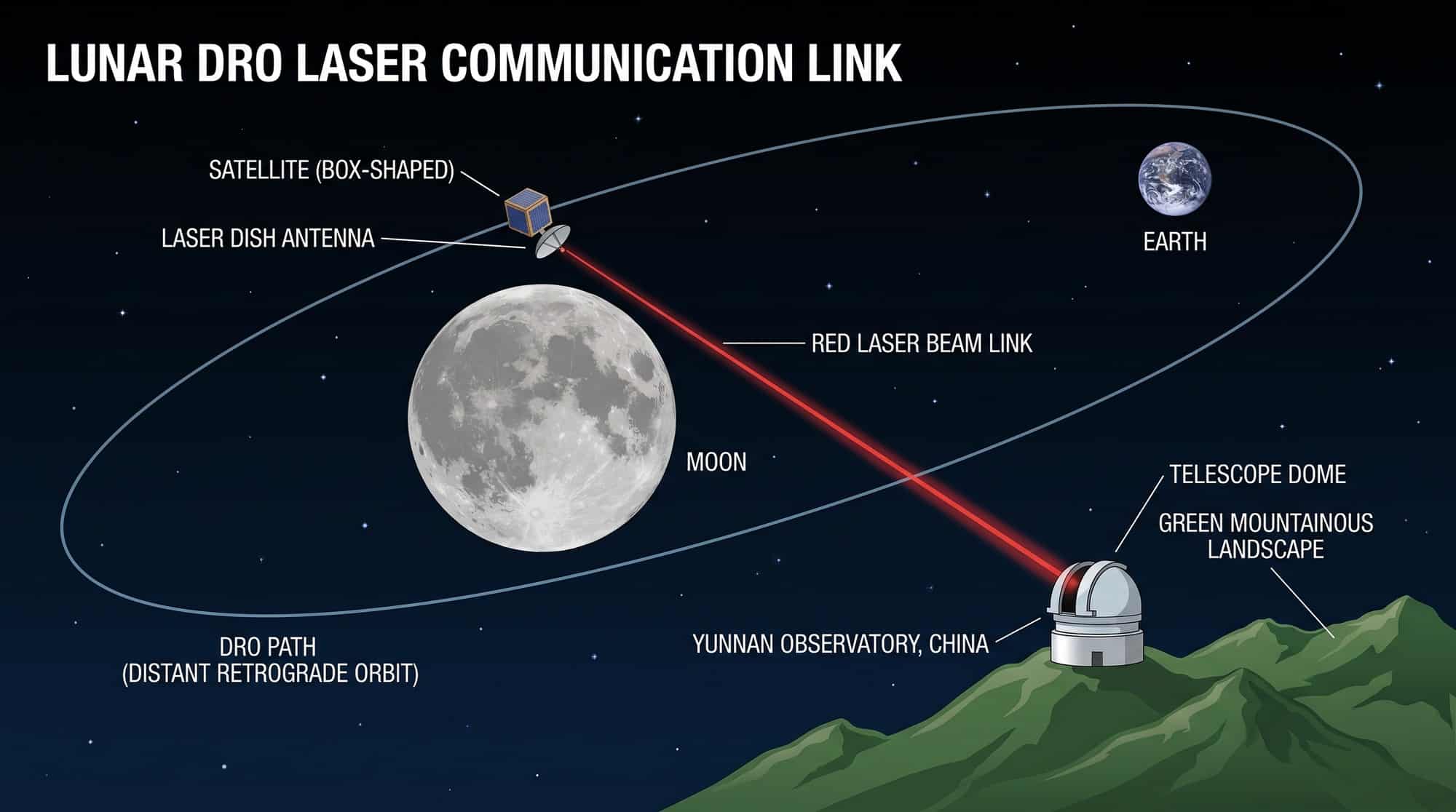
The test, led by the Technology and Engineering Center for Space Utilization (CSU) under the Chinese Academy of Sciences, used an experimental satellite called DRO-A that has been quietly orbiting between the Earth and Moon Lagrange points since a dramatic rescue mission in 2024. The achievement positions China as only the second country to verify two-way high-speed laser communication across cislunar space, and it provides a critical data pipeline for Beijing’s planned crewed Moon landings and International Lunar Research Station (ILRS) in the 2030s.
This is what happened, how the technology works, and why the comparison to NASA’s 2013 record is more nuanced than the headlines suggest.
What China Just Achieved
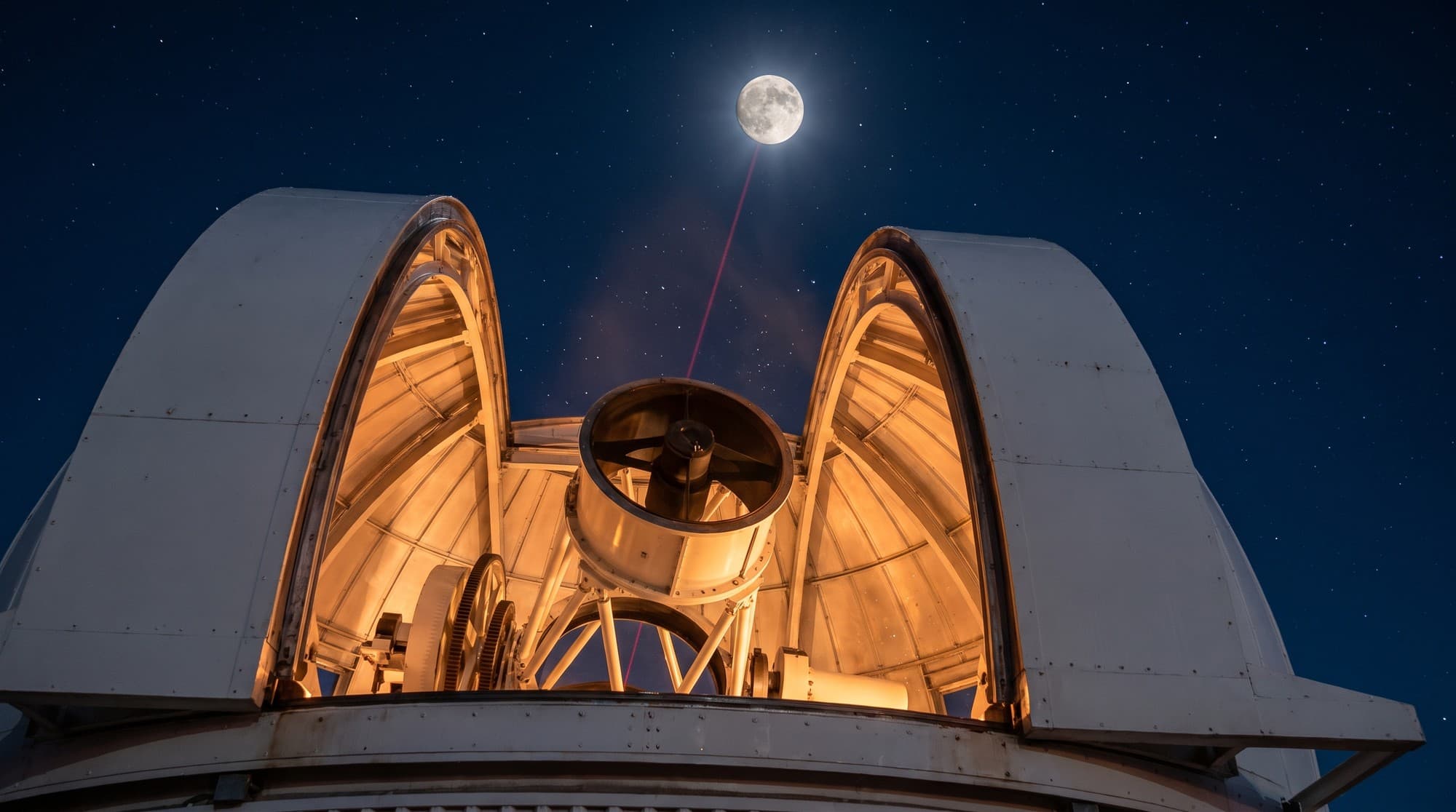
The test, first reported by China’s Science and Technology Daily on August 26 and confirmed by the Chinese Academy of Sciences, verified a two-way laser communication link between an Earth-based optical telescope in Yunnan province and the DRO-A satellite in a distant retrograde orbit (DRO) more than 400,000 kilometers away.
The headline numbers:
- Downlink (Moon to Earth): 100 Mbps
- Uplink (Earth to Moon): 1.25 Mbps
- Distance: Over 400,000 km, roughly 30 times farther than geostationary orbit
- Test duration: More than 12 months of in-orbit verification
Yang Lei, head of the CSU laser test team, told state broadcaster CGTN that “Earth-Moon communication is like threading a needle from a thousand miles away.” At that distance, even a microscopic wobble from the spacecraft or a brief shimmer in Earth’s atmosphere can bounce a laser beam miles off target.
To put the bandwidth in practical terms: an 8K high-definition image of the lunar surface, which takes four to five minutes to download over a conventional 5 Mbps microwave link, can be transmitted in about 12 seconds at 100 Mbps. That is a 25 to 40 times speedup for high-resolution scientific imagery, real-time rover control, and live HD video from the lunar surface.
How Laser Communication Works in Space
Traditional space communication uses radio waves, the same basic technology that carried Neil Armstrong’s voice from the Moon in 1969. Radio works, but it has bandwidth limits. As lunar missions grow more ambitious, generating gigabytes of mapping data, continuous HD video, and real-time telemetry from habitats and rovers, the radio spectrum becomes congested and slow.
Laser communication, also called optical or free-space optical communication, replaces radio with focused beams of infrared light. Because light has a much higher frequency than radio, it can carry vastly more data in the same spectrum allocation. The trade-off is precision: a laser beam that travels 400,000 km spreads far less than a radio signal, but it also demands pinpoint aiming.
The physics of why this works in space comes down to three advantages:
- Higher frequency: Infrared light oscillates roughly 100,000 times faster than the radio frequencies used for deep-space communication, allowing far more data per second.
- Tighter beams: A laser diverges far less than radio, so more of the transmitted power reaches the receiver instead of spreading into space.
- Smaller hardware: Optical telescopes and detectors are lighter and more compact than the dish antennas needed for equivalent radio bandwidth, a major consideration for launch mass.
The catch is that laser receivers capture only a handful of individual photons per second after the signal crosses 400,000 km, mixed in with a wash of moonlight, starlight, and city glare. That is where China’s specific innovation comes in.
The DRO-A Satellite: Born from a 2024 Launch Mishap
DRO-A is not a purpose-built lunar communications satellite. It is a rescue mission turned science opportunity.
DRO-A and its twin DRO-B launched in 2024 as part of the Chinese Academy of Sciences’ “Earth-Moon Space DRO Exploration Research” strategic priority program. They were meant to enter a distant retrograde orbit, a stable path around the Earth-Moon L1 and L2 Lagrange points that requires minimal fuel to maintain. Instead, an upper-stage anomaly left the satellites in the wrong trajectory.
Engineers spent months performing multiple orbital maneuvers to nudge the pair into a usable DRO. Once there, DRO-A and DRO-B linked up with a near-Earth satellite called DRO-L to form a three-satellite cislunar constellation for inter-satellite measurement and communication testing. The laser communication experiment piggybacked on that rescued hardware.
The DRO itself is significant. Distant retrograde orbits sit between 60,000 and 400,000 km from the Moon and are valued for their long-term stability without frequent station-keeping burns. They are also being studied as staging points for future lunar logistics depots and communications relays, which makes DRO-A a useful precursor to permanent cislunar infrastructure.
China vs. NASA: How the Numbers Compare
Headlines framing China’s test as a “first since NASA” are accurate but incomplete. The speed comparison is not straightforward, because the two tests had different goals, different hardware generations, and different definitions of success.
Here is how the milestones stack up:
| Mission | Year | Downlink | Uplink | Distance | Status |
|---|---|---|---|---|---|
| NASA LLCD (LADEE) | 2013 | 622 Mbps | 20 Mbps | ~400,000 km | One-way demo, short duration |
| NASA DSOC (Psyche) | 2023-2024 | 267 Mbps peak | Not primary focus | Up to 80 million km | Deep-space tech demo toward Mars |
| China DRO-A | 2026 | 100 Mbps | 1.25 Mbps | ~400,000 km | Two-way, 12+ months of in-orbit verification |
NASA’s 2013 Lunar Laser Communication Demonstration (LLCD) aboard the LADEE orbiter achieved roughly 6 times faster downloads and 16 times faster uploads than China’s 2026 test. On raw speed, NASA still holds the cislunar record.
But the South China Morning Post noted that the two experiments are not directly comparable. NASA’s LLCD was a short-duration technology demonstration optimized for peak speed. China’s DRO-A test focused on sustained two-way operation, year-long reliability, and integration with a constellation of cislunar satellites. Jonathan McDowell, a London-based space historian and former Harvard astronomer, told SCMP that “China has not yet reached the data rates the US can achieve, but the experiments are comparable in spirit.”
NASA’s more recent Deep Space Optical Communications (DSOC) experiment, which flew aboard the Psyche asteroid mission in 2023-2024, achieved 267 Mbps peak over distances of tens of millions of kilometers. That work is aimed at future Mars communication, not cislunar relays, but it shows the United States maintains a meaningful lead in deep-space optical technology.
Three Engineering Challenges That Made This Possible
The Chinese team published technical details through Sina Finance that explain how they overcame the three classic barriers to deep-space laser communication.
1. Pinpoint aiming across 400,000 km. The team built a real-time tracking system that continuously calculates the satellite’s orbital position, the speed-of-light delay (about 1.3 seconds each way), atmospheric refraction, and telescope mounting errors to keep the ground-based optical telescope in Yunnan province locked onto a target smaller than a pixel.
2. Catching single photons in a sea of noise. By the time a laser signal finishes its 400,000 km journey, the received signal is down to a handful of individual photons per second, mixed in with moonlight, starlight, and city glow. The Shanghai Institute of Microsystem and Information Technology developed a superconducting nanowire single-photon detector array capable of identifying individual photons at picosecond (trillionth-of-a-second) resolution. Paired with high-sensitivity signal-processing algorithms, the system could extract valid communication signals from extreme background noise.
3. Encoding data at speed despite weak signals. To push 100 Mbps through a channel that is mostly noise, the team adopted high-order pulse position modulation and strong error-correction coding. This is a technique where each laser pulse represents multiple bits of data depending on its exact timing, and the receiver can recover the original message even if many pulses are lost or misread.
The consortium behind the work included CSU (overall lead and onboard laser processing), Zhejiang Lab (the satellite’s optical-mechanical system), Yunnan Observatory (ground station optics and tracking), and the Shanghai Institute of Microsystem and Information Technology (the superconducting detector array).
What 100 Mbps Actually Unlocks on the Moon
Bandwidth is not just a number. It determines what lunar missions can actually do. The jump from 5 Mbps microwave to 100 Mbps laser changes the design space for surface operations.
High-resolution mapping. Lunar orbiters and landers generate terabytes of stereo imagery, lidar point clouds, and spectrometer data. Faster downlink means scientists can get detailed maps of landing sites, resource deposits, and geological features within hours instead of weeks.
Real-time rover teleoperation. Controlling a rover across 400,000 km of space involves a round-trip light delay of about 2.6 seconds. Even at 100 Mbps, the bottleneck is not the light speed but the data the operator needs to see. High-bandwidth video lets controllers watch what the rover sees in near-real-time, which dramatically improves safety and productivity.
Continuous habitat monitoring. A future crewed lunar base will produce constant streams of biomedical telemetry, environmental sensor data, and HD video. Laser links make it possible to stream that data continuously without saturating the radio spectrum.
Scientific payloads. Instruments like radio telescopes on the lunar far side (where the Moon’s bulk blocks Earth’s radio noise) generate enormous data volumes. As IL has previously reported, NASA has funded studies for such instruments. A 100 Mbps laser link is a prerequisite for getting that science data back to Earth.
The Lunar Internet Race: LunaNet vs China’s ILRS
The DRO-A test is not just a science experiment. It is a piece of a much larger competition over who builds the communications backbone for the next generation of lunar exploration.
NASA’s answer is LunaNet, a planned architecture of lunar-orbiting relay satellites that would provide navigation, communication, and timing services across the Moon, similar to how GPS satellites serve Earth. NASA’s Orion spacecraft is already testing laser communication terminals for Artemis missions, and the agency has partnered with Nokia to study deploying a 4G LTE network on the lunar surface.
China’s counterpart is the International Lunar Research Station (ILRS), a planned permanently crewed base at the lunar south pole by the mid-2030s, in partnership with Russia and several other nations. The CSU team explicitly stated that DRO-A’s laser technology will “support China’s crewed lunar landings, the construction of lunar research stations, and deep-space exploration.”
Whoever builds the cislunar relay network first will set the standards, frequencies, and protocols that everyone else has to follow, just as the United States effectively set the rules for near-Earth space with GPS. China’s DRO-A demonstration, along with its earlier success in quantum communication from satellites, signals that Beijing intends to be a full participant in defining that future.
Frequently Asked Questions
Is laser communication faster than radio?
Yes, by a large margin. Optical frequencies are roughly 100,000 times higher than the radio frequencies used for deep-space communication, which means lasers can carry proportionally more data per second. In practical terms, NASA’s 2013 lunar laser test achieved 622 Mbps, more than 100 times faster than the S-band radio links Apollo used in the 1960s and 1970s.
Is there really a laser reflector on the Moon?
Yes. The Apollo 11, 14, and 15 missions left behind retroreflector arrays, essentially mirror panels that bounce laser beams straight back to their source. Observatories on Earth have been firing lasers at these reflectors since 1969 to measure the Earth-Moon distance to within a few millimeters. The technique is called lunar laser ranging and has been used to study the Moon’s internal structure, test general relativity, and track continental drift. The new DRO-A test is different: it uses the Moon as a relay point for two-way data, not just a passive mirror.
How did the Apollo Moon landings communicate with Earth?
Apollo missions used a combination of S-band and VHF radio signals transmitted through a combination of ground stations, ships, and a global network of NASA antennas. The signals carried voice, telemetry, and television (famously, the grainy black-and-white video of Armstrong’s first step). Bandwidth was limited to a few megabits per second at best, and astronauts had to rotate the spacecraft’s high-gain antenna to maintain lock with Earth. Laser communication was not used during Apollo. The technology has only become practical in the last 15 years as detectors, pointing systems, and signal-processing algorithms have improved.
How fast is laser communication compared to 5G on Earth?
5G on Earth delivers peak speeds of around 1 to 10 Gbps, orders of magnitude faster than 100 Mbps. But the comparison is misleading. 5G is designed for short distances and many simultaneous users. Laser communication is designed for extreme distances and a single point-to-point link. The challenge is not speed in absolute terms, but speed across 400,000 km of vacuum, atmospheric distortion, and background noise. For deep-space missions, 100 Mbps is a major achievement.
What Comes Next
CSU has indicated the DRO-A laser link is a stepping stone, not the destination. The team is already working on increasing the data rate, reducing the size and weight of the optical terminals, and extending the technology to support China’s planned ILRS infrastructure. Future work will likely include higher-bandwidth deep-space demonstrations, possibly extending to Mars distances in the late 2020s or early 2030s.
For the United States, the message is not that China has caught up in raw speed. It has not. NASA’s 2013 LLCD record still stands. But China has demonstrated that it can build, launch, rescue, and operate a cislunar laser communications system reliably for over a year and that it intends to make laser links a standard part of its lunar architecture.
The next decade of lunar exploration will not be won by a single dramatic speed record. It will be won by whoever builds the most reliable, most widely compatible, and most cost-effective communications network across cislunar space. China’s 100 Mbps laser highway, and the DRO-A lunar laser communication milestone it represents, is a clear signal that Beijing intends to be a full competitor in that race.


