
The complexity of the brain, with its highly narrow and delicate blood vessels, makes navigating this organ’s nooks and crannies one of the most challenging tasks. Due to this, there are limitations to what existing catheters can achieve.
Thankfully, engineers and physicians have developed a first-of-a-kind “steerable” catheter that will give neurosurgeons the ability to safely navigate the brain’s arteries and blood vessels, opening new possibilities for treating hard-to-reach aneurysms. The device was inspired by nature, specifically the legs of insects and flagella (tail-like structures that allow microscopic organisms such as bacteria and sperm to swim).
The University of California (UC) San Diego team describes the breakthrough in a paper published on Aug 18, 2021, in the journal Science Robotics.
An aneurysm is an abnormal swelling in a blood vessel caused by a weakness in the blood vessel wall. As blood passes through this weakened blood vessel, the blood pressure causes a small area to bulge outwards like a balloon.
Current methods to tackle aneurysms in the brain involve neurosurgeons inserting tiny wires into an artery near the groin, guiding a catheter through the aorta and up into the brain. These wires include a curved tip that is used to navigate the many corners and junctions until the dreadful aneurysm is found.
The problem with this method is that the guidewires then need to be removed so that the catheter can deliver platinum coils to block blood flow to the aneurysm and prevent the brain from bleeding. However, this retrieval procedure often dislodges the catheter and changes its position; in other words – some types of aneurysms can be complicated to treat.
Among those is an unruptured intracranial aneurysm on the cerebral artery, blister-like grazes that are susceptible to rupture and affect over 160 million people worldwide. Unfortunately, around 25% of these cannot be treated because the aneurysm is too challenging to reach, leaving sufferers at risk of rupture, death, and long-term disability.
Study author James Friend, a medical engineering professor at UC San Diego, explained:
Unfortunately, many of the most important blood vessels we need to treat are among the most tortuous and fragile in the body. Although robotics is rising to the need in addressing many medical problems, deformable devices at the scales required for these kinds of surgeries simply do not exist.
Therefore, to create these devices, Friend and his team looked at the type of deformation and microscale hydraulics seen in mating beetles, flagella, and insect legs. This inspired the team to develop a hydraulically actuated soft robotic microcatheter fit to perform delicate neurosurgery.
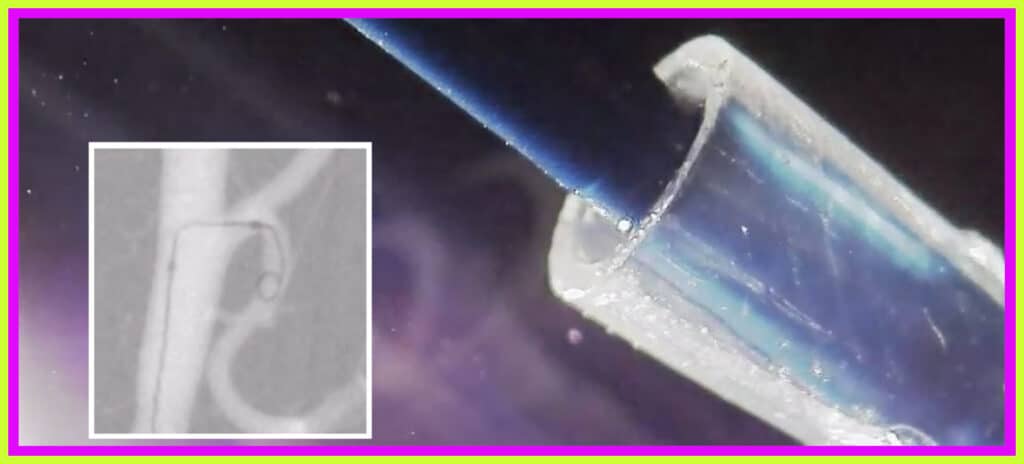
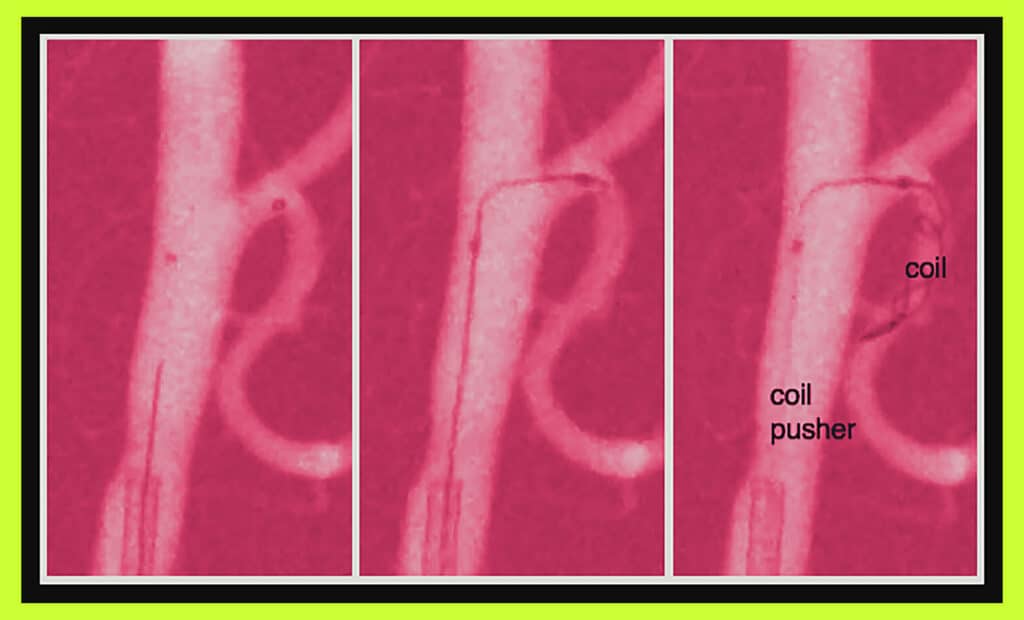
The team began by placing concentric layers of silicone on top of one another, each with different stiffness levels. This formed a silicone rubber catheter with interior cavities filled with harmless saline fluid via a handheld controller to enhance hydraulic pressure, allowing it to be piloted like a “Nintendo for neurosurgeons.” The novel technology was demonstrated in a pig’s brain artery, with the ‘steerable’ tip visible on X-rays. The device proved capable of deploying the platinum coils effectively.
Dr. Alexander Khalessi, MD, chair of the Department of Neurosurgery at UC San Diego Health, concluded:
As a neurosurgeon, one of the challenges that we have is directing catheters to the delicate, deep recesses of the brain. Today’s results demonstrate proof of concept for a soft, easily steerable catheter that would significantly improve our ability to treat brain aneurysms and many other neurological conditions, and I look forward to advancing this innovation toward patient care.
Next, the researchers will build on these promising early results with a larger trial on animals, and ultimately, humans. The UC San Diego team speaks about the technology in the video below.


