
For decades, the promise of wearable technology has been tethered to a single, limiting component: the battery. Devices that monitor our health or track our environment require constant charging or frequent replacement, creating a cycle of maintenance and waste. However, a breakthrough in ionic thermoelectric film technology is poised to sever this reliance, demonstrating that the gentle temperature difference between skin and air can drive real electrical work.
In a recent laboratory demonstration, detailed in a public news report and a peer-reviewed study published in Advanced Functional Materials, a flexible ten-pair ionic film module generated approximately 1.03 volts per kelvin of temperature difference. Remarkably, this system lit a commercial LED at about 1.5°C of body-to-air delta, proving that small, omnipresent thermal gradients can power functional electronics. These results point toward a new class of always-on devices that sip energy from everyday warmth, bypassing the need for bulky, rigid power sources.
This shift represents more than just a convenience; it is a fundamental change in how we power the Internet of Things. By supporting micro-power in realistic conditions, this technology makes battery-free wearables for sensing and safety easier to build and significantly more sustainable to recycle. As thermal harvesting matures, our bodies may soon become the silent engines of our digital lives.
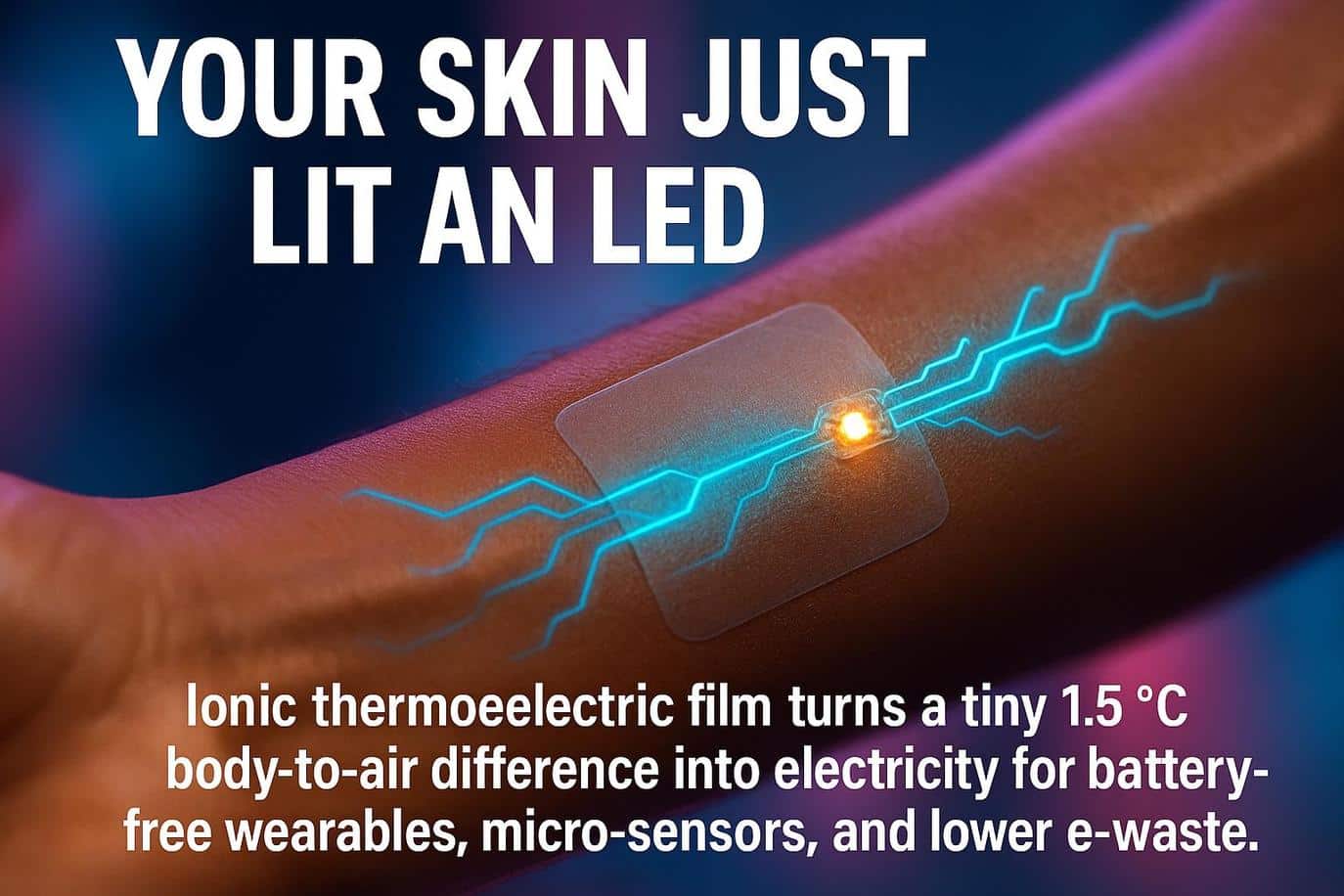
Generating Electricity from Body Heat with Ionic Film
- What it is: A skin-conformable ionic thermoelectric film that converts a small temperature difference into electricity by moving ions rather than electrons.
- Key demo result: About 1.03 V per K module slope, sufficient to light a commercial LED at roughly 1.5°C body-to-air difference.
- Stability: Reported performance retention of greater than 95 percent after more than two months of indoor operation under test conditions.
- Peer-reviewed source: The design strategy, material choices, and performance metrics are detailed in an Advanced Functional Materials article.
- Significance: Continuous micro-power from body heat can support low-demand wearables such as health or environment sensors, event detectors, and identification tags, with fewer battery swaps and fewer charge cycles.
Harnessing Everyday Body Heat for Battery-Free Power
Modern wearables already juggle power budgets carefully, yet most still depend on batteries that add weight and waste. The new ionic thermoelectric module shows that a temperature gap as small as about 1.5°C can provide enough voltage to drive a simple load. This capability marks a clear and memorable step toward battery-free wearables. While insufficient for displays or radios today, the output perfectly suits sensor duty cycles that gather data intermittently and buffer it in tiny storage elements.
Ionic harvesting fits within a wider family of ambient energy solutions. Motion-based devices convert walking or fabric flutter into charge, such as a wearable electric nanogenerator for low-cost clothing and accessories. Body-heat devices also have a history in research; one example is a self-mending wearable device capable of acting as a body battery. This project demonstrated how thin films and stretchable substrates can effectively ride gentle thermal gradients on skin.
What a 1.5°C Gradient can do Today
At a reported module slope near 1.03 V per K, a 1.5 K difference yields roughly 1.55 V across the series-connected pairs. Such output sits in the right neighborhood for a commercial LED under demonstration conditions. The same voltage can be rectified and stored, which is often more useful for wearables than direct drive. Storage elements built for tiny currents work well here, and research explores sweat-compatible supercapacitors that can sit on skin or in textiles as low-maintenance buffers.
Where Continuous Micro-Power Helps
Long-lived sensing is the clearest use case, specifically for applications requiring low duty cycles. Examples include:
- Skin temperature logging for health monitoring
- Hydration tracking during activity
- UV exposure badges for safety
- Periodic haptic alerts for notifications
If the harvested energy trickle-charges a small capacitor between these events, the device can perform short bursts of work without a heavy battery. Designers are exploring battery-free microcontrollers that operate on limited harvested energy, showing how software and hardware can be co-designed for severe energy budgets. Such an architecture is familiar in battery-free nodes and aligns with the module’s strengths at small temperature differences.
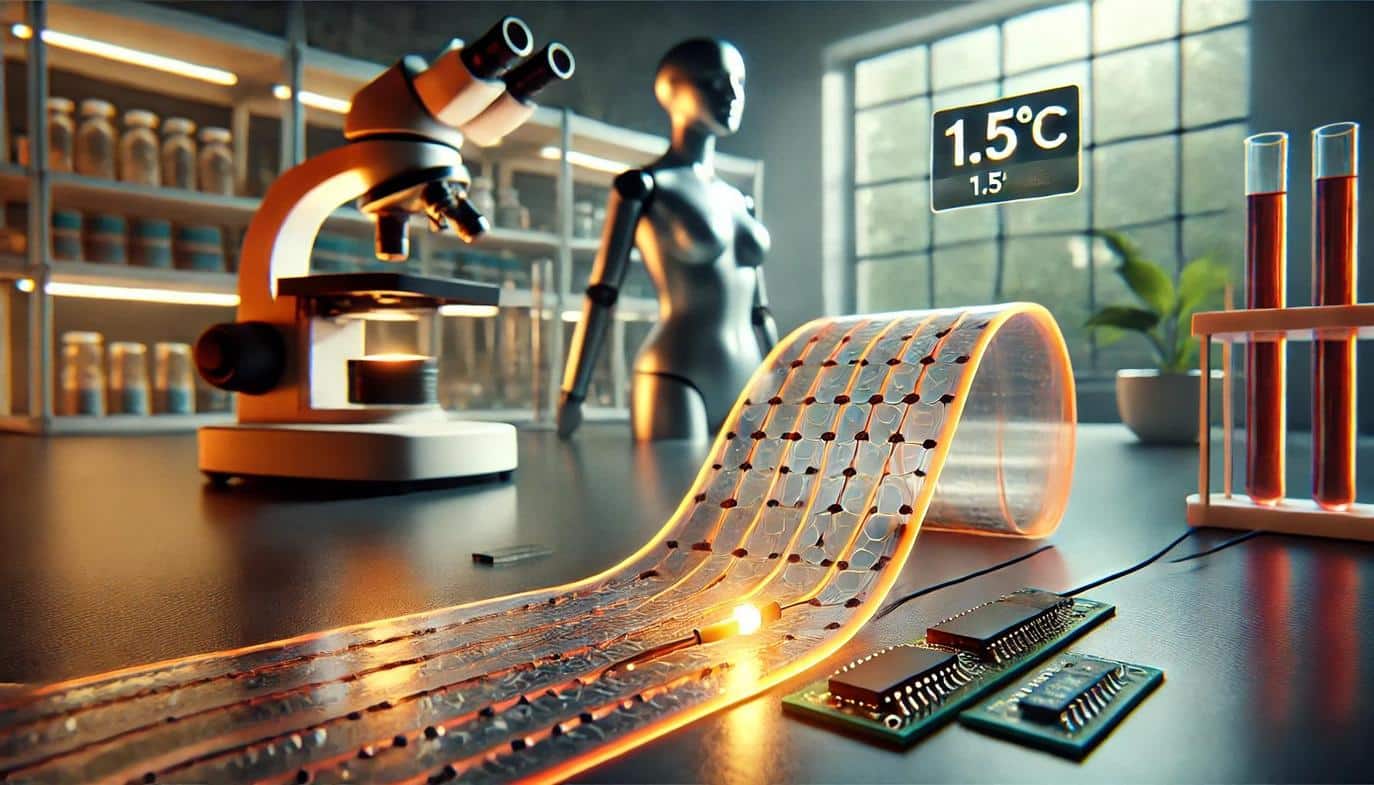
The Science of Ionic Thermoelectrics at Low Temperatures
Ionic thermoelectrics rely on ion motion under a temperature gradient. When one side of the film becomes warmer than the other, certain ions tend to drift, which builds up a thermovoltage. The ionic Seebeck coefficient defines this sensitivity, quantifying the voltage generated per unit of temperature difference. The practical advantage is that ionic systems can show large voltage per kelvin at room conditions, which makes them attractive for body heat where ΔT is small.
Ionic Seebeck Effect Explained
The film contains a polymer electrolyte where ions are mobile. A thermal gradient produces a slight imbalance in ion distribution, which leads to an electric potential that can be tapped by electrodes. The voltage scales with the gradient, so even a small ΔT can be used if the coefficient is large and the material is engineered to limit losses. Classic electronic thermoelectrics conduct charge using electrons within rigid semiconductors. In contrast, ionic films can be soft, stretchable, and conformal, making them far more suitable for skin contact and textile integration. Thermal engineering already shapes everyday products through precision temperature control systems, which offers useful context for how thermoelectric effects show up in practice.
p-Type and n-Type Ionic Conductors
As with electronic thermoelectrics, device modules pair p-type and n-type elements in series. In ionic films, the p-type side favors positive ion carriers and the n-type side favors negative ion carriers. By arranging many pairs in sequence, the total voltage adds up for a given temperature difference, which is why the ten-pair module can exceed one volt per kelvin at room conditions.
Ions Versus Electrons in Practice
Ionic devices trade high thermovoltage for other engineering considerations. Humidity and encapsulation can affect ionic mobility and long-term reliability, since water content changes the transport properties of polymer electrolytes. Designers must also manage several physical constraints alongside electrical performance:
- Skin comfort for long-term wear
- Washability for hygiene and maintenance
- Mechanical cycling to withstand thousands of bends
These are solvable challenges with standard packaging and textile integration, yet they deserve up-front testing in any product roadmap.

Key Findings: Ionic Film Performance Breakthroughs
The research group reports a thermodynamic design strategy for polymer complexes that deliver record ionic figures of merit for both p-type and n-type films. The resulting module is thin and flexible and is designed to follow the contours of skin or fabric. Crucially, the study offers quantitative performance metrics applicable to real-world scenarios.
Key Performance Metrics
The module demonstrates a slope near 1.03 V per K and lights a commercial LED at about 1.5°C of temperature difference under lab conditions. It also maintains greater than 95 percent of its performance after more than two months of indoor operation in the reported tests. These results align with the underlying peer-reviewed data and are echoed by an institutional press release that confirms the publication date and summarizes the demonstration.
Materials and Module Design
The study describes paired p-type and n-type ionic polymer complexes arranged into a ten-pair series module. The p-type component is based on a well-known conducting polymer formulation, while the n-type component incorporates a salt that favors negative ion carriers. The paper details how the material chemistry and microstructure were tuned so that ion transport produces high thermovoltage at room temperature with practical durability. Exact formulations and test protocols are reported in the peer-reviewed methods and supplemental materials of the study.
Stability and Real-World Considerations
Stability exceeding 95 percent after two months signals strong potential for early prototypes. Real products will still require broader environmental testing that covers humidity swings, sweat exposure, laundering cycles, and long-term mechanical fatigue. Packaging strategies that seal the ionic layer against moisture while preserving comfort are likely to be the next step. The broader energy-harvesting landscape also includes light- and shadow-based devices, which helps readers place ionic thermoelectrics in context with other ambient sources. A complementary approach uses a shadow-effect generator that produces electricity from light contrasts in everyday scenes.
Navigating Practical Challenges: Durability and Design
Real products live in complex conditions. Body heat varies with activity and clothing, room air changes with seasons, and skin is humid, salty, and constantly in motion. The film’s strong voltage-per-kelvin performance is promising, yet practical designs must translate that sensitivity into dependable energy budgets and comfortable wear.
How Much Film do Typical Sensors Need?
A simple way to think about sizing is to start from the duty cycle. Many wearables collect a small sample of data, sleep for long periods, then wake for a brief transmission or alert. Energy harvested from a gentle 1–2°C gradient can be accumulated in a micro-capacitor between events. The demonstrated LED at about 1.5°C proves that the module can produce useful voltage in this regime, and the same voltage can be rectified and stored with minimal overhead. For readers, the key is patience—continuous trickle harvest enables intermittent bursts of work when storage reaches a threshold.
Humidity, Sweat, and Encapsulation
Ionic transport depends on the polymer’s environment. Humidity and sweat composition can alter ion mobility and long-term reliability, since water content changes the transport properties of polymer electrolytes. Designers must also manage skin comfort, washability, and mechanical cycling over thousands of bends. These are solvable challenges with standard packaging and textile integration, yet they deserve up-front testing in any product roadmap.
Bend, Wash, Repeat
Wearables bend thousands of times and occasionally get laundered. The study’s reported greater than 95 percent stability beyond two months under indoor conditions is encouraging, yet a product roadmap still needs extended mechanical cycling, wash tests, and abrasion tests. Designers should also consider modular attachment points or carrier fabrics so the active film can be removed before washing when necessary.
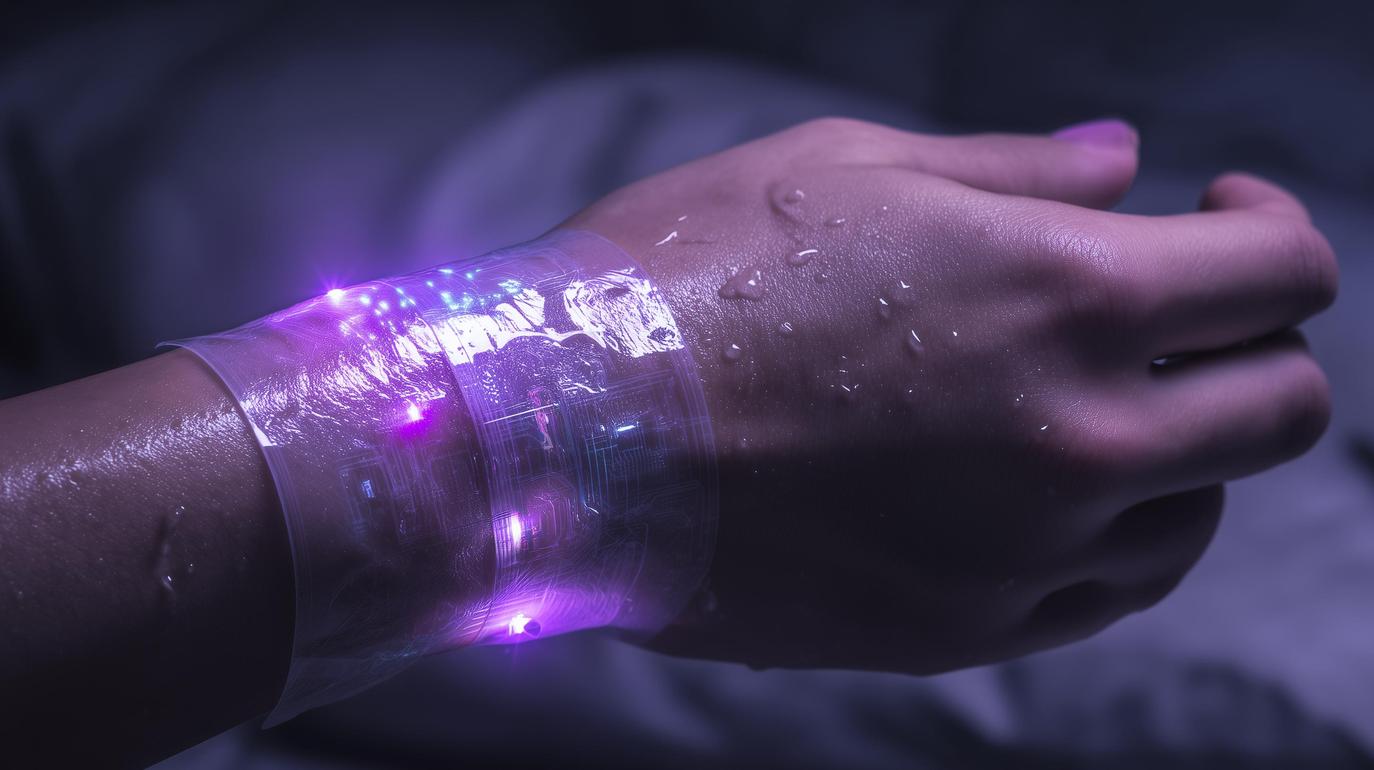
Reducing E-Waste with Body-Heat Harvesting
Batteries dominate the waste profile of small electronics. Sourcing even a modest portion of energy from body heat allows designers to specify smaller cells, reduce charge cycles, or move to hybrid storage with tiny capacitors that tolerate unlimited cycles. Over a product’s life this can lower material use and shrink the stream of retired cells. Broader context involves critical minerals and e-waste within the electronics lifecycle.
Harvest and Store Systems
The most practical path is a simple energy chain: film harvests heat, an ultra-low-loss rectifier conditions the output, a micro-supercapacitor buffers charge, and a microcontroller executes short tasks when voltage crosses a threshold. This architecture is familiar in battery-free nodes and aligns with the module’s strengths at small temperature differences.
The Path to Commercialization: Manufacturing and Safety
Translating a laboratory module into a daily-wear strap involves four parallel tracks: materials, manufacturing, electronics, and certification.
Materials and Skin Safety
Consumer devices must be gentle on skin. The ionic layer should be encapsulated to prevent direct exposure, while the outer surface should remain breathable and soft. Any salts or dopants used in the n-type film should be contained by design. Patch adhesives, if used, should follow standards common in medical wear.
Manufacturing at Scale
Flexible electronics are frequently produced with roll-to-roll printing and coating. The film’s simple, layered geometry is suitable for continuous processes where cost depends on line speed, yield, and material utilization. Quality control focuses on thickness uniformity, ionic composition, and the electrical contact resistance at series connections.
Electronics and System Design
Harvesters benefit from specialized circuits designed to stretch every microwatt of available power. Key components include:
- Low-leakage rectifiers
- Ultra-low-quiescent regulators
- Firmware tuned for long sleeps and brief bursts
Short-range data transfers or passive logging modes make sense until harvest capacity grows.
Regulatory and Reliability Testing
Wearable patches and straps must satisfy electromagnetic compatibility, biocompatibility, and environmental tests before sale. Reliability plans should include high-humidity storage, thermal cycling, accelerated aging, and realistic sweat exposure to verify long-term stability beyond the initial laboratory window.

Defining the Role of Ionic Films in Wearable Tech
Ionic thermoelectric films shine when the job requires tiny, steady energy near the body. Such films are a strong match for:
- Temperature and hydration sensors
- Low-duty haptic cues
- ID or security tokens that activate episodically
Hybrid architectures represent the most viable near-term path—combining body-heat harvest with other ambient sources to right-size a small rechargeable cell. They are not a substitute for today’s display-heavy watches, cellular radios, or GPS locators that demand sustained power.
The Future of Ionic Body-Heat Harvesting
The development of a soft, ionic film capable of turning a nominal temperature gap into usable electricity opens a critical new lane for battery-free design. By moving beyond rigid semiconductors to flexible, ion-based polymers, researchers have demonstrated credible voltage generation at room conditions with sustained stability. This leap validates the concept that our immediate environment—and our own biology—can fuel the next generation of personal electronics without the environmental cost of disposable batteries.
Looking ahead, the engineering roadmap is clear: mastering moisture control, refining textile integration, and optimizing low-power electronics. As these elements align, we can expect to see a wave of skin patches, smart straps, and active labels that gather their own energy quietly from warmth. This evolution promises to reduce device bulk and extend operational lifetimes, ultimately creating a seamless technology ecosystem where users never have to think about power again.
Frequently Asked Questions About Ionic Thermoelectrics
Can Body Heat Really Power Wearables Indoors?
Yes, for the right class of devices. The module’s ability to light an LED at about 1.5°C shows that small gradients can be harvested. Energy is modest, so systems rely on storage and careful duty cycles.
What Makes Ionic Thermoelectrics Different From Classic Thermoelectrics?
They move ions in a polymer electrolyte rather than electrons in a rigid semiconductor. This can yield high voltage per kelvin at room conditions and allows soft, conformal films suitable for skin.
Will Humidity or Sweat Hurt Performance?
Ionic mobility depends on moisture. Consumer products will need thin, breathable encapsulation that stabilizes the ionic layer against sweat and daily humidity swings while keeping the surface comfortable.
Could This Replace the Battery in a Smartwatch?
Not today. Displays, radios, and GPS are power-hungry. The sweet spot is low-demand sensing and intermittent tasks. Designers can still shrink the battery or extend the time between charges by adding heat harvesting.
How Close Is This to Market?
The core effect is proven in peer-reviewed work. The remaining steps are engineering: scale manufacturing, skin-safe packaging, and regulatory testing. Early niche products such as patches, badges, or straps are the most likely first movers.


