
Quantum entanglement is when two particles or objects are linked, even though they may be far apart; their properties are connected in a way that isn’t possible with the rules of classical physics. When two particles are entangled, they are correlated in a way that classical physics can’t describe, leaving physicists using mathematics for an explanation. This special connection plays a big part in many areas of quantum science, like keeping information safe, moving information from one place to another, and using particles to do calculations.
Quantum Entanglement Observed at Larger Scales
Quantum entanglement is an odd phenomenon that Einstein called “spooky action at a distance,” but scientists find it fascinating because of how strange it is. Quantum entanglement was directly inspected and recorded at the macroscopic scale in a 2021 study. This is a much larger scale than the subatomic particles that are usually associated with entanglement.
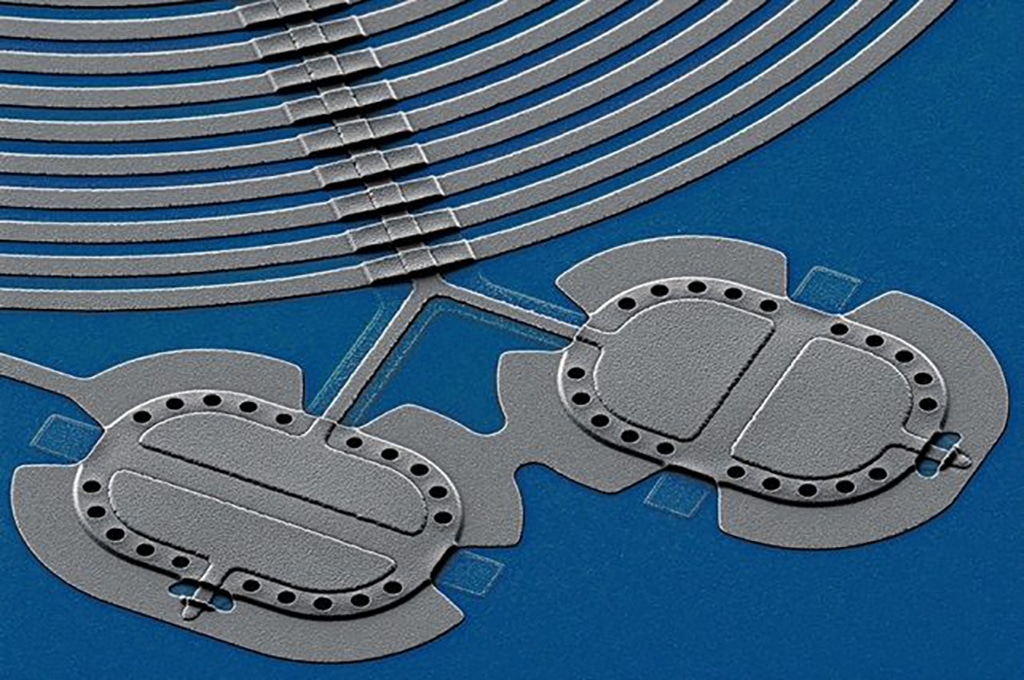
The experiments used two tiny metal drums one-fifth the width of a human hair – which are still very small from our perspective but are enormous in quantum physics.
John Teufel, a physicist at the US National Institute of Standards and Technology (NIST), said:
“If you analyze the position and momentum data for the two drums independently, they each simply look hot. But looking at them together, we can see that what looks like the random motion of one drum is highly correlated with the other in a way that is only possible through quantum entanglement.”
Although there is no reason to believe that quantum entanglement cannot occur with macroscopic objects, it was previously thought that quantum effects were not observable at bigger scales or that the macroscopic scale was subject to other laws. However, the 2021 study reveals that is not the case. In actuality, the same quantum laws also apply here and are visible.
How Did They Record Quantum Entanglement?
The researchers used microwave photons to vibrate the small drum membranes, and these laser beams kept them synced in position and velocity. The drums were cooled, entangled, then measured in stages within a cryogenically chilled container to avoid outside interference, a common issue with quantum objects. The states of the drums are subsequently encoded in a radar-like reflected microwave field.
While other studies have reported on quantum entanglement on a macroscopic scale, the research from 2021 took things further by actually recording all the necessary measurements of these entangled pairs rather than assuming them and by generating the entanglement in a predictable rather than random manner.
Other Studies on Quantum Entanglement
Separate but related experiments have demonstrated the ability to simultaneously measure the position and momentum of the two drumheads using macroscopic drums (or oscillators) in a state of quantum entanglement.
Laure Mercier de Lepinay, a physicist from Finland’s Aalto University, stated:
“In our work, the drumheads exhibit a collective quantum motion. The drums vibrate in an opposite phase to each other, such that when one of them is in an end position of the vibration cycle, the other is in the opposite position simultaneously. In this situation, the quantum uncertainty of the drums’ motion is canceled if the two drums are treated as one quantum-mechanical entity.”
The findings are noteworthy because they circumvent Heisenberg’s Uncertainty Principle, which states that momentum and position cannot be accurately measured simultaneously. According to the principle, recording either measurement will cause interference with the other due to a phenomenon known as quantum back action. Back action in quantum mechanics refers to a measurement device’s impact on entangled particles being measured.
In addition to supporting the previous study’s demonstration of macroscopic quantum entanglement, this particular investigation used that entanglement to avoid the adverse effects of quantum back action, thus exploring the boundary between classical physics (where the Uncertainty Principle holds) and quantum physics (where it appears to no longer apply).

Potential Applications for Both Findings
Both sets of findings have the potential to be used in quantum networks, which can manipulate and entangle things on a macroscopic scale to power next-generation communication networks, for example. “Apart from practical applications, these experiments address how far into the macroscopic realm experiments can push the observation of distinctly quantum phenomena,” wrote physicists Aashish Clerk and Hoi-Kwan Lau (who were not involved in the research) in a commentary on the 2021 study.
Both studies were published in the journal Science.


