
A groundbreaking space solar power prototype developed by Caltech‘s Space Solar Power Project (SSPP) has achieved a significant milestone, successfully demonstrating wireless power transmission in space for the first time. Named the Space Solar Power Demonstrator-1 (SSPD-1), the prototype employs the Microwave Array for Power-transfer Low-orbit Experiment (MAPLE) to wirelessly transmit power from space to Earth, harnessing the potential of solar panels in space-based solar power. This remarkable achievement edges us closer to realizing space-based solar energy as a reliable and abundant power source.
Space Solar Power represents a transformative solution capable of tapping into virtually unlimited solar energy in space through solar satellites. Unfettered by earthly constraints like day-night cycles, seasons, or cloud cover, this cutting-edge technology stands poised to revolutionize global energy access, providing a constant and abundant renewable energy source. The technology could provide gigawatts of power from space. Importantly, it holds the promise of democratizing energy access, extending benefits to remote regions and areas impacted by wars or natural disasters.
SSPD-1: A Comprehensive Approach to Space Solar Power
The SSPD-1 is a comprehensive project encompassing three key experiments: MAPLE, DOLCE, and ALBA. MAPLE concentrates on wireless power transmission, DOLCE demonstrates the architecture and deployment mechanisms of modular spacecraft, and ALBA assesses the effectiveness of different photovoltaic cells in the demanding space environment.
“Demonstration of wireless power transfer in space using lightweight structures is an important step toward space solar power and broad access to it globally,” says Harry Atwater, Otis Booth Leadership Chair of Division of Engineering and Applied Science; Howard Hughes Professor of Applied Physics and Materials Science; Director of the Liquid Sunlight Alliance; and one of the principal investigators of the project. Solar panels already are used in space to power the International Space Station, for example, but to launch and deploy large enough arrays to provide power to Earth, SSPP has to design and create solar power energy transfer systems that are ultra-lightweight, cheap, and flexible.
MAPLE: Enabling Wireless Power Transmission
MAPLE concentrates on wireless power transmission, a crucial element in the space solar power project.
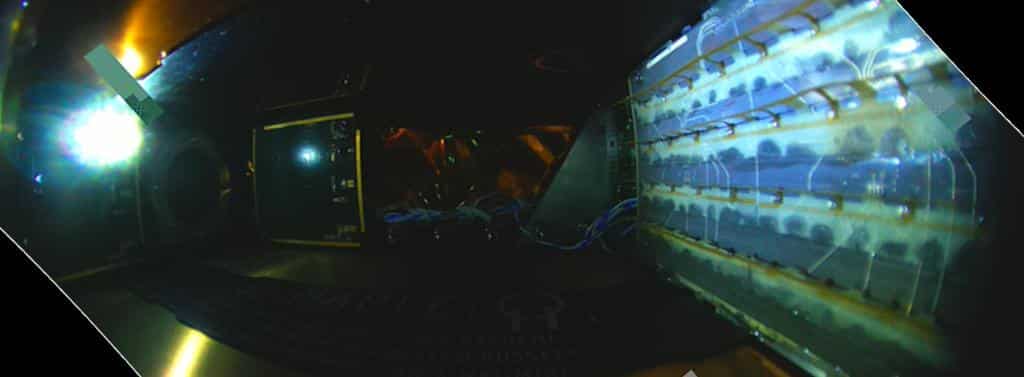
Developed by a team led by Ali Hajimiri, MAPLE is a key experiment within SSPD-1, consisting of an array of flexible lightweight microwave power transmitters driven by custom electronic chips. MAPLE’s design is deliberately lightweight, flexible, and cost-effective, underscoring the economic feasibility of space-based solar power and the idea of renewable energy from space. The prototype has already exhibited its capability to transmit power successfully to receivers in space and direct its energy towards Earth.
“Through the experiments we have run so far, we received confirmation that MAPLE can transmit power successfully to receivers in space,” Hajimiri says. “We have also been able to program the array to direct its energy toward Earth, which we detected here at Caltech. We had, of course, tested it on Earth, but now we know that it can survive the trip to space and operate there.”
DOLCE and ALBA: Expanding the Frontiers of Space Solar Power
Within the SSPD-1 project, DOLCE serves as a crucial experiment showcasing the packaging scheme and deployment mechanisms of modular spacecraft. ALBA, another significant experiment, involves testing 32 different types of photovoltaic cells in the challenging space environment. This assessment aims to identify the most effective cells for future space-based solar power systems.
The Role of Momentus Vigoride in the SSPD-1 Project
The Momentus Vigoride spacecraft played an instrumental role in the SSPD-1 project, enabling transportation of the prototypes to space. Launched aboard a SpaceX rocket on the Transporter-6 mission, this spacecraft offered critical support to Caltech by providing data, communication, and telemetry services, thereby ensuring the prototypes’ optimal performance.
Shifting Energy Focus with Precision
Employing a sophisticated system of constructive and destructive interference between individual transmitters, the MAPLE system can shift the focus and direction of transmitted energy without moving parts. This precision allows the majority of energy to be transmitted precisely where needed.
Successful Detection of Transmitted Energy
MAPLE features two separate receiver arrays located near the transmitter to receive the transmitted energy, convert it to direct current (DC) electricity, and power LEDs, demonstrating wireless energy transmission in space. The experiment has successfully detected the transmitted energy on Earth, validating its effectiveness in real-world conditions.
(Credit: SSPP)
“To the best of our knowledge, no one has ever demonstrated wireless energy transfer in space even with expensive rigid structures. We are doing it with flexible lightweight structures and with our own integrated circuits. This is a first,” says Hajimiri.
Environmental Impact and Contribution to Climate Solutions
Space solar power represents not only a technological breakthrough but also an important tool in our fight against climate change. By harnessing the virtually unlimited solar energy in space, we can reduce our dependence on fossil fuels and thus significantly cut carbon emissions. This transition to renewable energy is key to mitigating the effects of climate change.
Furthermore, space solar power, unlike terrestrial renewable energy sources, is not dependent on weather or seasonal variations, providing a stable, continuous source of clean energy. The successful deployment of space solar power systems could therefore make a substantial contribution to global efforts to transition to sustainable, low-carbon economies.

(Credit: Ali Hajimiri)
The Promise of Space Solar Power
Space Solar Power offers a promising solution to harness the abundant solar energy in space without the limitations of day and night cycles, seasons, and cloud cover. The SSPP envisions deploying a constellation of modular spacecraft that collect sunlight through solar panels, convert it into electricity, and transmit it wirelessly as microwaves over vast distances. This technology could significantly outperform traditional solar panels on Earth.
The Way Forward: Enhancing Efficiency and Rectifying Irregularities
While MAPLE’s successful demonstration of wireless power transmission in space is a groundbreaking achievement, further research is necessary to address potential irregularities within the system. Ongoing evaluations of individual elements within the system will help identify and rectify any issues, providing valuable insights for the development of future space-based solar power systems. The team at Caltech remains dedicated to enhancing the technology and improving its efficiency, thus paving the way for a new generation of space solar power.


