
Serious collectors constantly grapple with the tension between deep-vault security and rapid inventory accessibility. Managing a high-frequency investment portfolio or protecting a childhood inheritance requires a strategic choice between archival binders and storage boxes to ensure asset longevity. Selecting the right materials isn’t just about organization—it’s a calculated move to prevent surface scratches, corner wear, and environmental degradation that could silently devalue your rarest cards.
The 2026 Trading Card Binder vs. Box Capacity Guide replaces hobby speculation with a technical breakdown of volume, cost, and physical protection. We’ve analyzed how different housing methods respond to light exposure and humidity, offering a clear roadmap for anyone asking how to store expensive trading cards for maximum value. From bulk cardboard solutions to premium locking briefcases, this analysis ensures every decision you make strengthens the security of your inventory.
Contemporary ‘hybrid’ cases bridge this gap by integrating binder-style browsing with the reinforced security typically reserved for boxes. If you already own high-value slabs, jump to our premium collectables protection section to discover why many investors carry their grails in locking briefcases instead of binders or shoeboxes.

1. Hybrid Solutions: Integrating Archival Protection With Modern Accessibility
For decades collectors had two paths: display cards in binder pages or lock them inside storage boxes. That rigid split no longer applies.
Strategic Hybrid Integration
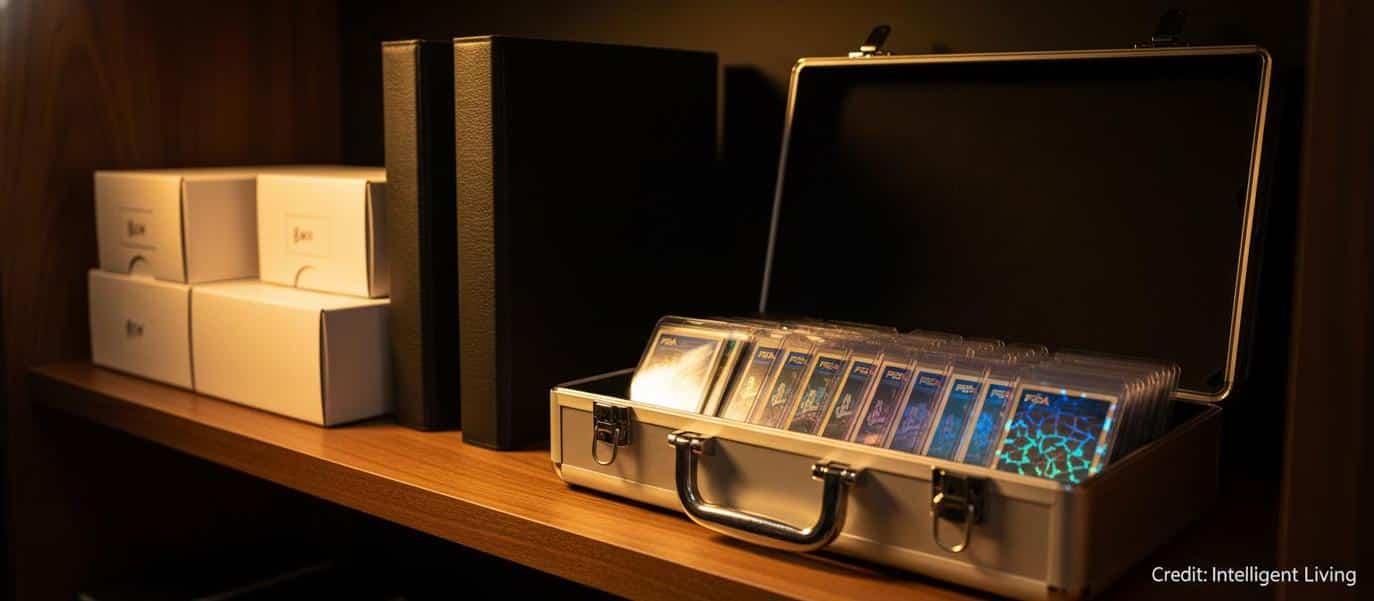
Modernized hybrid storage environments pair the tactile convenience of traditional albums with the rigid structural integrity of specialized vaults. Picture a slim aluminum briefcase lined with foam channels. Cards stand upright like books, shielded from light, moisture, and bumps, yet you open the lid and scan every title in seconds. Vaulted’s two-row case holds about 50 graded slabs or 1,000 sleeved raw cards in a footprint smaller than a laptop bag. Dual keyed latches keep the load safe on the show floor.
Archivists anticipated the shift. Museum suppliers now sell “binder-in-a-box” albums: D-ring binders that slide into acid-free slipcases to block dust and UV. The design finally gives pages the rigid shell they lacked while keeping every card visible.
Collectors no longer face a binary choice between accessibility and security, thanks to these engineering advancements. A hybrid case delivers binder-style browsing while meeting the preservation standards investors expect. Keep that concept in mind as we compare capacity, cost, and durability in the next findings.

2. Capacity Comparison: Analyzing Storage Density Per Linear Inch
Limited shelf space forces collectors to scrutinize how different formats consume their physical storage environment. When you compare the dimensions of traditional albums to high-capacity containers, the spatial efficiency becomes undeniable:
Volumetric Efficiency Metrics
- Standard 3-inch binders house approximately 360 single-sleeved cards.
- A row of eight binders consumes 61 centimeters (24 inches) of shelf space.
- Total capacity for this configuration tops out at 2,900 cards.
Collectors often struggle with physical bulk as their inventory expands under traditional organizational setups. Now consider a BCW 3,200-count monster box. It measures 40 centimeters long by 10 centimeters tall (15.7 × 4 inches) and fits about 3,000 penny-sleeved cards. One box, therefore, equals the storage of eight binders in a footprint narrower than a laptop, yielding roughly ten times more cards per linear inch.
Financial Scaling Patterns
Financial data from Beckett highlights a significant price gap between archival methods. If you are managing a large-scale inventory, the cost per thousand cards fluctuates wildly based on your choice of housing:
- High-capacity 3,200-count boxes: Under 10 USD total (approx. 3 USD per 1,000 cards).
- Binders and nine-pocket pages: Approximately 70 USD total (approx. 28 USD per 1,000 cards).
Cardboard solutions for bulk inventory preserve significant capital that can be reinvested into premium card acquisitions. Capacity scales smoothly within a box-based system. Adding a second monster box allows you to double your storage for just 10 USD. In contrast, expanding binder storage is far more complex, requiring the purchase of additional pages, specialized albums, and expanded shelving units.
Collectors who break cases or store decades of base cards gain the most. Boxes reserve budget for sleeves and top-loaders and keep shelf space open for showcase binders we review next.

3. Preservation Metrics: Mitigation of Light, Friction, and Physical Impact
Cards deteriorate fast when they rub, flex, or fade. Binders and boxes curb those threats in different ways, and the safer choice depends on what you fear most.
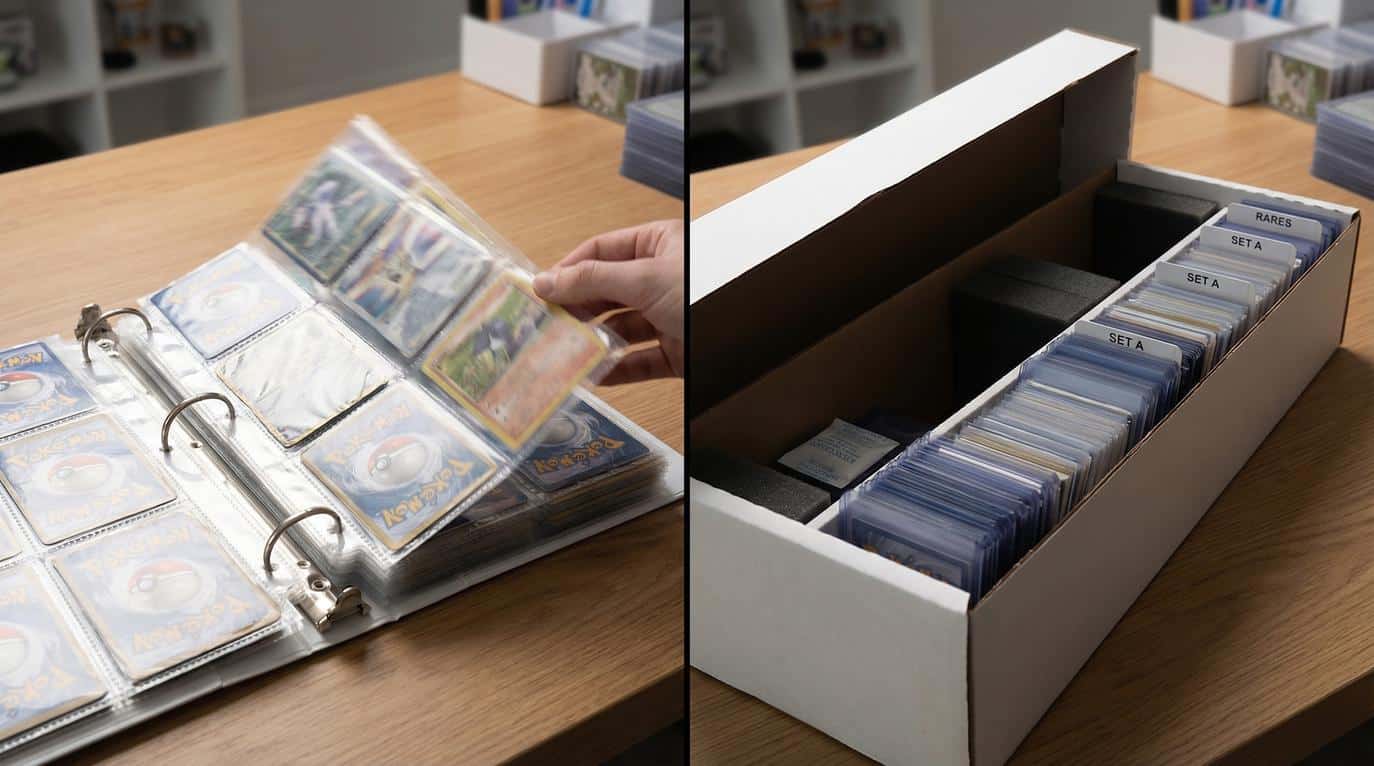
Binders seal each card in a clear polypropylene pocket, effectively blocking fingerprints and airborne dust. However, trouble often lurks at the edges; each page turn creates subtle vibrations where the card edges contact sleeve seams.
Mitigating Mechanical Friction
Procedural discipline consistently outperforms high-end equipment in long-term preservation:
This micro-friction can have devastating financial consequences. In one documented case, a first-edition Charizard slipped from gem-mint potential down to a PSA 7 after five years of casual browsing, resulting in a 4,200 USD loss at auction. Boxes reduce friction because cards hardly shift. Sleeved and top-loaded, they rest upright in darkness. Guides on Vaulted’s collectables protection echo this principle, noting that limiting movement and light exposure is the best insurance, and a sealed box achieves both.
Boxes still need care. A half-empty row lets cards lean, corners soften, and humidity creep in if the lid stays open. Overfilled binders pose a different hazard; misaligned rings press dents into lower pockets.
Environmental Maintenance and Humidity Control
- Slip every raw card into a penny sleeve before storage.
- Choose D-ring binders so pages lie flat.
- In boxes, fill empty sections with foam blocks or labeled dividers.
- Keep both formats out of direct light and maintain 18°C–24°C (65°F–75°F) with relative humidity near 45 percent.
Adopting these protocols ensures your assets maintain their physical integrity regardless of the chosen storage format.
4. Cost Analysis: Long-Term Financial Impact of Scaling Protection
A 10 USD binder or a 2 USD box feels trivial until you scale up.
Nine-pocket pages carry an average cost of 0.20 USD per unit, creating a subtle but compounding expense. Filling a 3-inch binder requires 100 pages, bringing the total investment to 25 USD for 900 cards. This calculates to roughly 0.028 USD per card. When you scale this to a 10,000-card collection, your total protection outlay climbs beyond 280 USD.
Incremental Scaling Analysis
Cardboard boxes slash that bill. Two BCW 3,200-count boxes hold the same 10,000 cards for roughly 20 USD, or 0.002 USD per card—about 90 percent cheaper than binders. Beckett’s hobby survey puts boxes at 3 USD per thousand cards, while binders hover near 30 USD.
Premium cases represent a different tier of asset management. While a 100 USD locking aluminum briefcase fits only 100 graded slabs—a cost of 1 USD per card—this ratio is justified for high-value hits. Spending one percent of an asset’s market value on protection serves as rational insurance for items worth 50 USD or more.
Apply a tiered investment strategy to your inventory management. Use low-cost boxes for bulk, choose archival binders for sets you enjoy flipping through, and reserve premium cases for high-value slabs. Let storage cost rise with card value, not card count, and you keep expenses and risk in balance.

5. Organizational Efficiency: Comparing Sorting Speed and Browsing Experience
Optimization for Visual Browsing
Binders excel when you want to enjoy a set card by card. The ability to unzip a cover and view nine cards at once allows for an immersive experience without ever touching the raw cardboard.
This hands-off display is more than just aesthetic; it prevents damaging fingerprints and significantly increases the speed of trades since every card on the page is immediately visible to a potential partner.
Streamlining High-Volume Sorting
High-volume organizational tasks move significantly faster when utilizing box-based systems rather than binders. To assemble a specific lot or integrate new pulls, the workflow is streamlined:
- Open the lid and slide dividers to locate the target era.
- Pull hundreds of cards in minutes without removing pages.
- Drop new sleeves directly into the correct row.
This eliminates the need for time-consuming page reshuffling, keeping your inventory management efficient. Practical split. Keep display binders within reach for nostalgia and quick show-and-tell. Store bulk and trade inventory in labeled boxes on a closet shelf. Using each format where it is most convenient removes friction and keeps your workflow efficient.

6. Future-Proofing: Scalability for Graded Slabs and Collection Growth
Collections evolve. Sets expand, cards get graded, and eventually you pack everything for a new house or a weekend show. Flexible storage is essential; without it, managing a growing collection leads to significant logistical friction.
Binders stumble first. When a new parallel belongs between card 17 and card 18, whole pages shift like a sliding puzzle. Repeat that across a master set, and you can spend an evening repositioning pockets. Boxes handle change with ease: open a row, place a divider, and the fresh card slides into place. Scalability lives in cardboard.
Scalability for Graded Slabs
Grading creates a sharper pivot. A PSA slab cannot fit a standard nine-pocket page, and forcing one risks a cracked case. Every binder therefore feeds a slab box or locking briefcase sooner or later. Many collectors keep “to-be-graded” cards in penny sleeves inside a spare row for quick retrieval at submission time.
Tactical Move Logistics
Relocating or transporting a collection provides the ultimate test of your gear’s durability. A full 900-card binder weighs roughly 3.6 kilograms (8 pounds), and a single misaligned ring can cause 200 cards to spill during transit. Conversely, boxes stack securely like bricks; once the lid is taped, they can easily ride out the bumps of a move. Trade up to a plastic card bin or aluminum case, and you add water resistance plus side handles that spare your wrists on steps.
Effective future-proofing relies on a tiered model that adapts to your changing inventory. Logistical friction remains minimal throughout your collection’s growth when you implement these tiered protocols:
- Bulk Commons: Utilize inexpensive monster boxes for high-volume storage.
- Premium Inserts: Protect slabs and grails in rigid bins or locking cases.
- Completed Sets: Keep slim archival binders for sets you enjoy browsing.
This ensures that when your collection grows, the logistical friction remains minimal. When storage cost tracks card value instead of card count, growth feels exciting rather than exhausting.
Strategic Finalization: Choosing Your Best Card Collection Protection
Thriving in the collectibles market requires disciplined habits that extend beyond simple gear selection. By aligning specific container strengths with the financial and sentimental value of your cards, you create a sustainable system that prioritizes both preservation and pleasure. High-value hits deserve the isolated security of rigid vaults, while completed sets thrive in the narrative flow of a premium D-ring binder.
A disciplined inventory strategy guarantees your collection remains both a point of pride and a profitable asset for decades. As your inventory evolves, let your storage costs scale with the value of your assets rather than the sheer volume of your cardboard. This disciplined strategy ensures your collection remains a source of both pride and profit for decades to come.
Essential Trading Card Storage FAQ
Are binders bad for trading cards?
No, high-quality D-ring binders with acid-free pages are excellent for organization, provided you avoid overfilling and store them vertically to prevent ‘binder bite.’
What is the best box for graded cards?
Heavy-duty plastic bins or aluminum briefcase-style vaults are the gold standard for graded slabs, as they offer impact resistance and moisture protection that cardboard cannot match.
How do I prevent trading cards from warping?
Maintaining a stable environment between 18°C and 24°C with 45% relative humidity serves as the primary defense against foil curling and paper degradation.
Should I use penny sleeves inside binders?
Yes, double-protecting cards by placing them in a penny sleeve before inserting them into a binder page adds an extra layer of defense against micro-scratches and dust.
Is cardboard safe for long-term card storage?
Acid-free cardboard storage boxes are safe and cost-effective for bulk inventory, but they should be kept off the ground in climate-controlled areas to avoid moisture absorption.

