
In an era characterized by rapid technological advancements, two iconic tech moguls, Mark Zuckerberg and Elon Musk, are pioneering a new frontier—artificial intelligence (AI) supercomputers that are more powerful than entire nations. These state-of-the-art machines are not only symbols of human ingenuity but also key enablers of progress in AI, a field poised to redefine every aspect of our lives from healthcare solutions to environmental sustainability.
At the heart of this unprecedented leap lie the cutting-edge supercomputing infrastructures like Meta’s AI Research SuperCluster (RSC) and the xAI Colossus, driven by NVIDIA’s formidable chip technology. These supercomputers mark a new chapter in AI’s journey, where immense computational power is harnessed to address complex global challenges, pushing the boundaries of what machines can accomplish. In this article, we delve into the origins, mechanics, and world-changing potential of these monumental creations, unveiling how Zuckerberg and Musk are reshaping the future, one AI-powered leap at a time.

Origins and Objectives of AI Supercomputers
Pioneering the AI Front: From Vision to Reality
The quest to build AI supercomputers from the visionary minds of Mark Zuckerberg and Elon Musk, leaders known not only for their innovative prowess but also for their uncanny ability to foresee future trends. But why these monumental machines, you may wonder? Simply put, the future of critical global problem-solving hinges on the ability to process staggering amounts of data quickly and efficiently—a task perfectly suited for AI supercomputers.
Mark Zuckerberg’s Vision: The Meta AI Research SuperCluster (RSC)
Meta, previously known as Facebook, embarked on creating one of the largest AI supercomputers with the development of the AI Research SuperCluster (RSC). This initiative is set to train AI models with over a trillion parameters, advancing capabilities in language processing and computer vision. But what does this mean in everyday terms? Imagine the digital assistant in your phone or smart speaker performing everyday tasks and understanding languages as proficiently as a human. The RSC is designed to take this to new levels, equipping machines to think, learn, and interact with more sophistication.
Meta’s comprehensive venture is not just about science fiction becoming reality; it’s about providing practical tools for tasks that span identifying harmful content on social media platforms to potentially revolutionizing sectors like healthcare with new diagnostic tools or educational technology with personalized learning experiences.
Elon Musk’s Vision: The xAI Colossus
On the other end of the spectrum, Elon Musk’s venture, known as xAI Colossus, boasts a setup of 100,000 NVIDIA H200 GPUs, with plans to expand even further, thereby cementing its status as one of the largest AI supercomputers ever built. This technological marvel underscores Musk’s relentless pursuit of innovation, playing a pivotal role in supercharging AI development across applications, including self-driving cars and space exploration projects.
The colossal scale of Musk’s endeavor indicates how these supercomputers will be the engines powering AI applications capable of real-time decision-making and lightning-speed data processing—abilities needed for tasks such as navigating autonomous vehicles through busy streets or even deploying AI systems in unknown regions of space to support interstellar research.
Zuckerberg and Musk’s Vision Revolutionize Corporate & Societal Landscapes
In essence, Zuckerberg and Musk share a vision where AI supercomputers function as pivotal tools to not only enhance corporate strategies and develop consumer technologies but also tackle enormous societal challenges. By unleashing these technological behemoths, they are setting the stage for a future in which machines help navigate and mitigate some of the world’s pressing issues, ranging from climate change to global health emergencies.

The Mechanics of AI Powerhouses
Inside the Giants: Understanding Supercomputer Architecture
Grasping the true capabilities of AI supercomputers requires diving into the intricate mechanics that make them tick. At the core of these mighty machines lies a sophisticated combination of technologies designed to process vast amounts of data at unimaginable speeds. So, what are these technical wonders composed of, and how do they operate?
NVIDIA’s Cutting-Edge Technology
A common denominator in the powerhouses at Meta and Elon Musk’s xAI is NVIDIA’s marquee technology. Known for serving the gaming community with powerful graphics processing, NVIDIA’s pivot towards AI has positioned them as a crucial player in this high-stakes technological arena. But let’s break it down into more relatable terms: Imagine these supercomputers as colossal calculators, able to solve complex problems that would otherwise take traditional computers months or years.
The underlying architecture of these supercomputers involves stacking thousands of powerful GPUs—or Graphics Processing Units. These GPUs are like the horsepower in a sports car engine. They provide the raw power needed to rapidly crunch numbers and spit out solutions at a pace far beyond what a regular laptop could manage. Meta’s RSC, for instance, utilizes NVIDIA DGX systems combined with the formidable H100 GPUs, while xAI incorporates the newer H200 chips, each packed with revolutionary computing technology.
The Role of Networking and Storage
Every supercomputer needs a robust backbone to manage its colossal data flow seamlessly. Enter NVIDIA’s Spectrum-X network architecture—a revolutionary step that transforms these huge computations from theory into reality. The network serves as the nervous system of the supercomputers, making sure data is transmitted at lightning speed. Essentially, it ensures that all the supercomputer’s parts can communicate without delay, allowing the system to function efficiently.
This advanced networking involves massive high-speed connections, akin to having superfast internet that never lags, no matter how many devices are connected. This is critical because any bottleneck in data transfer would be akin to traffic jams on a highway, slowing down processes that need to be seamless for effective AI operations.

The Role of NVIDIA Hopper and Blackwell Architectures
Powering the Future with Hopper and Blackwell Chips
The transition to NVIDIA’s Hopper and Blackwell architectures marks a significant leap forward in AI processing power. Why is this important? It’s like moving from using a bicycle to driving a supercar—it greatly enhances performance and capabilities. These chips are built specifically for executing the complex algorithms that drive AI tasks, such as language translation or facial recognition, which require high-speed data processing and immense computational capabilities.
The Hopper architecture, exemplified by the H100 GPUs, introduces a dedicated component called the Transformer Engine. This engine ensures computations are not only fast but also precisely accurate, something crucial for tasks like recognizing speech in various languages or predicting trends across social media platforms.
On the other hand, Blackwell chips integrate additional security features to protect data, addressing concerns about unauthorized access. This means that whether it’s server data or applications running AI models, all computed information remains secure and undisturbed by cyber threats.
Quantum Computing Connections
Lastly, let’s touch on the exciting overlap between traditional AI supercomputing and newer frontier technology—quantum computing. Some advanced NVIDIA systems are exploring integrating with hybrid quantum computing, using technology like NVIDIA’s Quantum-2 InfiniBand, which offers exceptionally high-speed data handling with unprecedented reliability. Quantum computing introduces a new paradigm, one where computations can happen even faster by exploiting quantum mechanics principles, useful in fields such as materials science and cryptography.
Advanced AI Supercomputer Architectures: Unleashing Tomorrow’s Innovations Today
In sum, the architecture of these supercomputers is far more than just a collection of powerful GPUs; it is a complex ecosystem where hardware innovation meets advanced networking, ensuring massive workloads are managed with unparalleled speed and precision. As we expand our understanding of AI’s potential, these supercomputers stand at the forefront, ready to tackle challenges once thought outside the realm of possibility.
Through cutting-edge technology like NVIDIA’s DGX SuperPOD, Spectrum-X, and advanced architectural designs, we are witnessing the dawn of a new technological era where supercomputers are not just tools but powerhouses fueling tomorrow’s innovations. As we look forward, these marvels promise a realm of possibilities that will continue to astonish and drive progress in AI and beyond.
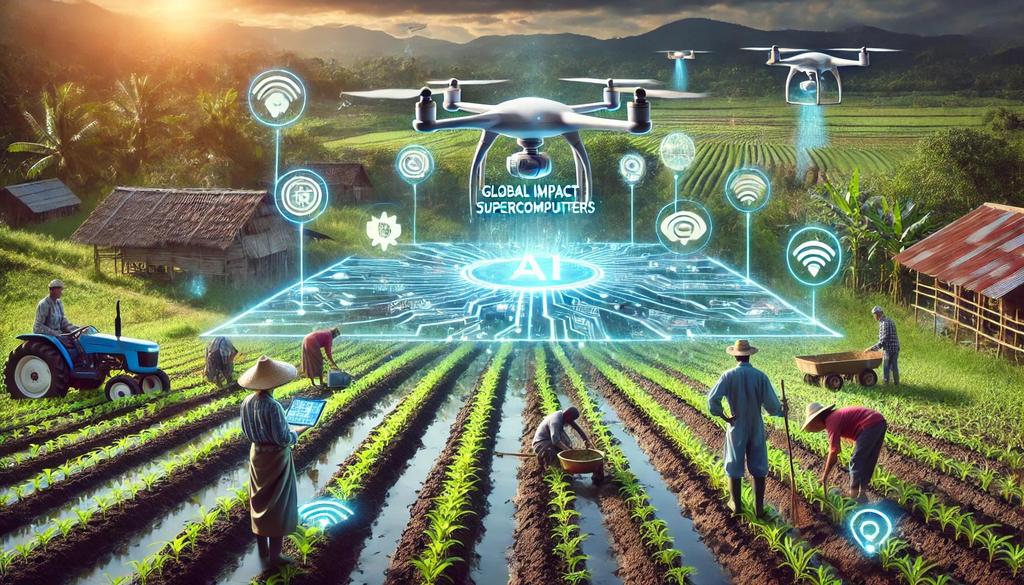
Global Impact of AI Supercomputers
Shaping the Future with AI: Impact on Societies and Industries
The ripple effects of AI supercomputers extend far beyond the walls of tech companies, potentially revolutionizing entire industries and reshaping societal structures. Mark Zuckerberg’s Meta and Elon Musk’s xAI ventures exemplify how leveraging NVIDIA’s cutting-edge technology could address some of the world’s most formidable challenges.
Revolutionizing Healthcare and Personalized Medicine
Let’s start with an area that touches everyone: healthcare. AI supercomputers like Meta’s AI Research SuperCluster promise to dramatically accelerate the development of personalized medicine. By expertly analyzing vast datasets, these powerhouses can refine diagnostic processes and tailor treatments to individual patient profiles, effectively predicting outcomes and honing preventive strategies. Imagine a world where diseases like cancer are caught early, thanks to AI predicting changes in your health before symptoms occur.
Transforming Global Industries
Beyond healthcare, industries across the globe—from finance and transportation to renewable energy—are poised for transformation. AI supercomputers assess, predict, and optimize complex processes in a way human analysts never could. In finance, AI models can sift through global markets data to forecast trends, minimizing risks and maximizing profits with immense precision. Transportation networks may become safer and more efficient, thanks to AI managing traffic flows and autonomous vehicles. Meanwhile, in the energy sector, AI can optimize grid systems, integrating sustainable energy sources like wind and solar in real-time, thus reducing reliance on non-renewable sources.
Denmark’s Gefion supercomputer illustrates how national infrastructures might evolve, employing AI capabilities to streamline processes in quantum computing, biotechnology, and beyond. Positioned as a beacon of sovereign AI, Gefion represents Denmark’s commitment to independent technological advancement, serving as a model for other nations looking to harness AI for societal betterment.

Quantum Computing Synergy
As advancements in AI supercomputing continue, the intersection with hybrid quantum computing presents a frontier ripe with possibilities. The integration of quantum computing algorithms could amplify AI’s potential, allowing solutions to previously insurmountable problems across various fields.
Amplifying AI with Quantum Power
Hybrid quantum computing introduces a fundamentally different way of processing data, using quantum bits or qubits. These qubits can exist in multiple states at once, simultaneously juggling complex calculations. When combined with traditional AI, these capabilities become transformative—imagine instantaneously modeling climate forecasts or executing highly secure financial transactions. As companies like NVIDIA venture into quantum territory with innovations like Quantum-2 InfiniBand, the result could be AI systems optimized beyond current technological limits.
Countries like China and companies like Google are pushing these boundaries further. For instance, China’s Xiaohong quantum chip showcases considerable advancements, offering international researchers access via a cloud platform. This initiative highlights the collaborative, borderless potential of quantum-enhanced AI, opening doors across disciplines from cryptography to drug discovery.
Ethical Considerations and Global Collaboration
However, these advancements are not without challenges. The potential of AI, intertwined with quantum computing, raises substantial ethical and security concerns. As these technologies advance, the implications for data privacy, equitable access, and even geopolitical dynamics intensify.
To ensure beneficial outcomes, collaboration among international stakeholders—including governments, private companies, and educational institutions—is vital. This collaboration not only accelerates innovation but also facilitates the creation of robust regulatory frameworks, ensuring that these powerful technologies serve humanity inclusively and responsibly.
As we stand on the brink of an AI-powered future, AI supercomputers developed by leaders like Zuckerberg and Musk demonstrate profound potential to redefine societal and industrial norms. The integration of quantum computing further expands these possibilities, heralding an era where computing power might literally reshape the world. By navigating these developments collaboratively and ethically, we secure a future where technology serves not just innovation but the broader tapestry of human advancement.

Challenges in a World Full of AI Supercomputing
Navigating the Challenges: Ethical and Technical Considerations
As the world stands on the cusp of an AI revolution fueled by supercomputers, it’s critical to address the accompanying challenges—both ethical and technical—that shape their development and deployment. While AI’s potential is vast, ensuring its benefits are universally accessible and ethically governed is equally paramount.
Ethical Implications of AI Prowess
With great power comes great responsibility, a notion highly applicable to AI technologies like those developed by Meta and xAI Colossus. As AI systems become more integrated into daily life, we must consider their implications on privacy, security, and societal equity. Who gets access to this powerful technology, and under what terms? There’s a significant risk that these breakthroughs could exacerbate existing inequalities if not managed inclusively.
Moreover, the massive datasets driving AI models often include personal information, raising concerns about data protection and user privacy. Ensuring that AI respects these boundaries is essential to build trust and prevent misuse. Companies like NVIDIA are leading the charge by incorporating secure computing solutions into their chips, like Blackwell’s confidential computing feature, which protects sensitive data from unauthorized access.
Technical Hurdles: Scalability and Energy Consumption
From a technical standpoint, scalability remains a central challenge. Building supercomputers like Meta’s RSC involves more than merely assembling powerful GPUs; it’s also about networking them to work seamlessly in tandem. Handling this efficiently requires sophisticated algorithms and architecture designs like NVIDIA’s Spectrum-X and Quantum-2 InfiniBand, which ensure data flows smoothly among thousands of interconnected parts.
But perhaps the most pressing challenge in this era of mega-computing is energy consumption. Supercomputers demand significant amounts of power, raising environmental concerns. As these systems grow, their carbon footprint could become substantial. Initiatives like liquid cooling, as used by xAI with Tesla Megapacks to stabilize power fluctuations, show the industry’s effort to promote sustainability and energy efficiency.
By pursuing greener technologies and fostering collaborations aimed at minimizing ecological impact, companies can balance innovation with environmental responsibility—a critical consideration as both industrial demand for AI and global consciousness of sustainable practices continue to rise.

The Pioneering Impact of Zuckerberg and Musk’s AI Supercomputers with NVIDIA Technology
In the rapidly evolving arena of AI supercomputers, the work of Mark Zuckerberg and Elon Musk represents a bold leap into an era where technology could redefine the very fabric of our societies. At the heart of this revolution lies the integration of NVIDIA’s groundbreaking GPU technology, alongside cutting-edge networking and data management systems that power machines capable of addressing issues from healthcare inefficiencies to climate change.
These technological titans are setting the stage for a future where machines not only assist humans but also enhance our capacity to solve complex, real-world problems. The global implications, spanning sectors from medicine to transport and beyond, showcase the ability of AI to bring about unprecedented advancements.
Yet, as we thrust forward, the journey is fraught with challenges. Ethical considerations around data use and accessibility must be addressed to ensure that everyone benefits from these technological leaps. Furthermore, technical hurdles, particularly around energy use and system scalability, require innovative solutions to keep pace with the demands of an AI-powered world.
In conclusion, the AI supercomputers born from the visions of leaders like Zuckerberg and Musk encapsulate both the potential and responsibility of modern technological advancement. They are more than tools—they are partners in the journey to a more automated, yet integrated, future. By embracing these innovations with a thoughtful approach to their ethical and environmental impacts, we can unlock a future rich in opportunity, where technology and humanity evolve together in harmony. As we stand at this cusp of technological evolution, the possibilities are as boundless as our collective imagination.


