
Africa is racing to deploy utility-scale solar and wind at an unprecedented speed. Based on recent analysis, nearly two-thirds of the continent’s prospective renewable energy pipeline is currently earmarked to power green hydrogen exports rather than strengthening local power grids. This pivotal moment is a critical intersection point.
Projects driven by external demand have the potential to either serve as a powerful financial engine for a just energy transition at home or risk diverting essential clean power away from communities that still lack basic electricity access. Mali offers the counter-example at the smallest scale: a natural hydrogen field at Bourakébougou that has powered a local village for years without any export infrastructure. To navigate this complex landscape, a clear-eyed review of three defining forces is necessary.
We must consider the immense, untapped renewable energy potential across the continent, the powerful market signals that are pulling investment toward global hydrogen exports, and the persistent energy justice gap that affects hundreds of millions of people. By connecting these realities, this article provides practical, actionable solutions aimed at ensuring green hydrogen works symbiotically for African citizens and international buyers alike.
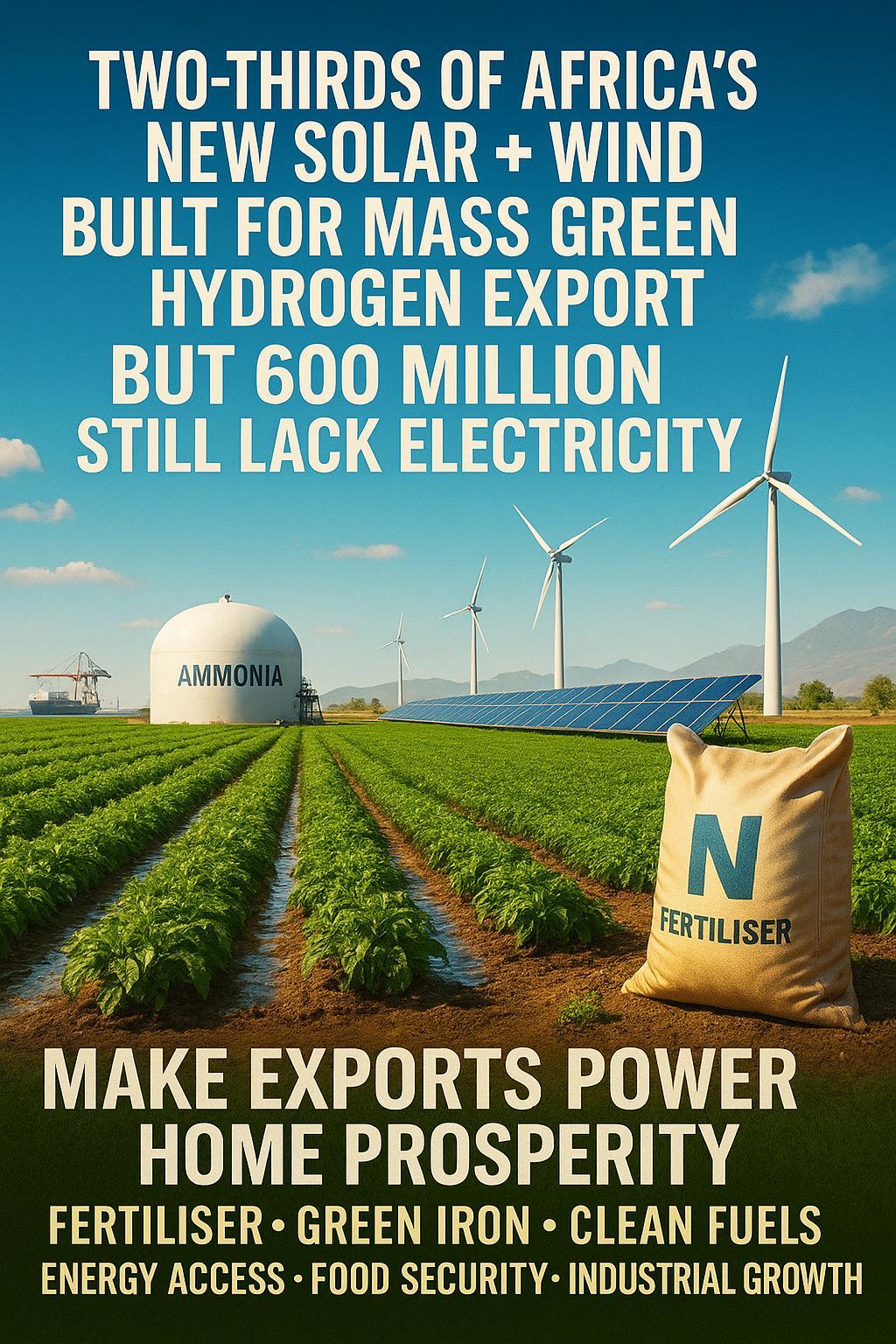
Africa’s Green Hydrogen and Renewable Energy Investment at a Glance
- About 61% of Africa’s prospective utility-scale solar and wind is tied to green hydrogen projects.
- This figure is grounded in independent mapping and corroborating news analysis on African power potential.
- Over 600 million people in Africa still lack access to electricity, and clean-energy investment across the continent remains a minimal share of the global total.
- Market analysts are optimistic: several analyses project that Africa could capture a meaningful share of traded hydrogen by 2050, requiring hundreds of billions in cumulative investment if policy and finance align.
- Water will matter where hydrogen scales: Electrolysis requires about 9 litres of deionised water per kilogram in theory and roughly 10–20 litres per kilogram in practice once treatment and cooling are included.
- Morocco is a bellwether for water-energy planning: Policymakers are pairing renewable power with large desalination programmes while scoping hydrogen and ammonia export infrastructure.
Africa’s Renewable Energy Moment: Huge Potential, Uneven Reality
Solar and Wind Riches Versus What Is Actually Installed
Africa enjoys some of the planet’s strongest solar resources and excellent wind corridors, yet installed clean power lags significantly behind its potential. The expanding utility-scale renewables, driven by the maturing global green hydrogen supply chain, directly inform the growing export debate.
Why this Gap Matters for Everyday Life
Households rely on diesel, kerosene, and unreliable grids when large projects fail to connect with local demand. Successful early wind farms in Africa show how grid-connected renewables can deliver dependable power in countries such as Kenya and Senegal.
What Investment Numbers Say
Global clean-energy finance provides the continent only a small slice, a reality tied to higher borrowing costs and grid bottlenecks. Although investment is beginning to shift, progress remains uneven across markets.
A Note on Health and Air-Quality Gains
Shifting from coal and diesel to renewables delivers immediate health gains, with evidence that thousands of lives could be saved if Africa switches to renewables. Capital allocation decisions must consider these benefits alongside climate outcomes.

Export Pull: Why Green Hydrogen Developers Love African Sun and Wind
Europe and Asia’s Demand Creates Powerful Market Signals
Countries with limited land and weaker solar resources plan to import green molecules at scale.
This demand largely explains why so much of Africa’s prospective renewables pipeline is coupled to hydrogen and ammonia production for export.
Green Hydrogen Projections and Policy Alignment
The Hydrogen Council’s analysis summarises the perspective that Africa could capture a significant share of traded hydrogen by mid-century if financing and policy frameworks align.
From Pilots to Pipelines: Infrastructure Changes the Game
Dedicated infrastructure allows molecules to move like everyday commodities. For instance, dedicated hydrogen pipeline networks in China show how quickly scale follows when pipes connect producers and ports.
Key Flagship Projects in North and Southern Africa
Project maps shift quickly, but certain countries keep showing up: Mauritania, Namibia, and Morocco. Namibia in particular is a study in contrasts.
At one end, smaller projects like HyIron’s Oshivela green iron are already operating. At the other, the multi-billion-dollar Hyphen ammonia complex has faced market uncertainty and community pushback.
The contrast between the operating HyIron green iron project and the slow-moving Hyphen ammonia complex illustrates how siting, consent, and offtake shape timelines.
Energy Justice Gap: When Export Molecules Come Before Local Electrification
The Access Deficit: Scale of Electrification Poverty
The lack of electricity for nearly 600 million people on the continent reframes the export conversation. A current baseline helps policymakers design projects that expand access, stabilise grids, and reduce energy poverty.
Geographical Disparity in Power Development
Hydrogen hubs are usually sited near good ports and wind-solar resources, not in the places where access gaps are deepest. The coastal site selection makes it essential to plan transmission upgrades, mini-grids, and productive-use programmes alongside export projects. Corridor planning in South Africa uses off-grid solar highway nodes along trade routes to serve logistics and nearby communities.
What Just Designs Look Like in Practice
Achieving shared benefits requires a combined strategy. Governments can require domestic offtake or capacity reservation, insist that hydrogen developers co-finance grid extensions, and mandate transparent water plans that prioritise towns and ecosystems first. Governments can also require revenue-sharing through well-designed approvals that fund local mini-grids and productive-use programmes such as cold chains and clinics.
Measuring Local Benefits: Health, Jobs, and Industry Growth
A fair design must channel benefits where people live. Success should be measured not only by export volumes but also by the following local metrics:
- Lower household energy costs and cleaner air.
- Growth of local green industries such as fertiliser, green iron and steel, and e-fuels for shipping.
Focusing on these elements ensures that prosperity is rooted in the communities where the resources originate.

Water, Land, and Communities: Can Export Hydrogen Help Electrify Africa Instead of Draining It?
Electrolysis Water Consumption and Siting Variables
Electrolysers split water into hydrogen and oxygen. The chemistry requires about nine litres of deionised water for every kilogram of hydrogen. Real projects usually need more once treatment and cooling are included, which is why planners cite a practical range near ten to twenty litres per kilogram.
RMI provides a clear arithmetic primer on green hydrogen water consumption. The key finding is simple: national totals look modest next to farming or fossil fuels, yet siting matters in dry coastal basins where local supplies are already strained.
Desalination, Brine, and Shared Benefits
Where freshwater is scarce, developers pair electrolysis with seawater desalination powered by renewables. The approach avoids drawing down aquifers, although it creates brine that must be managed with care.
Morocco offers a useful test case as officials plan to cover a majority of drinking water with renewable desalination by 2030, while also exploring hydrogen and ammonia export infrastructure at Tantan. This ambitious programme is described in plans to supply 60% of drinking water from renewable-powered desalination.
Well-designed projects can share intake and outfall infrastructure, route a portion of desalinated water to nearby towns, and publish transparent brine-discharge monitoring.
Prioritising Consent: Land Rights and Biodiversity Protection
Large hydrogen complexes bundle wind and solar fields, electrolysis halls, desal plants, pipelines, and export terminals. Extensive project footprints often overlap protected habitats and Indigenous territories if siting is driven only by wind and solar strength.
Namibia’s Hyphen proposal triggered a landmark rights discussion because it overlaps Nama ancestral land inside a national park. Court decisions and community claims are outlined, with legal findings on Nama land rights underscoring the necessity of robust consent.
The necessary policy response is to make Free, Prior, and Informed Consent a hard precondition and to publish biodiversity screening before permits are issued.
Design Levers Tie Exports to Energy Access
Structuring deals to share assets and value allows exporting hydrogen to help electrify Africa. Governments can reserve a share of project power or output for domestic use and require grid co-investment that extends transmission beyond ports. They can also mandate revenue-sharing that funds local mini-grids and productive-use programmes such as cold chains and clinics.
Developers can solidify local commitment by taking specific actions:
- Commit to public water budgets and open procurement to local firms.
- Build on-site demand for things like fertiliser and green iron that keep value and skills onshore.
Smaller modular concepts show how on-site ammonia can anchor local agriculture, illustrated by a farm-scale cotton project that produces hydrogen and fertiliser.

Energy Case Snapshots: Namibia, Mauritania, Morocco, and Beyond
Namibia: From Green Iron to Mega-Ammonia
What is Operating Today
HyIron’s Oshivela project in Namibia produces green iron using renewable power and electrolytic hydrogen. The Oshivela project shows how smaller, modular plants can start creating industrial value before export megaprojects reach final investment decisions. The contrast with large ammonia plants illustrates why phasing and right-sizing matter for skills and grid learning.
Social Licence and Market Risk
The much larger Hyphen project has moved more slowly. Protests over Indigenous rights increased scrutiny of permitting, and a non-binding offtake understanding with RWE did not hold as market expectations shifted. Timelines shifted after RWE withdrew from an offtake understanding, illustrating how changing demand signals in Europe directly impact African project pipelines.
Mauritania: Mega-Scale Potential in a Weak Grid
Mauritania’s Atlantic winds and solar resource attracted some of the world’s most ambitious hydrogen proposals. The projects target exports to Europe, yet the national grid is small and fragmented. The scale mismatch underscores the need for domestic offtake rules and shared transmission that connects coastal hubs to interior demand.
Morocco: Renewables, Desalination, and Export Ports
Morocco already operates large solar and wind plants, and it is expanding desalination powered by renewables. The country is studying port options for ammonia and hydrogen, actively considering Tantan as a candidate port. The combination of renewables, desalination, and export ports points to a multi-sector plan in which water security, grid stability, and export capacity grow together. Policy context reflects Morocco’s renewable energy targets, which have supported parallel growth in desalination and export planning.
Regional Overview: Egypt, South Africa, and West Africa
Egypt’s Suez Canal Economic Zone has attracted green ammonia proposals tied to shipping, while South Africa explores hydrogen for domestic industry and heavy transport. West African states consider export options alongside mini-grids and solar corridors that serve rural communities. Projects that connect to local industry and access goals prove more resilient when global demand shifts.

What to Watch for African Hydrogen Between 2026 And 2035
Signals to Track
Policy and Offtake in Europe and Asia
Policy and market signals will shape whether buyers sign binding contracts, including import rules, carbon pricing, and subsidies. Recent European policy signals demonstrate how demand can be unlocked through coordinated programmes.
Cost Of Capital and De-Risking
Financing conditions remain the largest driver of delivered hydrogen prices in developing markets. The higher weighted average cost of capital raises levelised costs, making blended finance and guarantees pivotal. Context on capital pathways is essential to understanding the scale of investment needed.
Grid and Interconnector Build-Out
Transmission infrastructure must serve both ports and people for new renewable clusters. Investment trends highlight how grid upgrades and demand growth reinforce each other.
Desalination and Water Governance
Decisions by North African policymakers on desal design, brine permits, and water sharing will set norms for coastal hydrogen hubs. Innovations in solar desalination technology will also shape what sustainable intakes and outfalls look like.
Implementation Roadmap: Aligning Hydrogen with Africa’s Future
Policymakers must reserve domestic offtake, require grid co-investment, and standardise Free, Prior, and Informed Consent. They must also codify indigenous water protections, publish water allocation rules that prioritise households and ecosystems, and ensure permits are tied to community benefit plans that include training, local procurement, and mini-grid funds.
To ensure local value, Developers and Investors should:
- Phase projects so that early modules anchor local industry.
- Disclose water and land plans.
- Create on-site demand, such as fertiliser or green iron, that keeps value onshore.
- Share transmission and desal assets with nearby communities where safe and feasible.
International Partners can provide strategic support by focusing on the following:
- Targeting concessional capital and guarantees to projects that prove co-benefits for access and industry, not just export volumes.
- Supporting African regulators with technical assistance for hydrogen standards, brine management, and FPIC implementation.

Securing Africa’s Energy Future: A Concluding Analysis of Green Hydrogen’s Dual Path
The current momentum surrounding Africa’s green hydrogen economy represents a profound economic opportunity, yet its ultimate impact is far from guaranteed. If these massive export initiatives are strategically designed as genuinely shared infrastructure for power, water, and domestic industry, they possess the capacity to significantly accelerate electrification and cultivate sustainable, local skillsets. This requires proactive planning that treats African energy access not as a secondary consideration but as a central design mandate for every single project.
Conversely, failure to prioritise local needs risks exacerbating the divide between world-class energy resources and the daily reality of energy poverty for over 600 million people. The choices made by policymakers and developers in the immediate future will fundamentally determine whether new renewables primarily result in shiploads of energy molecules passing by communities or become the foundational backbone of a fair, equitable energy system. Smart project design is the lever that ensures this hydrogen boom powers prosperity, lights homes, lowers bills, and drives local industrial growth across Africa.
Essential Questions: Key Facts and FAQs on Africa’s Hydrogen Export Boom
What Percentage of Africa’s New Renewables Targets Export?
Independent mapping indicates that roughly two-thirds (61%) of all prospective utility-scale solar and wind are currently slated to supply green hydrogen projects primarily orientated toward export.
Can Green Hydrogen Projects Resolve Africa’s Energy Access Deficit?
Yes, but only if they are structured to reserve domestic power capacity, co-finance local grid extensions, and share vital infrastructure with nearby towns as a permit condition.
Is Water Consumption in Electrolysis Sustainable in Arid Regions?
It can be, provided developers pair the process with renewable-powered seawater desalination, publish transparent water allocation plans, and prioritise local household and ecosystem needs first.
Which Three African Countries Lead the Flagship Project Race?
Mauritania, Namibia, and Morocco are the most cited flagship countries due to exceptional wind/solar resources and proactive government planning focused on export terminal and desalination infrastructure.
What Economic Benefits Should Projects Deliver Locally?
Benefits should be measured by lower household energy costs, cleaner air, and the establishment of local green industries, such as green iron and fertiliser production.


