
The next critical minerals shock will not look like the last one.
Future conversations surrounding the 2035 horizon will no longer revolve solely around how much lithium, copper, cobalt, or nickel the world can mine. It will center on which battery chemistries scale, which supply chains can prove compliance in near real time, and which grid systems can absorb renewable variability without defaulting to gas peaker plants.
Market stakes appear increasingly sharp because current projections for IEA scenario estimates of 2035 project pipeline shortfalls for copper and lithium suggest that announced copper and lithium ventures may not keep pace with demand under existing policy settings.
Simultaneously, alternative minerals have shifted in opposing directions in recent years. Surplus conditions can show up quickly, especially when supply ramps faster than demand or when chemistries shift. This is why the 2035 “supercycle” is not one curve. It is a shifting scoreboard.
A city energy planner in California described the transition in practical terms during a public reliability meeting. Ten years ago, storage mostly meant four-hour batteries to shave evening peaks. Today, the question being asked is how to keep hospitals, transit systems, and cooling centers powered through multi-day heat waves.
What changes the story this time is a new layer of infrastructure. Digital product records, satellite-based monitoring, and long-duration storage cost targets are turning traceability and resilience into competitive advantages. The mineral market is being reshaped not only by geology but also by chemistry and verification.
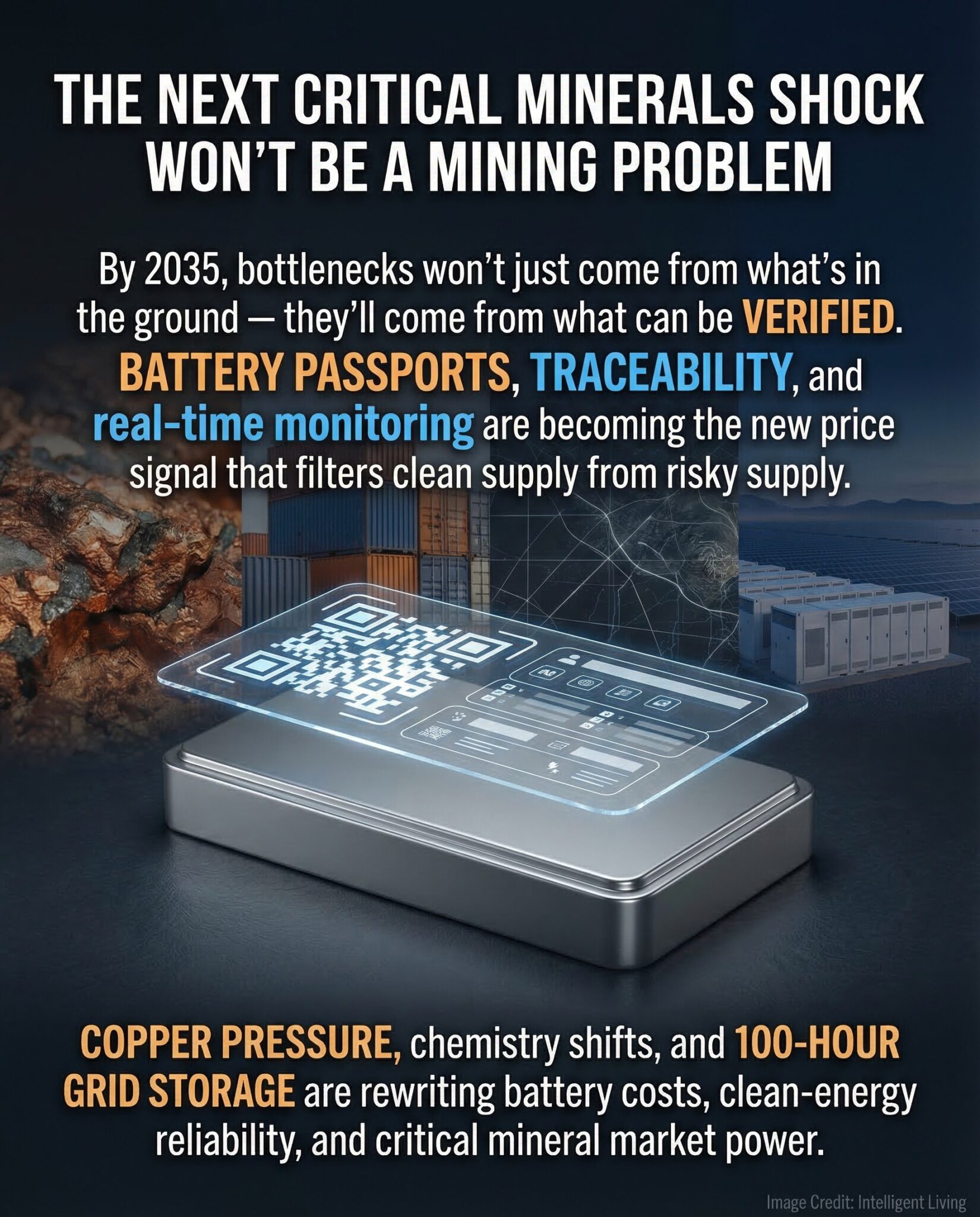
Electrification Pathways: The 2035 Critical Minerals Scoreboard and Market Signals
Critical Minerals 2035 Quick Facts: Copper Bottlenecks, Battery Chemistry Shifts, And Grid Storage Signals
- Look at the U.S. grid for a living proof case of industrial scale, where California’s 16,942 megawatts of battery storage has successfully transitioned from a pilot concept into a fundamental pillar of daily grid reliability.
- Long-duration targets now have a concrete number attached to them, as federal initiatives aim for a DOE Long Duration Storage Shot cost target of five cents per kilowatt-hour to push storage into hours-to-days use cases.
- Battery passports are moving from concept to field pilots, utilizing battery passport MVP pilot datasets that push reporting toward comparable and verifiable supply-chain data fields.
- Due diligence systems are becoming operational policy as new European battery regulations take effect, though implementation timelines reflect the reality that audit capacity takes time to build.
The 2035 Scoreboard: Which Minerals Tighten, Which Glut, Which Stay Volatile
Copper and Lithium: The Structural Pressure Points
Copper serves as the fundamental requirement for virtually all electrification pathways. Electric vehicles require more copper than internal combustion vehicles, and transmission buildouts can multiply demand again. Lithium remains central for most mainstream batteries, even as alternatives expand.
Functionally, extended lead times and deteriorating ore grades render new copper production sluggish and capital-intensive, while lithium projects can be highly sensitive to price swings and permitting timelines. The risk is not only scarcity but also whiplash; recent declines in mineral pricing illustrate how fast markets can swing when supply temporarily outruns demand, potentially freezing the next investment wave.
Nickel and Cobalt: Surplus Conditions, then Strategic Constraints
Not all minerals are tight at the same time. Some markets have experienced surplus conditions in recent years, driven by rapid new supply. Others become strategically sensitive because supply is concentrated.
A procurement director at a mid-sized manufacturer described the planning problem in the way many executives now search for it: “Which battery metals are oversupplied right now, and which ones can turn scarce quickly?”
This specific inquiry focuses less on an individual metal and more on the agility of battery manufacturers to substitute chemistries in response to market shifts.
A stable baseline for these moving targets can be found in USGS Mineral Commodity Summaries 2026, which tracks market shifts across key battery materials.
Graphite and Processing Bottlenecks
Graphite is critical for anodes in most lithium-ion batteries, and processing capacity can be more constrained than raw mining output. A supply chain manager once put the practical challenge into everyday terms: “battery-grade graphite is not the same thing as graphite in the ground.”
This distinction is vital because the true barrier lies in the specialized refinement, high-purity processing, and strategic location of conversion capacity required for battery-grade output.

Scaling Grid Resilience: Battery Chemistry Shifts and Storage Pathways for 2035
Beyond Lithium: The Battery Innovations that Actually Matter for 2035
Sodium-Ion: Abundance with Tradeoffs
Salt-based chemistries are moving out of the lab and into commercialization milestones, including the launch of sodium-ion battery platforms designed to reduce reliance on constrained battery metals in specific vehicle segments. Sodium is abundant, and its supply chains lack the geopolitical constraints often associated with lithium; however, sodium-ion technology typically exchanges energy density for lower cost and increased accessibility.
Common voice-search queries often reflect a central curiosity: ‘Do sodium-ion batteries get rid of lithium?’ The practical answer is that sodium-ion can reduce pressure in certain segments, especially stationary storage and lower-cost vehicles, without replacing lithium everywhere. For a full breakdown of how the chemistry works and the 2026 commercial breakthroughs, see our sodium-ion battery technology guide.
Solid-State: Timeline Signals and Manufacturing Risk
Solid-state batteries promise higher energy density and improved safety by replacing liquid electrolytes with solid materials. The public conversation often treats the phrase “solid-state” as a finish line. The more useful approach is to watch validation, yield, and scale indicators.
Industrial validation timelines for solid-state systems now increasingly hinge on manufacturing precision as targets tighten, specifically whether factories can deliver millions of consistent electrolyte layers and long cycle life at volume. For a family considering an EV purchase later this decade, the decisive factor isn’t the conceptual existence of solid-state technology; it is whether manufacturing lines can churn out millions of high-yield, cost-competitive cells that perform reliably on the road.
Lithium-Sulfur and The Mineral Substitution Bet
Lithium-sulfur pathways frequently face positioning as a primary replacement for conventional cathode metals, yet the technology must first overcome significant industrial barriers. These hurdles directly impact the 2035 adoption curve:
- Cycle Life Limitations: Improving the number of charge-discharge cycles before performance degrades.
- Manufacturability: Scaling production processes from laboratory environments to gigafactories.
- Cost Efficiency: Reducing the price per kilowatt-hour to compete with established lithium-ion benchmarks.
Overcoming these obstacles will determine if lithium-sulfur can transition from a niche solution to a primary driver of mineral substitution.
One real-world signal is that high-specific-energy lithium-sulfur prototypes have already been pursued for specialized applications, proving that chemistry shifts can start in niches before scaling. If lithium-sulfur scales meaningfully, demand curves for some constrained minerals could soften. If it does not, the mineral scoreboard stays closer to today’s pattern.

Iron-Air, Sodium, and Flow: How Grid Batteries Redraw The Storage Map
The Long-Duration Storage Target that Changes Economics
The long-duration storage story is not only about technology; it is about economics. The primary objective involves reducing storage costs sufficiently to mitigate prolonged renewable intermittency rather than merely addressing short-duration peaks. When that happens, storage starts to compete with fossil backup in a way that changes utility planning.
An LDES Council 2024 annual report on long-duration storage scale-up frames these systems as a necessity with system-level consequences rather than a boutique technology category. Alongside grid economics, modeled public benefits such as improved energy equity and air-quality impacts when storage replaces peaker plants when storage replaces fossil-fuel peaker plants in high-burden neighborhoods also matter.
A utility planner in the Midwest described the goal in simple terms during a community forum: “reliability for days, not hours.” That shift is what makes the mineral footprint of grid storage a separate story from EV batteries.
Cost Targets, LCOS, and What Utilities Compare
A practical way to evaluate progress is to track levelized cost of storage, contract structures, and delivered duration in operating projects, not just lab benchmarks.
Why Duration Changes Fossil Backup Planning
When long-duration storage effectively bridges extended renewable intermittency, it fundamentally alters the requirement for ‘always-on’ fossil-fuel capacity and directly reduces the pollution burden on communities situated near peak-hour peaker plants.
Iron-Air and 100-Hour Systems
Iron-air batteries operate by utilizing a reversible rusting reaction where discharging involves iron reacting with oxygen to produce electricity, while charging applies an electrical current to reverse the oxidation process.
This oxidation mechanism is why reversible rusting iron-air batteries for multi-day storage are increasingly viewed as the primary solution for 100-hour storage needs. The design goal is not compactness. It is endurance.
Flow Batteries and Mineral Tradeoffs
As vanadium redox flow batteries emerge as a leading technology class, the USGS 2026 vanadium tables relevant to vanadium redox flow batteries serve as an essential tool for identifying where new supply chain constraints might emerge.
Other long-duration pathways emphasize safety and low-cost materials, including zinc-air hybrid flow batteries designed for multi-day storage that separate energy capacity from power hardware.
Another grid-adjacent pathway is thermal storage, where the “battery” stores heat rather than electrons. In district heating contexts, the adoption of sand-based thermal storage used for district heating demonstrates how long-duration systems can decouple power from heating demand without battery-metal bottlenecks.
Mechanical storage still matters at the largest scales, including pumped-hydro “water battery” plants that stabilize grids that stabilize international grids when geography and reservoirs make it viable.
While other systems utilize phase changes, such as large-scale cryobatteries that rely on air liquefaction and regasification for energy storage.
Zinc-Air and Hybrid Designs that Decouple Energy Capacity
These systems matter because they can scale energy capacity with low-cost materials while keeping power hardware relatively stable.
Thermal and Mechanical Storage that Avoids Battery-Metal Bottlenecks
Heat-based and gravity-based storage can provide duration without relying on the same battery-metal supply chains that dominate EV manufacturing.
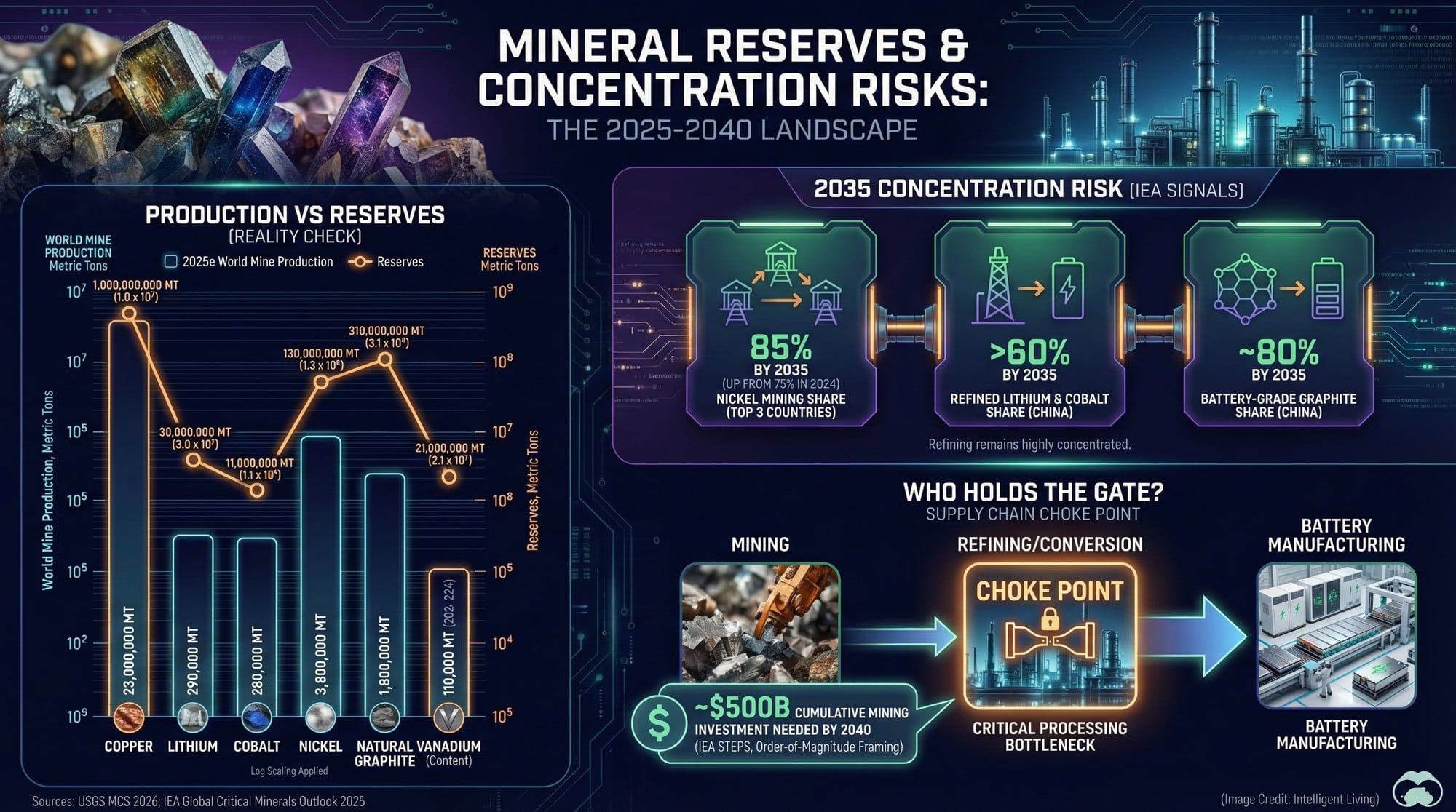
Strategic Leverage in 2035: Controlling Refinement Bottlenecks and Mineral Reserves
Mining Winners Versus Refining Winners
Mining output and refining capacity are not the same source of leverage. In many critical minerals, processing is concentrated in fewer places than extraction. Consequently, strategic dominance in 2035 will not necessarily reside with nations possessing the largest ore deposits but rather with those who control the industrial gatekeeping of refinement.
This shift in power is visible across key markets:
- Industrial Policy Impact: The expansion of Indonesian production demonstrates how targeted policy can reshape global pricing power in the nickel sector.
- Strategic Procurement: Clean energy investors now prioritize the control of battery-grade output over raw ore ownership.
Copper: A Systemic Constraint, Not Just Another Commodity
Copper is uniquely positioned because it is essential across EVs, grid expansion, data centers, and renewables. If copper tightens, electrification timelines can slow or costs can rise.
For a grounded snapshot of where supply is concentrated, USGS 2026 copper production and reserve tables provide a country-level baseline without hype.
Lithium: The Battery Metal that Still Anchors The Mainstream
Lithium has expanded rapidly, but investment cycles can still whipsaw supply responses. Under scenario modeling, lithium is a leading candidate for future supply tension.
A neutral way to track the fundamentals is through USGS 2026 lithium supply, price, and reserve tables, which can be revisited annually as production and reserves change.
Cobalt and Nickel: Concentration, Surplus, and Substitution
Cobalt supply remains highly concentrated, which creates geopolitical risk even when prices are low. Nickel dynamics are more complicated, with periods of surplus driven by fast new supply, especially when production ramps ahead of demand.
For the concentration baseline, USGS 2026 cobalt concentration data clarifies how dependent the market is on a small number of producing regions. For recent balance notes and supply growth signals, USGS 2026 nickel market balance notes help explain why surplus conditions can coexist with long-term strategic importance.
Graphite: The Quiet Bottleneck in Most Lithium-Ion Designs
Most lithium-ion batteries still rely on graphite anodes, which makes processing capacity a persistent leverage point.
Strategic planners often consult USGS 2026 graphite production and reserve data to compare raw mining output against actual conversion capacity.
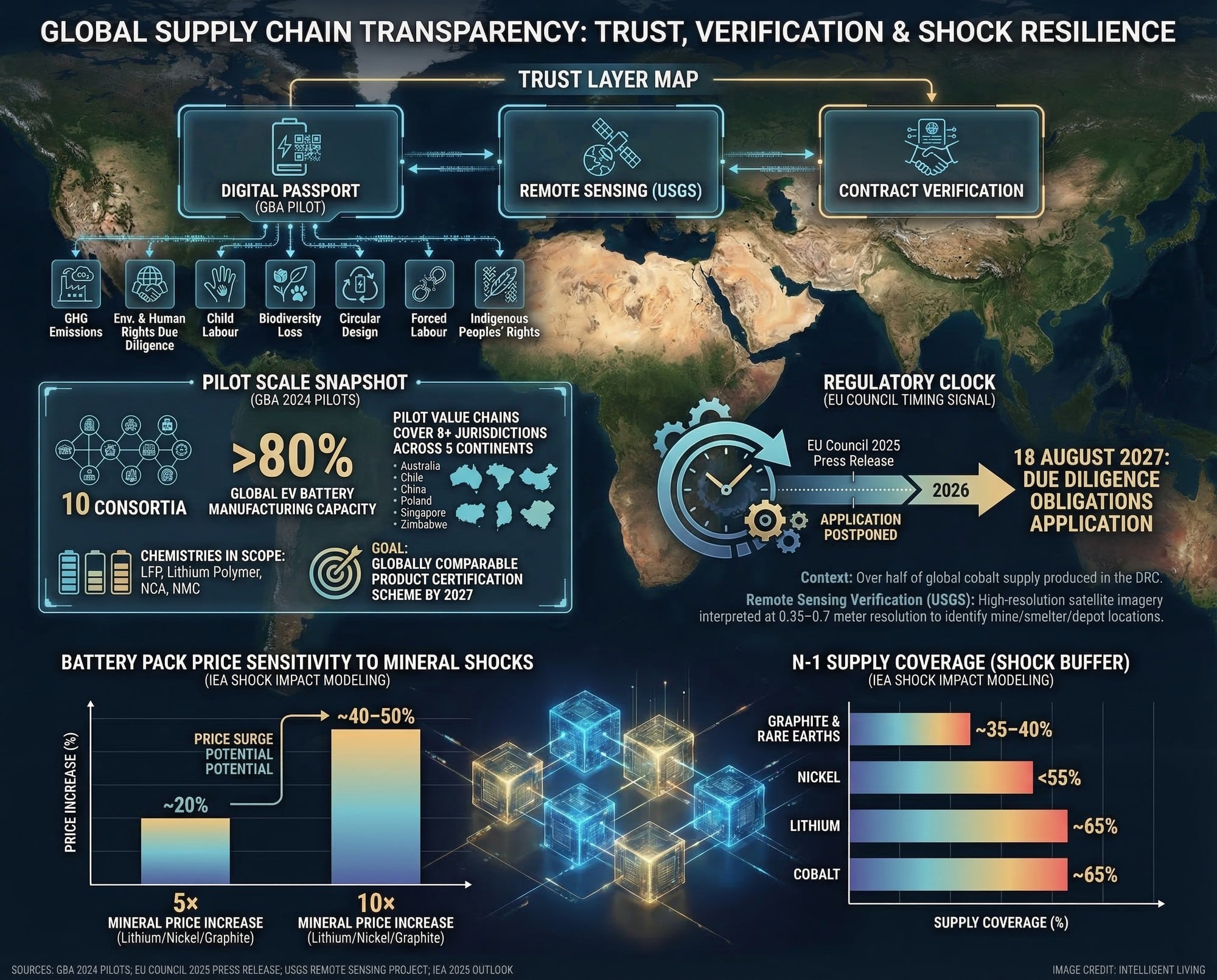
Supply Chain Transparency: Using Digital Passports to Mitigate Future Mineral Shocks
Battery Passports: The Data Layer that Changes Procurement
A battery passport is a standardized digital record that can attach key sustainability and compliance fields to a battery, including provenance, carbon footprint attributes, and due diligence artifacts. The reason this matters is simple. Markets price risk differently when buyers can verify origin and compliance systematically.
Current transparency efforts are highlighted by Global Battery Alliance’s 2024 battery passport pilot consortia, which focus on ensuring data comparability across global manufacturers.
Due Diligence: Rules are Real, Timelines are Practical
Since compliance systems rely entirely on the availability of robust audit capacity, these implementation windows serve as a practical safeguard for maturing verification ecosystems. A recent EU Council decision delaying battery due diligence obligations to August 18, 2027 signals that while standards are advancing, verification ecosystems require more time to mature.
For the broader framework that many companies use as a baseline, many companies now adopt the responsible conduct framework to identify and mitigate adverse impacts within their supply chains.
Remote Sensing: From Occasional Audits to Continuous Monitoring
Satellite monitoring and machine learning tools can reduce reliance on sporadic inspections by watching mining areas repeatedly over time. The key is resolution and systematic mapping, not marketing language.
While remote sensing is not an exhaustive solution, it fundamentally expands the boundaries of what can be verifiably audited at a global scale. Advanced monitoring is already in use, with sub-meter satellite mapping now being utilized to identify smelting sites and unauthorized cobalt depots in real time.
A second reason continuous monitoring matters is human impact, as studies on artisanal exposure risks reveal a direct link between mining conditions and regional health outcomes.
A procurement manager described the practical value in plain terms: ‘If a supplier says the material is clean, can it be checked without flying a team across the world?’
The 2035 Playbook: What to Watch (Signals, Not Predictions)
Forecasts can be useful, but the more actionable approach is to watch whether the real-world machinery of mining, manufacturing, and compliance is actually moving. The difference between a tight market and a stable one often shows up first in a small set of leading indicators.
Signal 1: Copper and Lithium Projects Crossing Real Milestones
Announced deposits rarely equate to immediate supply; consequently, deliverable copper and lithium only materialize once reserves are proven, feasibility is complete, financing closes, permits clear, and construction stays on schedule. Construction must stay on schedule, utilizing a standardized methodology for evaluating project readiness to distinguish between speculative announcements and deliverable metal. Stakeholders should monitor these specific indicators of progress:
- Final investment decisions supported by fully funded budgets.
- Environmental and operational permits that have successfully navigated the appeals process.
- Secured refining capacity designed to convert raw concentrate into battery-grade metal.
Tracking these milestones provides a realistic baseline for supply expectations rather than relying on speculative announcements.
Signal 2: Chemistry Adoption Showing Up in Procurement, Not Press Releases
Chemistry shifts matter when they show up in purchase orders and operating assets. For grid storage, watch whether delivered systems track toward the projected cost and performance trajectories established for long-duration technologies.
Strategic policy serves as a secondary driver for this adoption:
- Procurement Pull: phaseout of new combustion vehicle sales in major markets like California encourages earlier battery contracting.
- Reshaping Demand: These chemistry choices alter mineral requirements years before vehicles reach the showroom floor.
Signal 3: Concentration Risk Rising in The Parts of The Chain that Convert Material into Product
Most market shocks originate from bottlenecks in processing, refining, and export permissions rather than raw ore scarcity. When a limited number of suppliers controls a vital conversion step, it creates a systemic choke point. This concentration of leverage is precisely why IEA warnings about supply concentration and export controls remain as critical as raw mining output statistics.
Signal 4: Verification Becoming a Standard Line Item in Contracts
Traceability is increasingly becoming a core component of contract pricing. The primary signal to watch is whether origin documentation and carbon-accounting fields become default requirements. Furthermore, the industry must ensure that verification capacity grows rapidly enough to mitigate risk without creating unnecessary operational friction.
Building Structural Resilience: The 2035 Critical Minerals Roadmap
The path toward 2035 is not a straight line but a series of overlapping waves in chemistry and compliance. As we have seen, the ability to pivot between lithium-ion, sodium-ion, and iron-air systems creates a strategic buffer that price alone could never provide. This diversification ensures that a single bottleneck in copper or a sudden spike in lithium costs does not derail the broader electrification agenda. By embedding transparency directly into the hardware through battery passports, we are creating a market that values proven sustainability as much as raw output.
Try to imagine a grid that functions with the quiet reliability of a machine that never rests. This is the ultimate promise of the 2035 shift: a system where multi-day storage and real-time data layers turn the ‘critical’ in critical minerals into a manageable engineering challenge rather than a geopolitical threat. The resilience of our future energy systems will be measured by the strength of these shock absorbers—ensuring that the next energy shock remains a footnote rather than a crisis.
Critical Minerals and Battery Storage 2035: Common Questions
Which critical minerals are most likely to face shortages by 2035?
Copper and lithium remain the primary pressure points due to extended permitting timelines and a projected gap between announced mining projects and total global demand.
Why does the market whiplash between surplus and scarcity?
Volatility often occurs when high prices trigger rapid supply expansions that temporarily overshoot demand, leading to price collapses that freeze the investment needed for the next growth cycle.
Can sodium-ion batteries replace lithium-ion completely?
No, sodium-ion technology is designed to complement lithium-ion by serving stationary storage and low-cost vehicle segments, thereby reducing overall pressure on lithium supply chains.
How does 100-hour storage improve grid reliability?
By using low-cost materials like iron and air, long-duration systems can store energy for days, allowing the grid to bypass fossil-fuel backup during prolonged renewable lulls.
What role does a battery passport play in the energy transition?
It provides a digital proof-of-origin, tracking carbon footprints and labor compliance to ensure that the minerals powering the transition are sourced responsibly and transparently.


