
Susanne Hellmuth and Olaf Stemmann made a discovery in the regulatory mechanism of chromosome splitting that will be useful in future cancer research. They unearthed an unknown mechanism that regulates the activity of an enzyme called separase, also known as separin.
When a cell divides, the genetic information on the chromosomes must be distributed equally between the newly developing daughter cells and then split at precisely the right time, because otherwise, the cell dies or it turns cancerous. So, what regulates when all the genetic information has finished duplication and when it’s time for the cells to split? Separase dictates that but what governs the activity of the separase? The pair of researchers from the chair of genetics at the University of Bayreuth figured that out, and their fundamental findings have added a new aspect to the current understanding of chromosome inheritance.
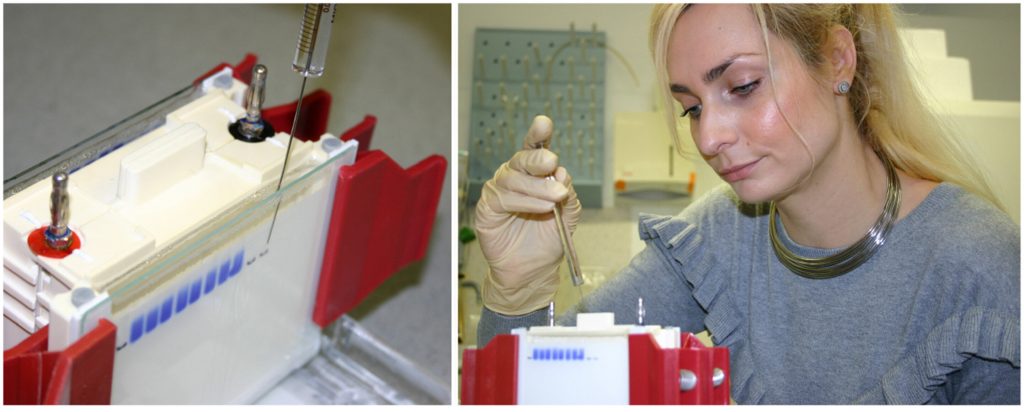
The process of cell division:
- Human growth and reproduction depend on healthy cell division.
- The process starts with the genes stored on the chromosomes being duplicated.
- Then, when each chromosome contains two identical threads of DNA – known as the sister chromatids – the division part of the process can begin.
- Up until this point, a ring consisting of several proteins called cohesin was holding the chromatids together, enclosing the chromosome throughout the duplication process.
- When it’s time to separate, separase comes in and cuts the cohesin, allowing the chromatids to migrate to the opposite poles of the spindle apparatus.
- At this point, the chromatids form the genetic basis of the forming daughter cells.

Separase must cut the cohesin at precisely the right time. If the enzyme becomes active too soon or too late, you can get genetic malfunctions. The new cells can develop into tumor cells or die. So, what regulates that?
Up until this research, it had only been known that a protein called securin suppresses the premature activity of separase. But now, Hellmuth and Stemmann, in cooperation with geneticists from the University of Salamanca/Spain discovered that there’s more to it than that. There’s a protein called shugoshin (Japanese for “guardian spirit”) that causes the separase to remain inactive until the right moment for the cohesin splitting. Meaning, the separase is not exclusively regulated by the securin, but by the shugoshin as well. Furthermore, if the securin fails or is not present, the separase can be activated by the shugoshin alone. The research has been published in Nature.

First author Susanne Hellmuth said:
We are dealing with a type of redundancy that is not at all uncommon in the cell cycle: In order for a vital process to proceed in a well-ordered manner, nature has safeguarded it by controlling it simultaneously in two or more different ways. This makes the process particularly robust, but also difficult to study, because individual disturbances have no visible effect.
In a follow-up study (soon to be published in Nature as well), Hellmuth and Stemmann made yet another discovery. The regulating influence of the securin and the shugoshin are controlled by the spindle assembly checkpoint (SAC). Therefore, the SAC has supremacy over all the processes involved in chromosome inheritance. SAC stabilizes the securin until it is time for it to allow the separase to split the cohesin. SAC also controls how the shugoshin suppresses the premature activation of the separase through the SAC component Mad2.
Stemmann said:
I was particularly pleased to hear a remark on our publication by one referee that the textbooks will now have to be rewritten. Our further research will show how our fundamental findings could also find their way into cancer therapy.
These discoveries will likely pave the way for life-saving cancer treatments.


