
Wearables in the future could be powered by human sweat. It’s a fascinating new field of research that has taken off in recent years.
Last year, engineers from the University of Glasgow reported developing a technology that allows wearable fitness trackers to be powered by sweat, with no batteries required. However, the person has to break a sweat for the device to start working, and it stops working when the person stops exercising.
Another pioneering team that has reported several advances over the years is a group of University of California (UC), San Diego engineers. Their most recent creation uses the surprisingly substantial sweat output of fingertips, generating electricity even when the user isn’t moving at all. The wearer could even be sleeping; thus, the device can potentially be a 24-hours source of power.
This UC team is the same one that last year demonstrated a shirt that generates electricity via movement and sweat, a wearable vitamin C sensor that works similarly to this new finger wrap, and a temporary tattoo that worked as a sweat-powered bio-battery in 2014.
Their new finger wrap is a thin, flexible strip worn on a fingertip. It generates small amounts of electricity, enough to power small electronics and sensors, via sweat or pressing pressure. The fact that the device works even if the person is sitting or asleep is a big deal. Until now, sweat-fueled machines required movement. Being hailed as the first-of-its-kind, this device could pave the way for many exciting possibilities in wearable electronics since it can act as a power source anytime, anywhere.
Co-first author Lu Yin, a UC nanoengineering Ph.D. student, said:
Unlike other sweat-powered wearables, this one requires no exercise, no physical input from the wearer to be useful. This work is a step forward to making wearables more practical, convenient, and accessible for everyday people.
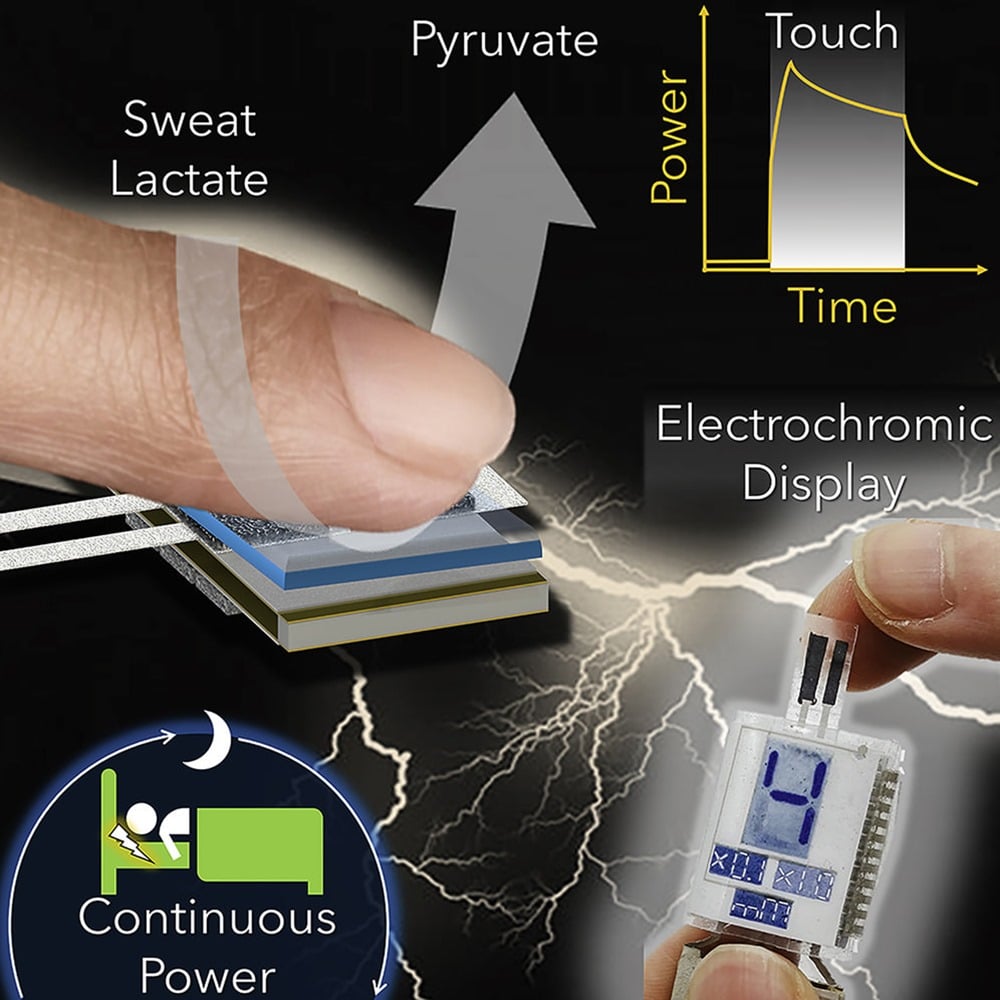
The device also generates additional power from light finger presses, like typing, for example.
Senior author Joseph Wang, a professor of nanoengineering at the UC, said:
We envision that this can be used in any daily activity involving touch, things that a person would normally do anyway while at work, at home, while watching TV or eating. So the goal is that this wearable will naturally work for you, and you don’t even have to think about it.
Most people don’t know this, but the fingertips are one of the sweatiest spots on the body. They are 24-hour factories of perspiration – each one packed with over a thousand sweat glands that can produce from 100 to 1,000 times more sweat than most other body areas.
Yin said:
The reason we feel sweatier on other parts of the body is that those spots are not well ventilated. By contrast, the fingertips are always exposed to air, so the sweat evaporates as it comes out. So rather than letting it evaporate, we use our device to collect this sweat, and it can generate a significant amount of energy.
How It Works
- The Band-Aid-like device consists of padding of carbon foam electrodes that absorb sweat and converts it into electrical energy.
- The electrodes contain enzymes that trigger chemical reactions between oxygen and lactate molecules in sweat to produce electricity.
- Beneath the electrodes lies a chip made of a piezoelectric material, which generates extra electrical energy when pressed.
- The electrical energy generated as the wearer sweats or presses on the strip gets stored in a small capacitor and is discharged to external devices when needed.
Testing
- The engineers had a participant wear the device on one fingertip while doing sedentary activities.
- The device collected nearly 400 millijoules of energy (enough to power an electronic wristwatch for 24 hours) from ten hours of sleep.
- The device collected nearly 30 millijoules from one hour of simple typing and mouse clicking.
- And strapping devices on all ten fingertips should generate ten times more energy, but they didn’t test that yet.

Wang said:
By using the sweat on the fingertip—which flows out naturally regardless of where you are or what you’re doing—this technology provides a net gain in energy with no effort from the user. This is what we call a maximum energy return on investment.
Yin said:
Compare this to a device that harvests energy as you exercise. When you are running, you are investing hundreds of joules of energy only for the device to generate millijoules of energy. In that case, your energy return on investment is meager. But with this device, your return is very high. When you are sleeping, you are putting in no work. Even with a single finger press, you are only investing about half a millijoule.
Our goal is to make this a practical device. We want to show that this is not just another cool thing that can generate a small amount of energy. Then that’s it—we can use the energy to power useful electronics such as sensors and displays.
The team is now working to improve the device and make it more efficient and durable. In addition, they hope to combine it with other energy harvesters to invent new types of self-powered wearable devices.
Another similar invention: University of Colorado Boulder researchers invented a ring-like, low-cost wearable apparatus that turns the body into a biological battery using its radiating heat.


