
In 2026, e-invoicing has evolved far beyond a mere compliance checkbox. While meeting local regulations remains the baseline, the focus for modern CFOs and IT leaders has turned toward capturing the broader operational dividends: end-to-end automation, real-time data integrity, and total AP/AR continuity. Finding the best e-invoicing providers is now a search for a strategic partner, one capable of turning mandatory digital reporting into a high-performance engine for the entire enterprise.
Companies that learn how to leverage technology for a competitive edge are better positioned to streamline their operations.
Continue reading to:
- Discover how to turn mandatory digital reporting into a high-performance automation engine.
- Identify the three non-negotiables for scalability and seamless ERP integration in 2026.
- Learn how enterprise-grade solutions bridge the gap between global consistency and local legal requirements.
What is e-Invoicing in Practice and Why Does it Matter for Business?
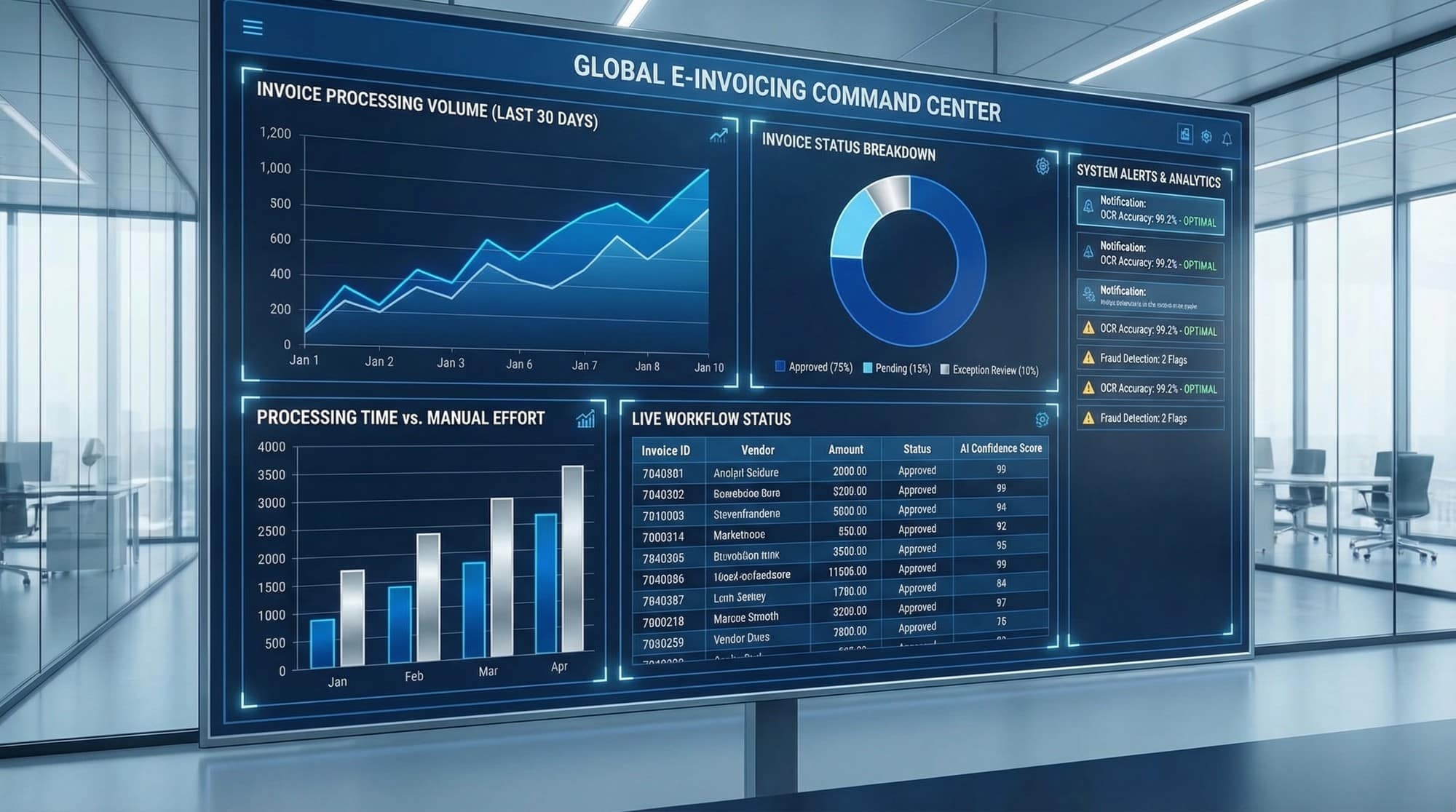
E-invoicing is not simply about sending invoices in PDF format. From an operational perspective, it refers to the structured exchange of invoice data between systems – compliant with local and international regulations, automated, and fully auditable.
For enterprises, this means:
- Consistent financial data across the entire organization
- Shorter cycles from invoice issuance to payment
- Reduced workload for finance teams
- Seamless integration with ERP systems, banking platforms, and data warehouses
E-invoicing also becomes the foundation for further automation, including tax reporting, compliance processes, and real-time cash flow analysis.
What Challenges Do Companies Face When Implementing e-Invoicing?
Regulatory Volatility
Mandatory e-invoicing is being introduced gradually across successive countries, often based on different models such as centralized government platforms, clearance systems, or post-transaction reporting. International companies must maintain compliance without duplicating systems.
This global shift toward digital reporting requires companies to stay agile as regulatory landscapes change.
Integration with Existing ERP and IT Architecture
E-invoicing must work seamlessly with ERP systems, accounting platforms, procurement workflows, and document archiving. A lack of flexible integration leads to manual workarounds and data inconsistencies, which is a major hurdle for large-scale operations.
Scalability and Invoice Volumes
Large organizations process hundreds of thousands or even millions of invoices annually. The solution must handle high volumes without performance degradation and securely store data for legally required retention periods.
Integration with Financial and Government Systems
Companies searching for mature solutions realize the real challenge is not just issuing an e-invoice but processing it correctly across different jurisdictions. Clearance models, real-time reporting, and integrations with government platforms require continuous system updates. Data exchange must be seamless, without replacing core systems or increasing the operational burden on internal teams.
How to Choose the Best e-Invoicing Provider in 2026
The best e-invoicing solutions are those that combine automation, global compliance, and data security within a single, coherent environment. In this context, Comarch e-Invoicing addresses the needs of international enterprises by offering centralized invoice management, integration with government platforms, and support for e-invoicing in more than 60 countries.
Comarch’s solution enables companies to standardize AP and AR processes globally while adapting to local legal and technical requirements, which is one of the key criteria when evaluating the best e-invoicing providers in the enterprise segment.
Selecting an e-Invoicing Platform for Long-Term Growth
For organizations operating across multiple countries, e-invoicing has become one of the foundations of operational stability and regulatory compliance. When assessing which e-invoicing providers can meet enterprise requirements, companies increasingly focus on the overall completeness of the solution rather than on individual features.
In this context, Comarch e-Invoicing stands as an example of a platform that combines automation, global compliance, and data security within a single, integrated environment, supporting companies in the long-term transformation of their financial processes.
FAQ
What is e-invoicing, and how does it differ from sending invoices as PDFs?
E-invoicing refers to the structured, system-to-system exchange of invoice data in standardized electronic formats, ensuring automation, auditability, and compliance with legal regulations. Unlike PDFs, e-invoices can be automatically validated, processed, and archived without manual intervention.
Why is global compliance a critical factor when selecting the best e-invoicing provider?
Regulatory requirements for electronic invoicing vary by country and change frequently. A globally compliant e-invoicing platform enables companies to manage invoices centrally while meeting local mandates, reducing legal risk and operational complexity.
Can one e-invoicing solution support both Accounts Payable and Accounts Receivable processes?
Yes. Modern enterprise e-invoicing platforms are designed to optimize both AP and AR processes within a single environment, improving data consistency, reducing processing costs, and increasing transparency across the entire invoicing lifecycle.

