
Some bacteria have naturally evolved the ability to eat plastic. In 2016, a plastic-eating bug was discovered by scientists at a Japanese waste site. A separate team of Portsmouth researchers then took the bug to their lab in the UK. They wanted to see if it could be used to enable the full recycling of bottles. By 2018, the team had an engineered version of an enzyme from the bacteria that could break down plastic in a few days. That was much too slow to be commercially applicable.
But the scientists at the University of Portsmouth, working with four US institutions, felt there was something there. They continued the work, building on the discovery made by the Japanese. They separated a second enzyme from the Japanese bacteria involved with the plastic degrading process. They linked it to the first to create a super-enzyme, which degraded the plastic bottles six times quicker than before. The team thinks they could use the new lab-made bug for recycling within one to two years.

In the 2018 study, the researchers had determined that an enzyme called PETase can tackle the crystalline surface of plastic bottles. The new study involved a different enzyme that doubles the breakdown of chemical groups released by PETase. Both enzymes were found in the Japanese bacteria. The scientists speculated that the enzymes could work better as a combo than solo, so they connected the two to see if it might increase degradation speed. And they were right!
Prof John McGeehan, from the University of Portsmouth, said:
When we linked the enzymes, rather unexpectedly, we got a dramatic increase in activity. This is a trajectory towards trying to make faster enzymes that are more industrially relevant. But it’s also one of those stories about learning from nature, and then bringing it into the lab.
This sort of enzyme-team-work is typical of bacteria that break down natural polymers, like cellulose. It’s a process that evolved over millions of years. However, the team had to link these two plastic chomping enzymes together in the lab because the pairing would have been impossible for a bacterium to create on its own.

Meanwhile, French bio-recycling company Carbios has already started using enzymes to facilitate the plastic recycling process. But it uses a different enzyme than those from the Japanese bacteria – one that was first discovered in 2012 in a compost heap of leaves. In its natural state, the enzyme wasn’t able to break down plastics efficiently, so the company developed a new version of it that could. And while its enzyme can degrade 90% of plastic bottles within ten hours, it requires heating over 70°C.
The new super-enzyme, on the other hand, requires no heating. It works at room temperature. McGeehan is hoping to work with Carbios to combine the different approaches and, perhaps, speed up the process towards commercialization. The super-enzyme team is currently building a £1m testing center in Portsmouth, and Carbios a plant in Lyon.
McGeehan said:
If we can make better, faster enzymes by linking them together and provide them to companies like Carbios, and work in partnership, we could start doing this within the next year or two.
The scientists also think that they can combine their super-enzyme with enzymes that break down cotton to allow mixed-fabric clothing to be recycled. Millions of tons of clothes are either incinerated or sent to take up space in a landfill every year.
McGeehan said:
Combining the plastic-eating enzymes with existing ones that break down natural fibers could allow mixed materials to be fully recycled. Mixed fabrics [of polyester and cotton] are really tricky to recycle. We’ve been speaking to some of the big fashion companies that produce these textiles because they’re really struggling at the moment.

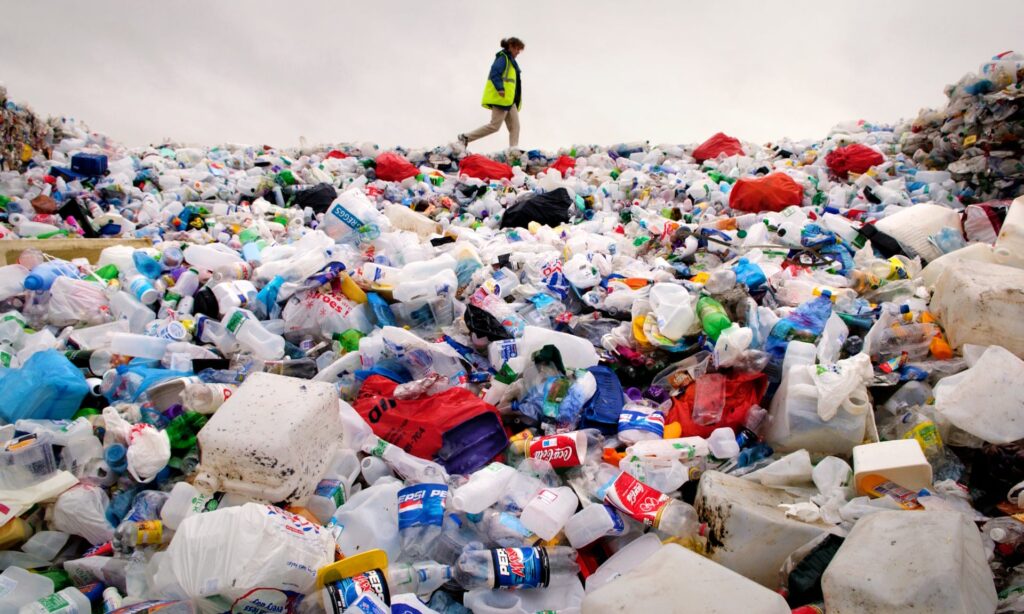
The more solutions, the better because plastic pollution is consuming the planet. Microplastic particles (from the waste breaking down) can be found everywhere now, from the Arctic to the deepest oceans, and even in our milk, vegetables, and air.


