
Few fast-growing nations have successfully navigated the transition from a mounting municipal waste crisis to a structured renewable energy strategy. Indonesia, however, is now bridging this gap through an integrated circular economy framework.
Municipal solid waste volumes are projected to rise sharply by mid-century, according to UNEP’s 2024 global waste outlook, turning local dumps and hauling routes into critical climate and public-health bottlenecks.
Regulatory momentum surged after the signing of the 2025 waste-to-energy presidential regulation, resetting the national framework after years of uneven delivery. State-backed initiatives are now pairing this policy with a rollout aimed at bringing waste-to-energy facilities to dozens of urban regions.
A convergence of sovereign capital, regulatory reform, and community-led systems defines this new approach to creating a practical blueprint for ASEAN cities. The government’s plan focuses on an intensive multi-city waste-to-energy investment programme that Danantara will help structure and fund, with PLN positioned to purchase the resulting electricity. Locally led systems prioritise the harder reality of remote-region waste management programmes in places where transfer stations and recycling markets are not guaranteed.
Everyday experiences in Jakarta or Surabaya revolve around the tangible impacts of overflowing landfills and marine debris rather than abstract policy frameworks. ASEAN policymakers are now evaluating whether Indonesia can scale these waste-to-energy solutions without merely shifting environmental burdens.
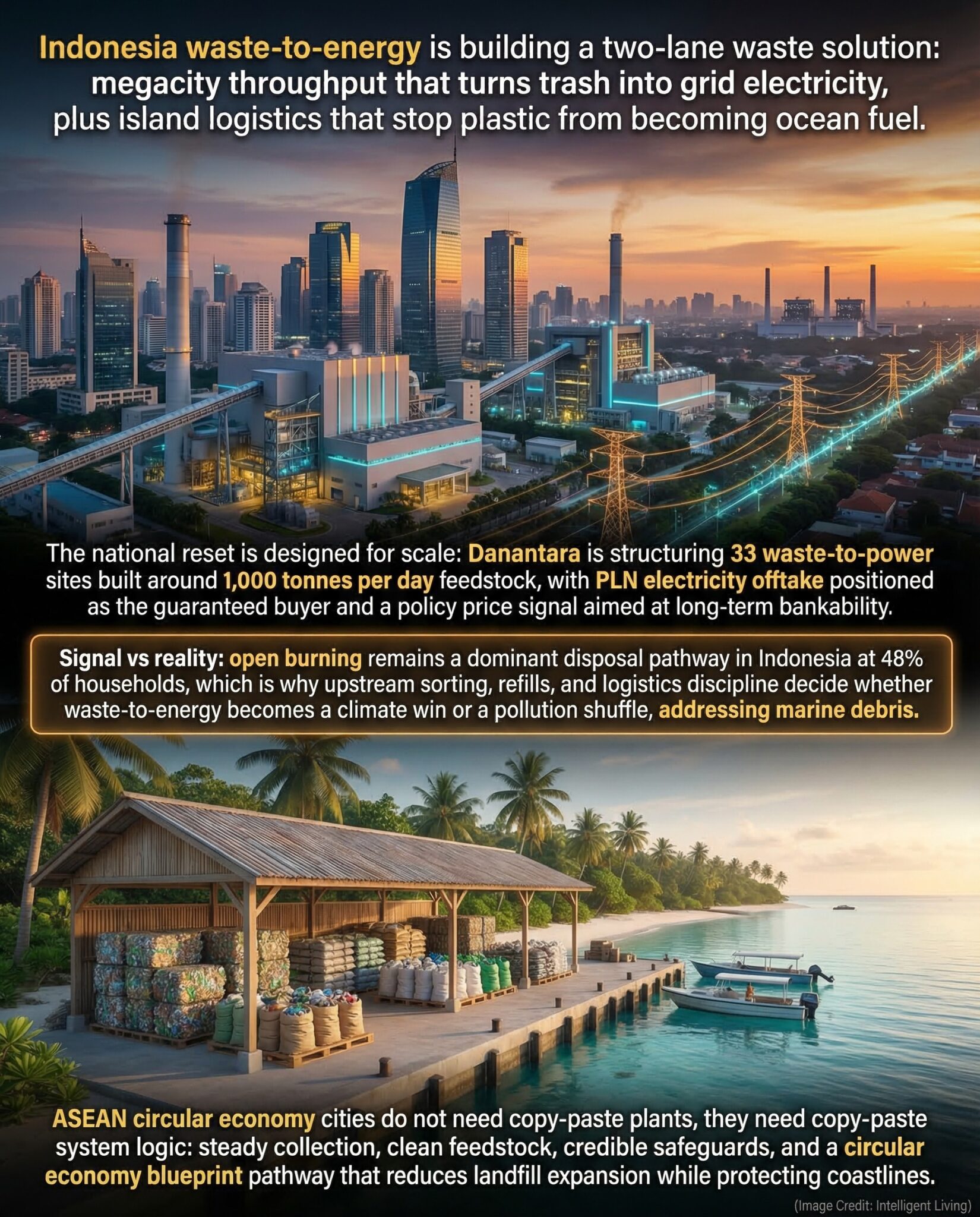
Indonesia Waste to Energy Expansion: Strategic ASEAN Circular Economy Signals
- National frameworks now define waste-to-energy processing as conversion into electricity, bioenergy, and renewable fuel oil. This modernised implementation structure formally replaces previous waste acceleration policies to improve structural transparency.
- Revenue certainty for bankable projects is anchored by a fixed electricity tariff and guaranteed power offtake under the latest financing and governance setup.
- Eligibility for these programmes requires a 1,000 tonnes-per-day minimum waste volume. Specific roles assigned to Danantara and PLN include ensuring land readiness and establishing consistent supply logistics.
- Capital costs are estimated at roughly Rp 2 trillion to Rp 3 trillion for a standardised high-capacity processing unit, focusing on big-city throughput rather than small island needs.
- Observed capacity in cities like Surakarta demonstrates that active processing sites can generate 8 MW from roughly 545 tonnes of daily waste, anchoring performance expectations in reality.
- Regional pressure continues to mount as municipal solid waste volumes in ASEAN were projected to double between 2012 and 2025, necessitating urgent financing models.
- Economic infrastructure increasingly incorporates waste reduction through the regional circular economy framework, which treats resource efficiency as a primary growth driver.
Taken together, these signals mark a shift from isolated pilots to a national buildout that other ASEAN cities can study, stress-test, and adapt.

Two-Lane Waste Solutions: Bridging Urban Throughput and Island Logistics
Industrial-scale intervention is now mandatory as metropolitan areas face a compounding set of waste management hurdles.
Urban Throughput: Volume, Land Constraints, and Grid Integration
Metropolitan areas face a compounding set of waste management hurdles that require industrial-scale intervention.
- Major cities produce massive volumes of mixed municipal solid waste daily.
- Available landfill capacity continues to shrink as populations grow.
- Unmanaged organic waste creates a persistent source of methane emissions.
- Waste-to-energy facilities prioritise high-volume throughput to alleviate pressure.
These facilities effectively reduce total waste volume while generating electricity for the regional grid.
Managing The Sensory and Social Impact of Urban Landfills
Residents typically experience waste through sensory friction rather than abstract policy frameworks. Neighbourhoods struggle with harsh odours from overburdened dumps and disruptive truck routes, which fuel persistent anxiety regarding future landfill expansions. Serious waste strategies must acknowledge these daily frictions and pair them with measurable results like capturing methane and recovering landfill gas energy.
Island Logistics: Why Infrastructure Alone is Not Enough
Logistics, rather than sheer volume, define the challenges faced by remote island communities. Transporting material from smaller archipelagos remains economically unworkable while recycling centres remain concentrated on Java. Bridging this logistical gap requires community-led systems that prioritise localised sorting and education.
Unregistered partnerships now facilitate collaborative waste management in remote Indonesian archipelagos, emphasising systems that stop waste from becoming litter at the outset.
Addressing abandoned, lost, or otherwise discarded fishing gear is a prerequisite for plastic reduction in fishing-dependent economies. Effective strategies combine this with shoreline cleanup and localised sorting efforts.
Automated zero-emissions waterway collection systems prevent floating debris from spreading through ports and lagoons.
Prevention and Interception: Stopping Marine Debris at The Source
Fishermen who describe plastic arriving faster than it can be collected are highlighting a stark supply chain reality, not using metaphors. Bridging this gap requires river plastic interception systems that guide debris into solar-powered conveyors before it reaches open water.
The Policy Reset: Indonesia’s Waste to Energy Reboot in 2025
Operational success remained elusive under Indonesia’s earlier waste-to-energy acceleration framework. Permitting complexity and financing uncertainty caused multiple projects to stall, alongside a lack of delivery accountability.
Tangible daily impacts must eventually follow these significant regulatory shifts. The 2025 reset reframes waste as an energy input, fundamentally recalibrating implementation and delivery requirements through guaranteed power purchase agreements.
Jakarta’s environmental strategy has already introduced bans on single-use plastic bags to reduce the volume of low-value plastic entering the waste stream.

Danantara’s Waste to Energy Buildout: Financing Renewable Infrastructure and Operational Proof
From Money to Megawatts: Danantara’s De-Risking Stack
South-east Asian waste-to-energy projects have historically found their weakest link in complex financing structures. Danantara’s model attempts to remove some of that uncertainty by pushing the hardest early-stage work towards centralised coordination.
Eight facilities serve as the initial targets for the first phase of this national waste-to-energy rollout. Major utilities are now providing offtake support for renewable waste power, which reduces uncertainty around who purchases the electricity.
Feasibility Funding and Revenue Certainty
Vague waste projections and contested land rights often trigger project collapse during early due diligence. A structured de-risking stack fundamentally flips this primary investor concern.
The core enquiry shifts from buyer availability to a city’s ability to guarantee waste supply, land readiness, and hauling logistics. Sovereign-backed coordination proves essential here to overcome the typical failures of fragmented municipal responsibility.
A project developer hearing residents describe daily dumping and irregular collection schedules will immediately recognise the problem: the plant can be engineered, but the feedstock system is the actual machine.
What’s Working Today: Lessons from Benowo and Putri Cempo
Indonesia does not start from zero. A small number of facilities are repeatedly used as operational references, which helps separate hypothetical capacity from real-world constraints.
Benowo, Surabaya: Operational Reference Point
Operational models in Surabaya prove that municipal waste can be integrated into grid supply under a workable build-operate-transfer structure.
Putri Cempo, Surakarta: Operational Friction
Putri Cempo is useful because it shows the opposite side of the story: the plant only works if the waste system feeding it works. Analysts have noted significant implementation constraints in metropolitan regions, reinforcing why project readiness is as much municipal as it is technical.
Broken collection routes deliver waste of inconsistent quantity and quality, causing plants to fall short of design assumptions even after construction is complete.
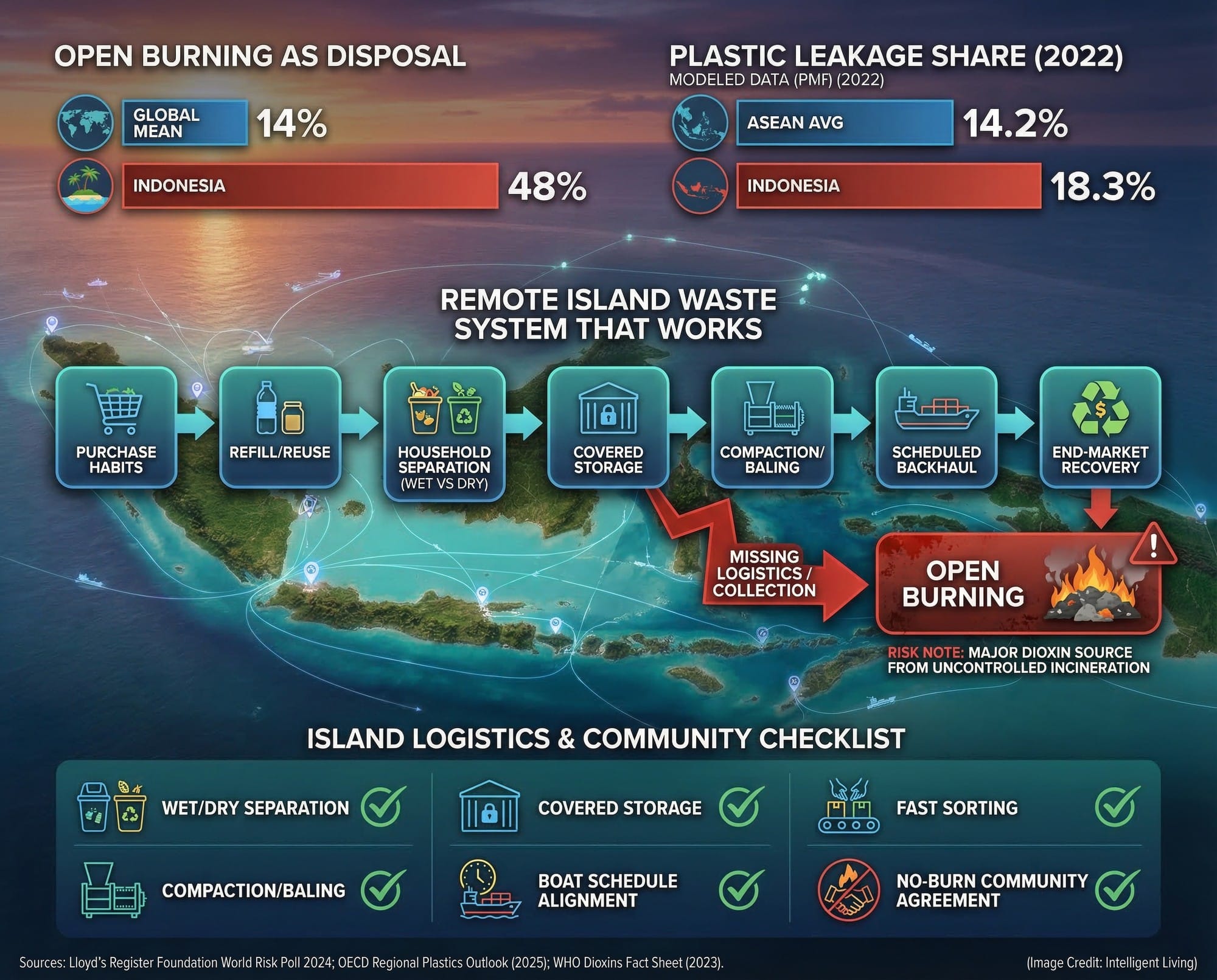
Island Circular Economy Blueprint: Community-Led Systems for Remote Waste Management
The Indonesian Waste Platform focuses on rural and remote communities, particularly small island fishing regions. In those environments, the waste problem can be defined by distance, limited municipal budgets, and a higher risk that waste becomes marine debris.
Implementation of localised best practices, such as the Komodo waste management model, ensures that household-sorted materials remain separate from degraded litter. Reducing toxic emissions from open plastic burning remains a primary focus of targeted programmes designed to shrink the non-recyclable sachet stream.
Extended Producer Responsibility and Refill Models
Extended producer responsibility shifts part of the waste cost upstream to companies. Refill models reduce single-use packaging at the source, which matters when shipping waste “out” is not feasible.
Sustainable shopping systems utilising reusable containers and bulk refill models demonstrate how to cut packaging flow before it reaches the environment.
Refill stations prove especially vital on islands where sachets and single-serve packaging dominate store shelves. These systems reduce the low-value plastics that frequently contaminate mixed waste streams.
A shopkeeper explaining why refill stations reduce packaging waste is not making a political statement. It is a practical response to storage limits, hauling costs, and beaches that cannot absorb another season of unmanaged trash, especially during tourist surges when daily waste volume spikes.
Distance to Recycling Markets
Remote regions often face the same structural constraint: if the recycling market is far away, sorting and recovery must be designed around what can realistically move through logistics chains. In tropical climates, mixed waste degrades quickly, and rainwater contamination can turn “recyclables” into low-value residuals.
Optimised Logistics for Remote Island Waste Transportation
Consequently, remote programmes prioritise covered storage, rapid sorting, and strict separation between wet organics and dry materials.
Communities rely on compacting, baling, and predictable backhaul routes on supply boats when shipping becomes unavoidable. In these scenarios, timing proves as critical as distance. Stabilising residual fractions as a non-recyclable commodity allows specialised strategies to manage waste safely before it enters the environment.
What An Island Waste System Needs Before Shipping Sorted Material
Achieving a functional island waste system requires a combination of logistical precision and community consensus. Before any sorted material can be shipped to distant recycling markets, specific operational checkpoints must be satisfied:
- A local sorting point with simple rules for wet organics versus dry recyclables
- Covered storage to prevent rain damage and contamination
- A reliable pickup rhythm tied to boat schedules or haulier routes
- A community agreement that keeps open burning from becoming the default response

ASEAN Replication Guide: Scaling Regional Waste to Energy Implementation Success
How ASEAN Cities Can Copy this Without Copy-Pasting It
ASEAN cities face rapidly rising waste volumes and constrained disposal options. A workable blueprint needs to be flexible enough to fit different city types.
City Typologies Matter
Operational requirements vary significantly based on urban and geographical profiles.
- Megacities need high-throughput facilities with stable grid integration and long-term contracts.
- Secondary cities require robust regional coordination to manage fluctuating waste volumes.
- Tourism hubs must prioritise marine leakage prevention and organic waste diversion.
- Island regions demand localised logistics paired with aggressive upstream reduction.
These distinctions ensure that waste management infrastructure aligns with the specific metabolism of each city type.
Modelled evidence highlights high plastic leakage rates in South-east Asian archipelagos, emphasising the need for regional interventions.
This is where “copying without copy-pasting” becomes practical. Cities should copy the system logic, not the exact plant design. One strategic goal is a circular economy city pathway where waste, energy, and water planning are treated as one system.
Reality Check: The “Boring Stuff” that Determines Success
Waste-to-energy projects fail for predictable reasons. Feedstock shortages, weak data reporting, unclear tariffs, and public mistrust can derail even well-funded projects. Accurate waste data, contract enforcement, and service reliability remain the core pillars tracked in the comprehensive global waste management database.
Waste supply inconsistency stands as one of the most common failure modes in the sector. Real-world challenges with consistent feedstock delivery show how operational performance can be limited by upstream collection realities.
For a city planner, the takeaway is uncomfortable but simple: a facility is not a system. The waste collection system is the plant’s fuel line.

The Waste to Energy Technical Stack: Climate Mitigation and Upstream Prevention Strategies
Methane, Maths and Organic Waste
Organic waste decomposing in landfills produces methane, a potent greenhouse gas. Organic waste often dominates the municipal mix in fast-growing cities, positioning methane management as a critical climate lever. High-impact climate mitigation depends on diverting organics and capturing methane, according to international assessments.
Methane solutions remain highly relatable at the household level. Residents quickly adapt to backyard biodigesters that produce renewable cooking gas from organic food waste.
Upstream Prevention and EPR
Extended producer responsibility and refill models reduce waste generation before it reaches landfills. Upstream prevention is often the most cost-effective climate strategy because it prevents the highest-pollution waste pathways from forming.
A circular system also needs credible outlets for recovered materials. Demand for recovered material stabilises when infrastructure projects utilise recycled plastic and glass aggregate for construction. Replacing asphalt binders with processed plastic waste for road surfacing is a growing initiative aimed at increasing recycled content absorption.
Technology Pathways and Guardrails
Waste-to-energy is not one technology. Policy discussions in Indonesia have focused on establishing regulated prices for waste-to-electricity pathways, including incineration and gasification.
Energy outputs and byproducts shift fundamentally when utilising advanced plasma gasification routes for green hydrogen production. For plastics that resist mechanical recycling, chemical recycling through pyrolysis oil conversion is often positioned as a viable recovery route.
Health guardrails remain non-negotiable. Keeping emissions low requires controlled high-temperature systems with filtration that adhere to global safety standards regarding dioxins and health risks.
ASEAN Circular Economy Blueprint: Why Indonesia’s Waste to Energy Model Matters Beyond its Borders
Indonesia’s approach suggests that waste-to-energy is not a single project but a layered system. It combines regulatory clarity, sovereign-backed delivery, municipal logistics, community action, and upstream prevention.
For ASEAN cities facing landfill saturation and rising plastic leakage, the model offers a structured checklist. Secure regulatory clarity. Guarantee feedstock. Align financing. Invest in community systems. Monitor emissions transparently. Prioritise reduction and refill alongside conversion.
Source Separation and International High-Performance Benchmarks
One reminder is that high-performing waste systems are built, not wished into existence. Preventing expensive downstream fixes relies on high source separation and residual waste reduction rates.
For many readers, the most memorable version of the lesson is simple: the best waste-to-energy project is the one that is paired with upstream reduction. Even when waste becomes power, it is still better when the waste stream is smaller, cleaner, and easier to control.
In practice, waste-to-energy can also support broader clean-fuel systems, where waste-derived power supports public transportation fuel cycles under certain infrastructure conditions.

Circular Solutions: Frequently Asked Questions on Indonesia’s Waste Strategy
How does the 33-city waste-to-energy programme impact local residents?
The state-backed rollout aims to stabilise electricity supplies while simultaneously removing the environmental threat of overflowing landfills from urban neighbourhoods.
Can remote islands truly participate in a circular economy?
Successful circular economies on islands depend on refill models and local sorting to reduce plastic leakage and manage waste effectively.
What makes the 2025 waste-to-energy regulation different from previous attempts?
The new framework provides a fixed electricity tariff and designates PLN as a guaranteed buyer, creating the revenue certainty needed to attract long-term investment.
Does turning trash into power release harmful emissions?
When equipped with modern high-temperature conversion and advanced filtration, facilities can keep dioxin levels low and meet strict international health guardrails.
How do refill stations help reduce marine debris?
In-store refill dispensers for soap and household goods eliminate the need for single-use sachets that typically contaminate marine environments.


