
University of California, Davis (UC Davis) researchers have pinpointed a psychedelic that doesn’t trigger hallucinations – a molecule called AAZ-A-154. This is a medical breakthrough because it could allow scientists to accelerate the development of easy-to-use remedies for mental health and neurological conditions.
The researchers found the psychedelic-like drug created fast and durable antidepressant impacts on mice without the consequence of hallucinations. Furthermore, the effects were immediate and long-lasting from just a single dose.
Psychedelic drugs can improve mental health by forcing the user to confront their issues and accept distressing memories. A few prestigious establishments have launched programs in recent years to explore the uses, effects, benefits, and hazards of using such drugs as therapy. For example, New York’s Icahn School of Medicine at Mount Sinai has launched a new center for psychedelics research, and so has Johns Hopkins.
Studies from these centers have revealed that several psychedelic drugs have therapeutic benefits. DMT delivered extraordinarily positive improvements in well-being through its antidepressant qualities. Microdosing LSD increases pain tolerance and could help with mental health and addiction problems. Magic mushrooms (psilocybin) also helped with mental health and addiction and improved long-term creative thinking from a single treatment. And, the strangest of all was the discovery that smoking psychedelic toad slime holds profound mental health benefits.
But all these drug options are not easy treatments. The sessions require a medical professional to be present for hours throughout the experience and then follow-up appointment later. AAZ-A-154, on the other hand, could potentially be taken home and consumed without assistance and the dramatic experience of hallucinations.
Assistant professor David Olson at UC Davis said:
Non-hallucinogenic compounds are a particularly seductive notion because they could allow for medicines to be self-administered the way aspirin is. Suppose you undergo the psilocybin [the psychoactive component in magic mushrooms] therapy session. In that case, you have to go to the doctor to prepare yourself for the session, then be in the medical setting for at least eight hours, and then go back for some follow-up.
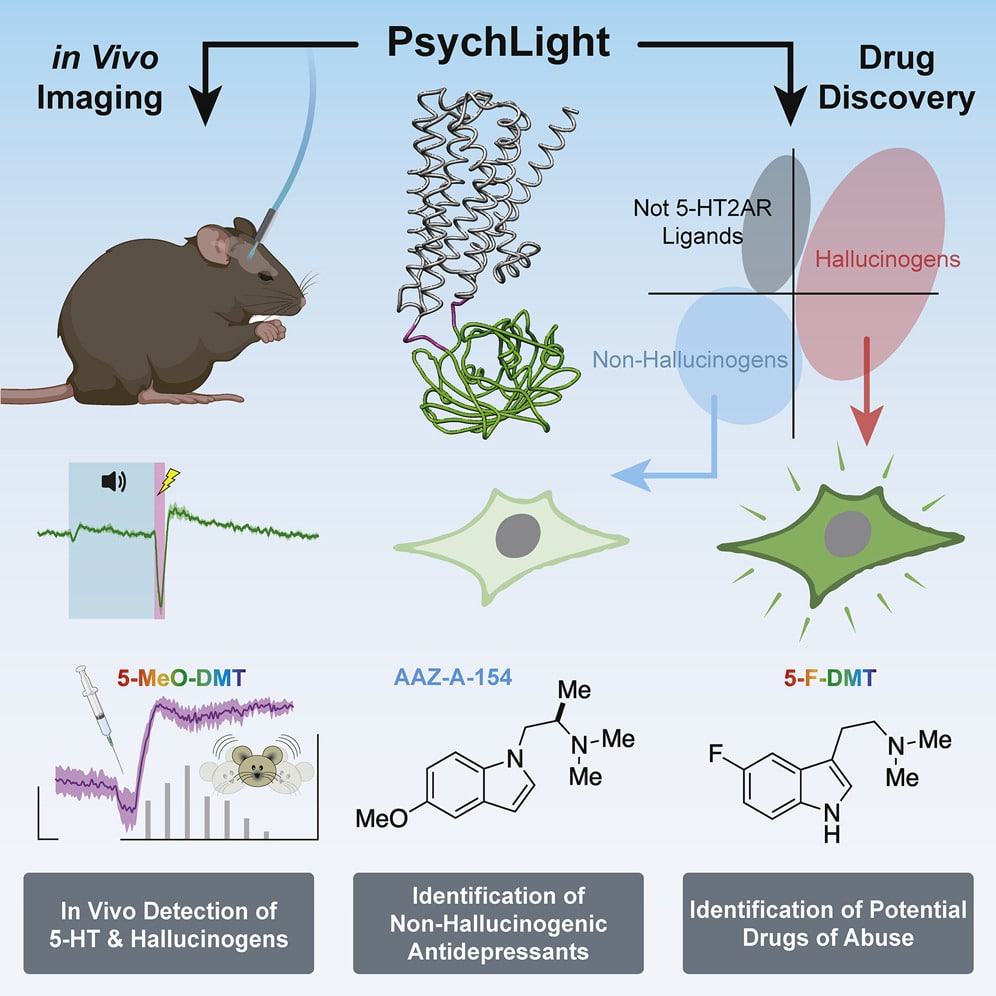
The molecule acts on a single serotonin receptor within the brain, promoting neuronal growth and creating beneficial habits for weeks after a single dose. Granted, these results have yet only been proven in rodents. But the researchers are confident AAZ-A-154 would have the same effect in other species, like humans.
If proven effective, this method could result in a drug that works after a single, tiny dose rather than current antidepressant or antianxiety medicines that have to be taken indefinitely. While antipsychotics usually work by altering brain chemistry, psychedelics seem to promote neural plasticity, basically enabling the brain to rewire itself.
Also, a psychedelic that is non-hallucinogenic would be a Goldilocks compound because it’s less likely to become a recreational drug.
The UC Davis researchers found the molecule by genetically encoded a green fluorescent protein into a particular kind of serotonin receptor responsible for triggering hallucinations. This allowed them to observe the receptors being activated in living muscle.
Associate professor Lin Tian, the study’s senior author and a UC Davis biomedical researcher, explained in a press release:
Serotonin reuptake inhibitors have long been used for treating depression, but we don’t know much about their mechanism. It’s like a black box.
This sensor allows us to image serotonin dynamics in real-time when animals learn or are stressed and visualize the interaction between the compound of interest and the receptor in real-time.
The sensor could also help pharmaceutical companies with a broad portfolio of compounds to see whether a drug can target the serotonin receptor and what their hallucinogenic potential is.
Making use of their sensor, the researchers have homed in on hallucinogenic and psychedelics that are non-hallucinogenic – like the star molecule AAZ-A-154.
For now, lots more research is needed to comprehend the underlying mechanisms, both at the cellular and molecular level, before human beings can test AAZ-A-154. But prospects are optimistic.


