
In 2019, a Georgia Institute of Technology team produced a tiny robot – dubbed “micro-bristle-bot” – that was only two millimeters long (the size of the world’s smallest ant) and weighed less than a teaspoon of salt.
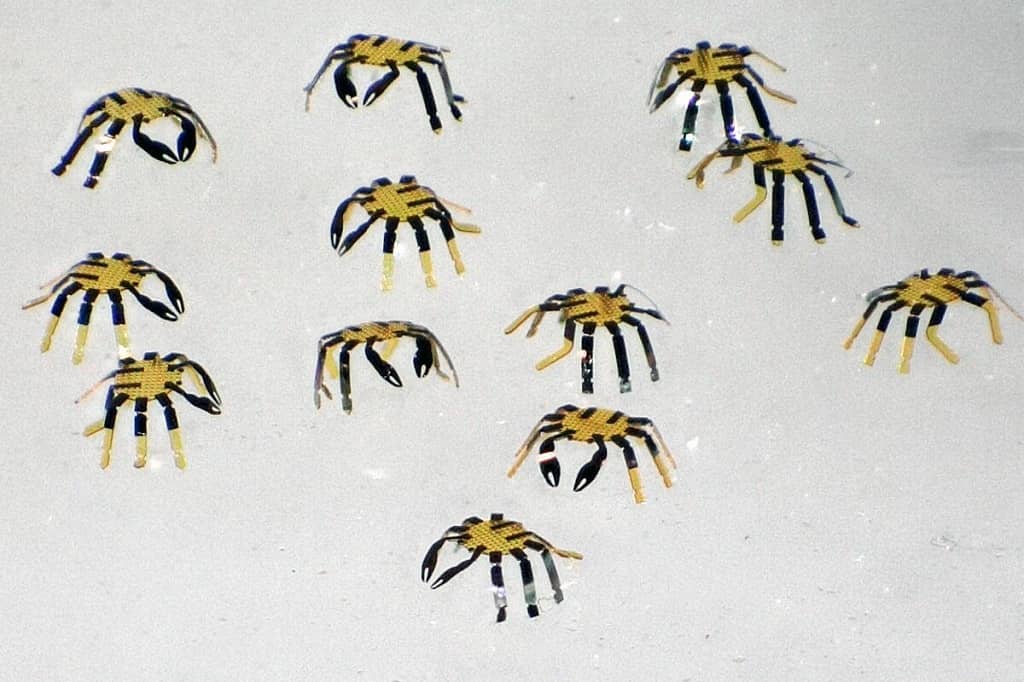
Now, researchers at Northwestern University (NWU) in Illinois have built the world’s most miniature remote-controlled walking robot at half a millimeter wide. Impressively, such tiny devices can crawl, walk, bend, twist, turn and jump without electricity or hydraulics.
Shape-memory alloy materials are used to build the robots, which are then warped into the desired shape. When these alloys are heated, they spring back to their original form, and when the heat is withdrawn, a tiny layer of glass can elastically snap them back into their deformed shapes.
In this case, the heat was provided by a scanning laser that passed over the crabs to warm up the alloy. Since they’re so small, the heat dissipates quickly, allowing them to respond at speeds of up to 10 cycles per second. Due to the timing of the leg actuation, the direction of movement is determined by the scanning laser – scan right, and the crabs walk right. According to the team, they were moving at half their body length each second.

The NWU researchers then experimented with various shapes, including:
- Water-walking tripod structures that can spin by rotating the scanning laser,
- Coiling structures capable of modest jumps,
- Structures capable of twisting and other motions.
The manufacturing procedure is fascinating: first, the flat structures were adhered to a stretched-out rubber substrate, albeit only at the footpoints. Then, the rubber was relaxed, forcing the robots to pop up off the surface in a controlled buckling process, putting them in their final, three-dimensional “cooled” state, where the glass coating could be added to keep them in form until they were heated.
John A. Rogers, a materials science and engineering professor who led the experimental work, said:
“Robotics is an exciting field of research, and the development of microscale robots is a fun topic for academic exploration. For example, you might imagine micro-robots as agents to repair or assemble small structures or machines in industry or as surgical assistants to clear clogged arteries, stop internal bleeding, or eliminate cancerous tumors — all in minimally invasive procedures.”
Of course, picturing them as such requires considering how to deliver targeted laser heating into the small confines they’re designed to operate in – a concept that won’t be easy within the body. So, there is still much work to be done.
Rogers explained why they chose crabs as their inspiration:
“With these assembly techniques and materials concepts, we can build walking robots of almost any size or 3D shape. But the students felt inspired and amused by the sideways crawling motions of tiny crabs. It was a creative whim.”
The research is detailed in Science Robotics, while the mini crab-bot can be seen in action below.


