
A team of economists from the International Monetary Fund (IMF) has recently released a report titled, “Nature’s Solution to Climate Change.” The report details just how valuable whales are to our ecosystem and notably absorbing CO2.
Whales can absorb large amounts of carbon in their bodies, especially great whales. On average whales live to be around 60 years old and can absorb up to 33 tons of carbon dioxide. Whales also help to promote the growth of phytoplankton. Phytoplankton are the foundation of the ocean food chain and responsible for pulling CO2 from the atmosphere down to the bottom of the ocean when they die. In comparison, a tree only absorbs up to 48 pounds of CO2 per year.
Taking an even more in-depth look at the effect of whales and phytoplankton, researchers came up with some staggering numbers. They found that phytoplankton contribute up to 50% of all oxygen in our atmosphere by capturing 37 billion tons of CO2, which is estimated to be around 40% of all CO2 produced. This would equate to 4 amazon forests worth of trees or 1.7 trillion trees! It’s safe to say we need phytoplankton.
Recently scientists have discovered that wherever the whales go, the population of phytoplankton increases. It turns out the waste products of whales have high levels of iron and nitrogen that enable the phytoplankton to grow. The whales’ vertical movements help to bring the minerals to the surface, something they call the ‘whale pump.’
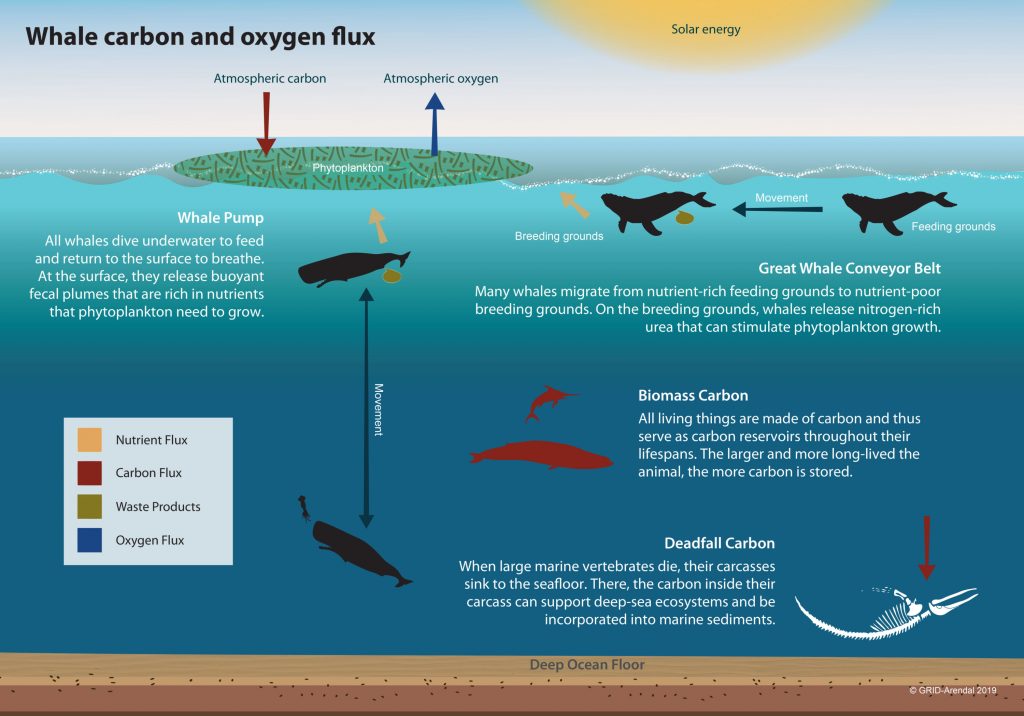
After learning this information, hopefully, something will be done to protect the remaining whales. Since whaling has been allowed to continue, whale numbers have dropped from 4 to 5 million down to 1.3 million. The whale population faces other dangers aside from the danger of whalers. They are prone to ship strikes and more recently whales have been washing up on beaches with large amounts of plastic in their stomachs.
An increase in the whale population would help to significantly raise the phytoplankton population. The researchers pointed out that as little as a 1% increase in phytoplankton would help to capture hundreds of millions of tons of CO2 per year.
We can see now just how important whales are to cutting greenhouse emissions. Their lives have a direct effect on every person on this planet. Researchers and economists are looking at viable ways to go about protecting the whales. One such way is some sort of incentive program for shipping companies to alter their routes to avoid possible collisions.
Cleaning up our oceans of all the plastic pollution that we have created, will not only help the whale population but all marine life. Scientists are calling for a more holistic approach and the protection of whales to be implemented into the Paris agreement and for governments and organizations to realize the importance of protecting whales and other wildlife. Knowing that drastic measures must be taken by humanity to lower carbon emissions, and finding out this information that once again nature can help us to solve this problem. Maybe it’s truly time for big businesses to come forward, whatever the cost, to help solve this problem.


