
Such advancements resolve major high-frequency engineering bottlenecks. New ultrathin single-walled carbon nanotube coatings behave like microscopic black surfaces for guided terahertz waves, soaking up energy across a wide sub-THz band and reducing the tiny reflections that can snowball into interference inside dense circuits. Conventional materials typically fail to provide signal control without adding excessive bulk.
Acoustic treatment in a compact room provides a helpful analogy for signal behavior. When sound echoes continuously, clarity is lost. Similarly, a waveguide carrying sub-THz signals becomes unstable when energy reflects repeatedly. Operational instability drives research into terahertz and quantum communication, which frequently addresses signal management at the limits of silicon hardware.
The ‘black paint’ metaphor represents a shift toward functional nanomaterials integrated directly into the silicon platform. Utilizing aerosol CVD and dry transfer techniques, the team created a scalable pathway for these absorbers, moving the technology from a laboratory curiosity toward a dependable building block for future 6G architectures.
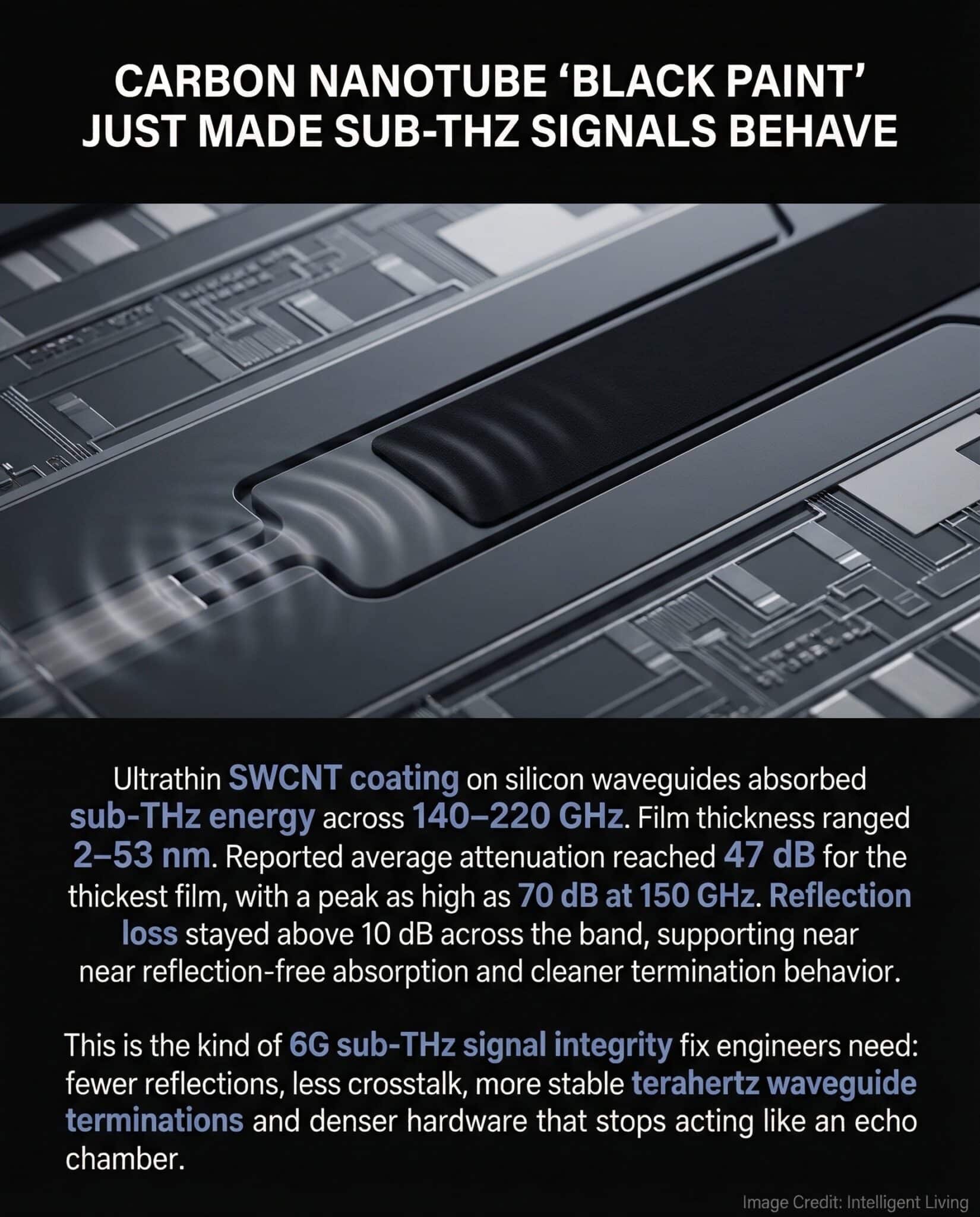
Sub-THz Terahertz Absorber Snapshot and 6G Device Design
Sub-THz Quick Facts: 6G Hardware Performance and Terahertz Absorbers
At-a-Glance Measurement Data for SWCNT Thin Films
- Frequency Range Tested: 140 to 220 GHz
- Film Thickness: 2 to 53 nanometers
- Peak Attenuation Reported: Up to 47 dB for a 53 nm film
- Reflection Behavior: Near reflection-free absorption in the tested band, with absorption dominating over reflection
- Film Method: Polymer-free single-walled carbon nanotube networks made via floating-catalyst aerosol CVD and dry transfer
Sub-THz Reflection-Free Termination Analysis
Measurement ranges from 140 to 220 GHz confirm that a nanometer-thin surface layer effectively dissipates guided sub-THz energy while preventing the waveguide terminal from acting as a reflector, as detailed in the 140 to 220 GHz measurement set that documents reflection-free termination and shielding breakdown.
SWCNT “Black Paint” Implementation and Practical Design Logic
Compact SWCNT Film-on-Waveguide Termination Design
Polymer-free SWCNT films produced for silicon dielectric waveguides serve as compact terminations. The resulting coating couples to electromagnetic fields to dissipate energy as heat, utilizing the geometry detailed in the compact nanotube-film termination on terahertz dielectric waveguides.
The “Black Paint” Metaphor for Ultralow Reflectance Coatings
The ‘black paint’ metaphor describes total energy absorption rather than application method. In optics, carbon-nanotube surfaces are known for achieving ultralow reflectance, and similar low-reflectance performance at longer wavelengths has been quantified in terahertz radiometry studies.
Lab-Scale Reality: Minimizing Signal Ripples in Sub-THz Circuits
High-frequency testing often produces spectral artifacts that disappear only after precise absorber placement. Coating applications target these interference issues at scales suitable for integrated terahertz circuitry. Similarly, conductive graphene-based paints hint at how fast functional surface layers move from lab curiosity to routine manufacturing.
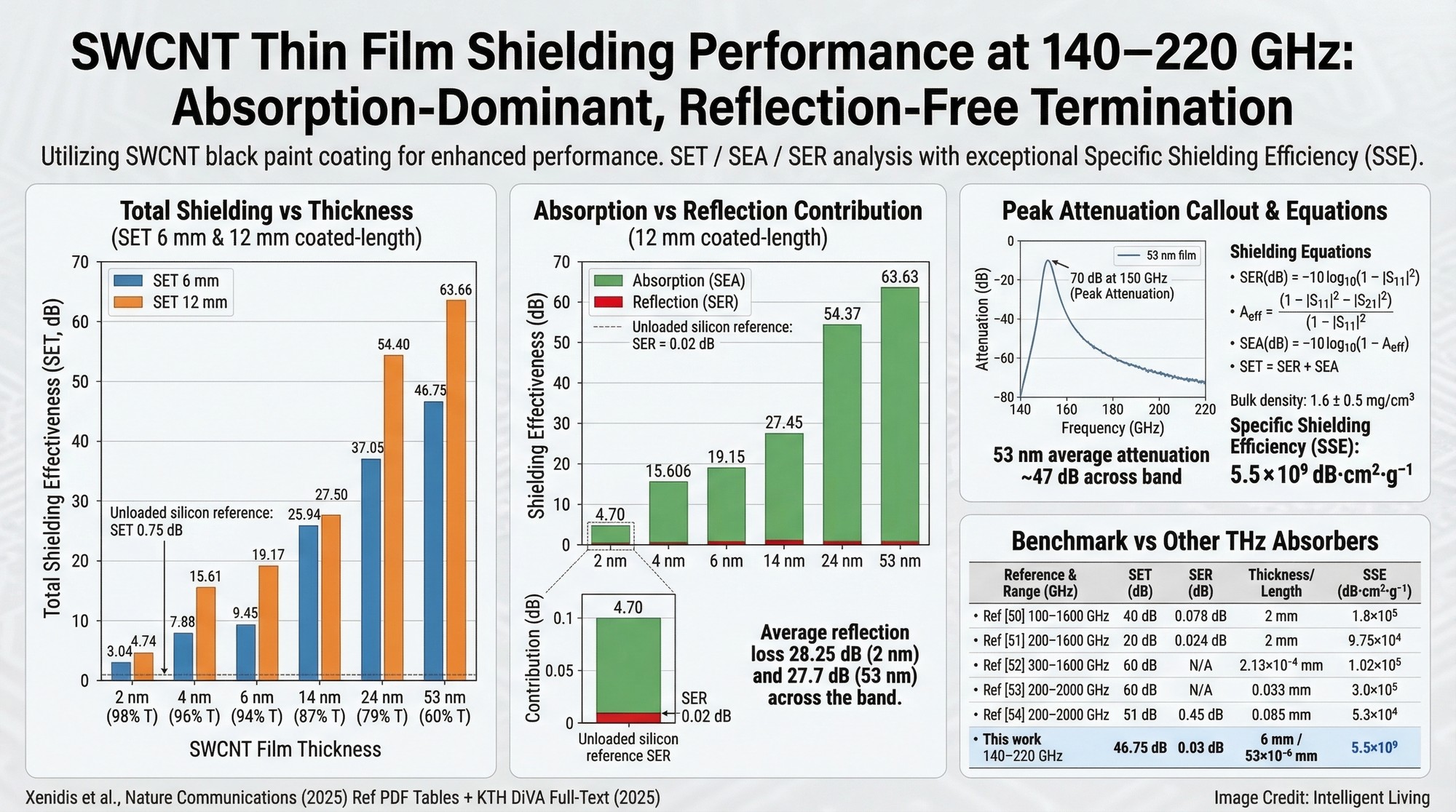
Broadband Performance Results and Terahertz Termination Principles
Primary Research Findings: Broadband Absorption at 140–220 GHz
Broadband Energy Absorption Across the Sub-THz Band
Testing from 140 to 220 GHz confirmed broadband absorption. The waveguide terminal effectively sinks energy from guided waves rather than reflecting it back into the system.
Sub-THz Attenuation, Reflection Loss, and Absorption Dominance
The thickest film tested, 53 nanometers, reached up to 47 dB attenuation in the reported dataset. The study also describes high reflection loss and a shielding breakdown where absorption dominates, which matters because reflections are what set up standing waves and unpredictable coupling between nearby structures.
Frequency-Specific Trace Analysis and Supplemental Data
Uncontrolled reflections manifest as spectral noise and signal instability. This coating reduces hardware fragility, ensuring reliability as sub-THz circuit density increases. Comprehensive DiVA full-text PDF with supplemental plots and frequency-by-frequency details illustrates the effectiveness of these nanotube films across the tested frequencies.
The Critical Role of Terminations in 6G Terahertz Circuits
Mitigating Standing Waves and Sub-THz Interference
Terminations capture energy from guided waves to block interference. Compact sub-THz interconnects are vulnerable to modest reflections that trigger standing-wave patterns. These interference zones distort measurements and compromise signal integrity.
Optimizing Dense 6G Layouts via Compact SWCNT Terminations
Traditional terminations can rely on bulky absorbers or long tapers that gradually leak energy away, but those approaches consume area and complicate dense layouts. A thin-film termination placed directly on a waveguide surface can reduce that footprint and simplify multiport circuit characterization, supporting the goal of a terahertz electronic–photonic integrated circuit on a single chip.
Practical Impact: Improving Reliability in High-Frequency Prototyping
Prototype development often stalls when measurement artifacts masquerade as device behavior. Compact terminations eliminate these errors, ensuring data accuracy during critical hardware testing.

6G Sub-THz Spectrum Context and Manufacturing Scalability Audit
Strategic Value: Integrating SWCNT Coatings into 6G Frameworks
Sub-THz Integration in Global 6G Spectrum Allocation
Future systems prioritize sub-THz frequencies for short-range, ultra-fast wireless 6G links, where high-throughput data rates are the primary objective. Current industry standards define 6G sub-THz bands as covering approximately 90 GHz to 300 GHz.
Documented 6G Milestones and Sub-Terahertz Data Rates
Ambition translates into real milestones. In a 300 GHz-band hardware demo, NTT reported 160 Gb/s while defining sub-terahertz as 100 to 300 GHz. Simultaneously, a 280 Gb/s lab link demonstrates how measurement ecosystems are pushing data boundaries.
Scaling Challenges: Crosstalk and Reflections in Denser Hardware
Proximal sub-THz deployment requires strict control over internal reflections and crosstalk as hardware density intensifies. Recent Japan’s 100 Gbps sub-terahertz 6G device demonstration reflects the necessity for tighter signal control, alongside earlier tests of ultrafast terahertz wireless transmitter chips.
Manufacturing Viability: Scalability of the SWCNT Process
Industrial Scalability: Aerosol CVD and SWCNT Transfer Methods
Scaling requires uniform production, reliable transfer, and durability during packaging. The team utilized floating-catalyst aerosol CVD and dry transfer. Broader nanotube manufacturing pathways are being mapped to support these industrial requirements.
Global Materials Ecosystem and Functional Surface Layers
Nanotubes are already integrated into RF hardware, such as microstrip antennas. Supply chains are expanding through innovations like plastic upcycling via catalytic pyrolysis, signaling a move toward industrial-scale manufacturing. Similarly, conductive graphene-based paints hint at how fast functional surface layers move from lab curiosity to routine.
Verification Requirements for Routine Manufacturing Integration
A small but relatable detail from manufacturing culture is that teams do not adopt a new coating because it is impressive on a graph. They adopt it when the process stops behaving like an art project and starts behaving like a routine, repeatable step.

Sub-THz Selective Shielding Potential and Future Validation Metrics
Quiet Zones: Selective Shielding Applications for 6G Sensing
Scaling Shielding: From Waveguides to Controlled Environments
Absorption behavior seen in terminations facilitates field control in instrument enclosures and localized interference zones. This application extends the utility of absorption-dominant shielding beyond on-chip testing.
Spectrum Coexistence and Regulatory Transmission Windows
In parallel, spectrum planning increasingly treats the 100 GHz to 1 THz range as usable pockets, referencing transmission windows above 100 GHz for future regulatory perspectives.
Practical Examples: Cross-Interference Management in 6G Labs
Co-located imaging and communication labs require efficient shielding to prevent cross-interference. Effective absorbers mitigate bench-to-bench noise, ensuring stable operation for simultaneous high-frequency experiments. Absorber logic mirrors that of reconfigurable intelligent surfaces for 6G indoor signal shaping via intelligent surfaces.
Next-Generation Materials: MXenes and Absorption-First Shielding
On the materials side, absorption-focused shielding is an active theme across different platforms, including MXene-based 2D materials that soak up energy rather than reflecting it.
Roadmap: Validation Phases and Ecosystem Integration
Critical Stability and Performance Validation Protocols
TTransitioning toward industrial integration necessitates several rigorous validation protocols to support the broader evolution of terahertz and quantum communication networks.
- Broad-band testing across extended frequency ranges
- Long-term stability audits under operational stress
- Integration trials within complex multiport networks
- Reliability testing in packaged modules
Sub-THz Metrology: Ensuring Repeatability in the Terahertz Range
Sub-THz research faces significant repeatability challenges between laboratories. Repeatability hurdles highlight the importance of vector network analysis and power-measurement limits in the terahertz range as new components transition into broader ecosystems.
Packaging Realities: Performance Maintenance in Packaged Modules
Terminations must maintain performance beyond controlled laboratory environments. Environmental resilience and mechanical stability distinguish lab-scale absorbers from industrial building blocks. Reliability requires consistent performance despite mechanical handling, thermal cycling, and proximity to other active components.

Conclusion: Cleaner Sub-THz 6G Hardware Starts With Small Fixes
Current results demonstrate component-level improvements targeting repeatable problems in high-frequency engineering: reflections and interference that intensify as systems move into the sub-THz range.
The most practical takeaway is modest and valuable. When a nanometer-thin coating can act like a broadband absorber on silicon waveguides, it reduces the engineering burden for people building and testing sub-THz circuits, and foundational solutions move prototypes toward stable hardware by ensuring consistent, repeatable performance.
As 6G development moves from lab records toward field deployment—such as 100-meter outdoor 6G terahertz transmission tests—technical reliability hinges on these foundational improvements that ensure consistent, repeatable performance.
FAQ: Carbon Nanotube Terahertz Absorber Questions
What frequencies does the sub-THz absorber target?
The coating is tested between 140 and 220 GHz, effectively soaking up energy in the lower sub-THz band.
Is the nanotube coating applied like traditional paint?
No. It is a nanometer-thin film transferred onto waveguides via aerosol CVD, acting metaphorically like black paint due to its total absorption.
How does this improve 6G hardware reliability?
By eliminating internal reflections, the coating prevents signal distortion and interference in dense, high-frequency circuits.
Can this technology be used for room-scale shielding?
Current optimization targets on-chip waveguides. However, the underlying absorption principles could eventually protect larger sensing environments.
Why is the terahertz band difficult to manage?
Frequencies in the terahertz gap are prone to high reflection and signal loss, requiring precision materials like nanotubes for control.


