
Vast new datasets recently sparked a compelling theory: mastering several languages could shield the aging brain from decline. Claims like these propagate quickly, hitting home for anyone noticing the subtle drag of afternoon brain fog or occasional memory lapses. Such neurological excitement stems from how bilingualism might bolster cognitive reserve—a hidden mental bank account that helps the brain bypass damaged circuits.
Mastering the mental effort required to switch between vocabularies acts as a unique form of neuroplasticity. However, we must distinguish between the biological benefits of language and the structural advantages of the people who speak them. Access to education, healthcare, and the social determinants of health that shape older adults often overlap with multilingual ability, making it difficult to isolate language as a lone savior against cognitive decline.
Instead of viewing language as a magic bullet, we should see it as a spotlight on healthy aging. The real narrative involves how social mobility, community design, and the way retirement location and neighborhood patterns can tilt longevity outcomes work together to build brain resilience. By examining the data through a lens of equity, we can better appreciate why some brains appear younger than their chronological age suggests.
A familiar scene helps frame it. A retiree joins a free language meetup, not to “biohack” anything, but because the room is warm, the jokes are fast, and the brain has to stay awake to keep up. That social and cognitive pressure feels protective, even when the science is still arguing about what is cause and what is context.

Analyzing Multilingualism and Brain Aging: Evidence vs. Viral Claims
Quick Facts: Multilingualism, Brain Aging, and What the Data Really Shows
- While this expansive cross-national study excels at detecting broad societal trends, it stops short of offering personal health guarantees.
- The “language effect” in this analysis is largely measured at the population level, not by tracking one bilingual person’s brain over decades.
- Critics argue the correlation may be driven by wealth, healthcare quality, education, and migration-linked opportunity rather than language itself.
- The statistical trap to watch is when country-level findings are treated like individual-level prescriptions.
- Language learning can still be a high-value habit for connection and mental engagement, even if it is not a proven anti-aging intervention.
- In everyday life, speaking more than one language is often shaped by region, education, and daily exposure rather than a deliberate attempt to protect the brain.
The Headline Claim: Multilingual Countries Look “Younger” in a Massive Dataset
Nature Aging Study: Key Population Results
A Nature Aging analysis of 86,149 adults across 27 European countries reported that higher multilingualism was associated with a lower likelihood of what the authors called “accelerated aging.” In plain terms, some populations looked healthier and more resilient than the model predicted for their chronological age.
Interpreting the Biobehavioral Age Gap and Health Metrics
The phrase “look younger” is shorthand for a statistical gap, not a literal claim that brains stop aging. Study authors draw relationships between multilingual environments and composite aging signals to identify underlying health drivers.
Emotional Resilience and the Appeal of Language Learning
Public intrigue is high because the story lands. A middle-aged commuter practicing phrases on a phone between stops often feels that a second language forces attention into the present moment. That experience can be real and meaningful, but the dataset is making a broader claim about populations, not a promise about one person’s future memory.

Inside the Study: What Was Measured and Why Critics Push Back
What the Study Actually Measured (and Why That Matters)
Mechanics of the Biobehavioral Age Profile
The authors first estimated an ‘expected’ age-related profile using a variety of metrics. Researchers then compared this baseline to real-world data points to reveal significant health gaps. This difference is described as a biobehavioral age gap, a statistical way of saying that a person or group looks older or younger than expected based on the model.
Public health researchers value this metric for its ability to condense multi-factor health signals. This synthesis allows for clearer comparisons across diverse populations. Predictive accuracy depends heavily on the specific variables measured and the extent of statistical inference involved.
Distinguishing Societal Trends from Individual Health Choices
The multilingualism signal used in this study does not track individual daily habits over decades. Instead, it reflects the broader linguistic environment of the surrounding society. Discrepancies between data and reality matter because human lives exceed the limitations of a spreadsheet. Multilingualism often travels with education systems, labor markets, migration patterns, and healthcare access.
Practical scenarios clarify the impact. An older immigrant who uses multiple languages for work, family, and daily life may also live in a region with strong preventive care and stable public services. In that setting, language and health can rise together even if language is not the direct biological driver.
The Pushback: Critics Say Wealth, Healthcare, and Mobility May Explain the Pattern
The most debated takeaway is also the most sober one. A University of Houston critique of the multilingualism-brain aging narrative argues that multilingualism can act like a proxy for structural advantage, especially when comparisons are made across countries.
Expert analysis aligns with a 2026 Brain and Language critique regarding country-level multilingualism and causal claims that emphasize how easy it is to slip from “countries with more multilingualism look healthier” to “learning a language will make you healthier.” Those are different statements, and the data are stronger for the first than the second.
A quiet detail that matters in this debate is how large the health gradient can be when education and income are uneven. In Europe, education-linked life expectancy gaps have been documented as substantial in many countries, which is one reason “wealth effect” explanations keep resurfacing.
Structural Factors that Can Travel with Multilingualism
Structural advantages often accompany linguistic diversity, creating a layered effect on cognitive health:
- Education access and the cognitive demands of complex work
- Preventive healthcare coverage, screening, and chronic disease management
- Economic stability and the life-course cost of poverty and inequality
- Migration-linked mobility, social networks, and urban opportunity
A grounded, everyday picture helps. A family that moves for work may become multilingual because it has to, not because it is chasing brain health. If that move also improves income, housing, and healthcare access, the “language effect” can quietly turn into an “opportunity effect.”
How to Read the Evidence: Avoiding Statistical Traps and Testing What Works
The Science-Literacy Lesson: Don’t Fall for Country-Level Shortcuts
What the Ecological Fallacy Means in Real Life
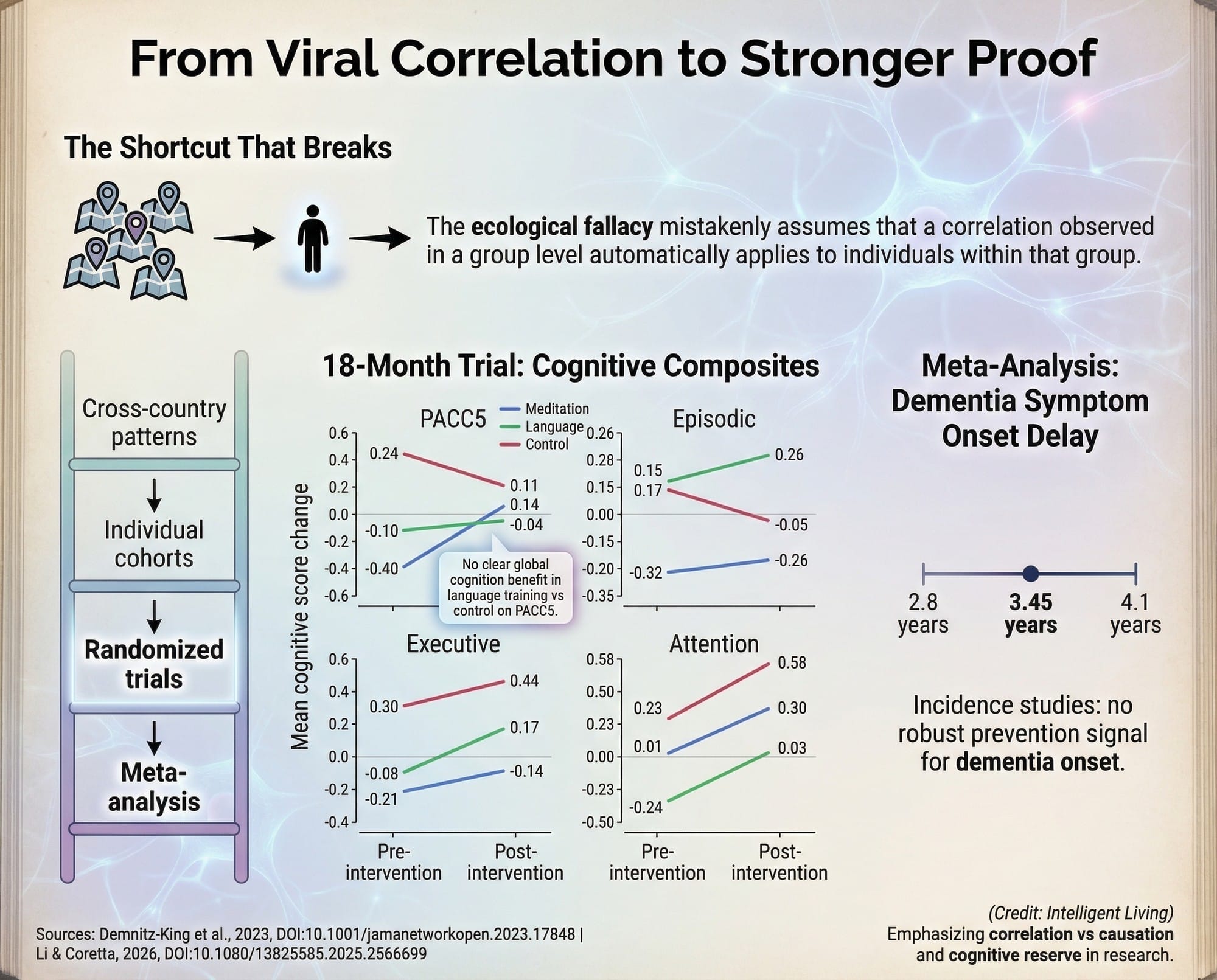
Group data analysis successfully identifies broad policy trends. However, applying these population-level patterns to individual choices can lead to significant errors. Researchers identify this error as the ecological fallacy: assuming that what is true for a group must be equally true for each individual within it.
Country-level correlations should not be marketed as personal anti-aging guarantees. Such patterns may still point to genuine underlying factors, but these indicators likely represent a cluster of conditions that shape health over decades.
How to Translate Big Patterns into Personal Choices
The safest translation is modest and practical. A headline like this can be used as a reminder that the brain responds to challenge, novelty, and social engagement, especially when daily attention starts to feel fragile, like a frazzled mind trying to regain focus during an overloaded week, and it should not be used as a substitute for the fundamentals that consistently predict healthier aging.
A relatable example is the friend who swears a new language “saved their brain,” when what actually changed was routine: weekly classes, more walking, more conversation, better sleep, and fewer lonely evenings. The brain does not care which single label gets credit.
Brief Reality Check Before the Finish: Cognitive Reserve is Real, but Interventions are Mixed
Why Cognitive Reserve Makes the Story Plausible
Cognitive reserve describes the brain’s ability to keep functioning despite age-related change. In recent years, the National Institute on Aging has updated the scientific understanding of cognitive reserve and resilience, emphasizing that these are not single traits but patterns shaped by education, occupation, engagement, and health conditions. Such scientific context helps explain why multilingual communication looks plausible: it requires intense attention switching, memory, and inhibition control, especially during rapid conversation.
It also sits alongside other mentally demanding routines, including mind-stimulating activities that improve memory and creativity when they are sustained over time.
What Happens When People Start Language Training Later
Here is the key limiter for “just start now” narratives. An 18-month analysis in JAMA Network Open of later-life language training found no clear, generalized cognitive benefit in cognitively healthy older adults, even with sustained instruction.
That does not mean language learning is useless. It means the strongest promise may be social and emotional, not clinical. A person who joins a group class may gain routine, belonging, and confidence in conversation, even if standard cognitive test scores barely budge.
For broader context, a Bayesian meta-analysis of dementia symptom onset studies suggests bilingualism is sometimes associated with later symptom onset, but that pattern does not automatically translate into prevention, and it is shaped by how studies measure language history and health.

Summary of Evidence-Based Brain Health Strategies
Where Language Fits Without Overpromising
Language learning can still be a smart, human habit, especially when it replaces passive screen time with effortful attention and real conversation. The evidence problem is not that multilingualism is “fake.” It is that the study design makes it hard to isolate what language is doing versus what the surrounding system is doing.
What the Strongest Public Health Evidence Points To
In daily life, this translates into prioritizing foundational health habits and personal cognitive challenges. We must also recognize that dementia risk often involves internal disease processes. These brain changes tied to dementia-driving disease can begin decades before the first symptoms appear.
Adopting a holistic approach to brain health means looking beyond a single habit. The following lifestyle factors consistently show the strongest links to long-term cognitive resilience:
- Daily habits strongly influence dementia risk, and specific lifestyle choices tied to lower dementia risk demonstrate how multiple behaviors work in tandem.
- Blending coordination with recall, such as dancing that blends coordination with recall, provides the exact kind of memory demand the brain needs to update itself.
- Emerging research suggests that prebiotic fiber linked to better memory signals may support the gut-brain axis and cognitive performance by improving memory signals.
- New microbiome findings connect gut bacteria to how fast the brain ages, reinforcing the case for gut-friendly habits.
- Addressing recovery is essential, as inadequate sleep as a health hazard remains a major driver of chronic inflammation and mental strain.
- Exploring the emotional benefits of bilingualism and mental well-being can improve mood and confidence, even when clinical cognitive changes are subtle.

Frequently Asked Questions: Multilingualism, Cognitive Reserve, and Brain Aging
Does This Study Prove That Learning Languages Prevents Dementia?
Population-level associations documented in this study do not equate to individual prevention. The analysis reports an association at the population level. These findings do not prove that learning a language prevents dementia for an individual.
If I Start Learning a New Language at 60, Will It Slow My Brain Aging?
Language learning may improve engagement, mood, and social connection, but controlled trials do not support a guaranteed, generalized cognitive “anti-aging” effect. While these personal benefits are real, they are not reliably measurable as clinical interventions.
What Is the Best Evidence-Based Strategy for Brain Resilience?
Successful brain resilience requires a multi-faceted approach: cardiovascular maintenance, metabolic health, consistent sleep, and social connection. Language can fit inside that stack, but it should not replace it.
How Should Science Headlines Phrase Findings Like This?
Reliable science reporting favors precise terms like ‘associated with’ while clarifying if data stems from broad group statistics or specific individual case studies.


