
While electric vehicles are often celebrated as the face of clean transportation, simultaneous charging sessions—occurring primarily during the evening surge—generate severe load transients that legacy infrastructure cannot safely accommodate. When dozens or hundreds of vehicles plug in at similar times, the load can spike in ways that neighbourhood transformers were never designed to handle. Widespread adoption of high-speed charging often hits a critical grid upgrade bottleneck behind five-minute charging claims that must be resolved before five-minute refuelling becomes a reality for the average driver.
Electric vehicles reached a milestone consumption of 130 terawatt-hours in 2023, representing the International Energy Agency’s Global EV Outlook 2024 analysis, according to recent international energy analysis. Stated policy scenarios suggest EV electricity demand could rise toward 2,200 terawatt-hours by 2035. This growth potential accounts for 6 to 8 per cent of total global electricity demand.
Shifting the perspective from rapid refuelling to flexible storage reveals that swapping stations operate as critical grid assets. When carefully placed alongside wind and solar generation and operated with intelligent scheduling, they can absorb renewable energy when it is abundant, reduce peak strain on feeders, and support grid stability in the right market conditions.
Functionally, a battery swapping station operates as a renewable sponge rather than a static load. It charges battery inventory when the grid is calm or renewable output is high, then serves drivers without pulling large bursts of power at the worst possible moments. Reframing the conversation shifts the focus from mobility convenience to infrastructure resilience.
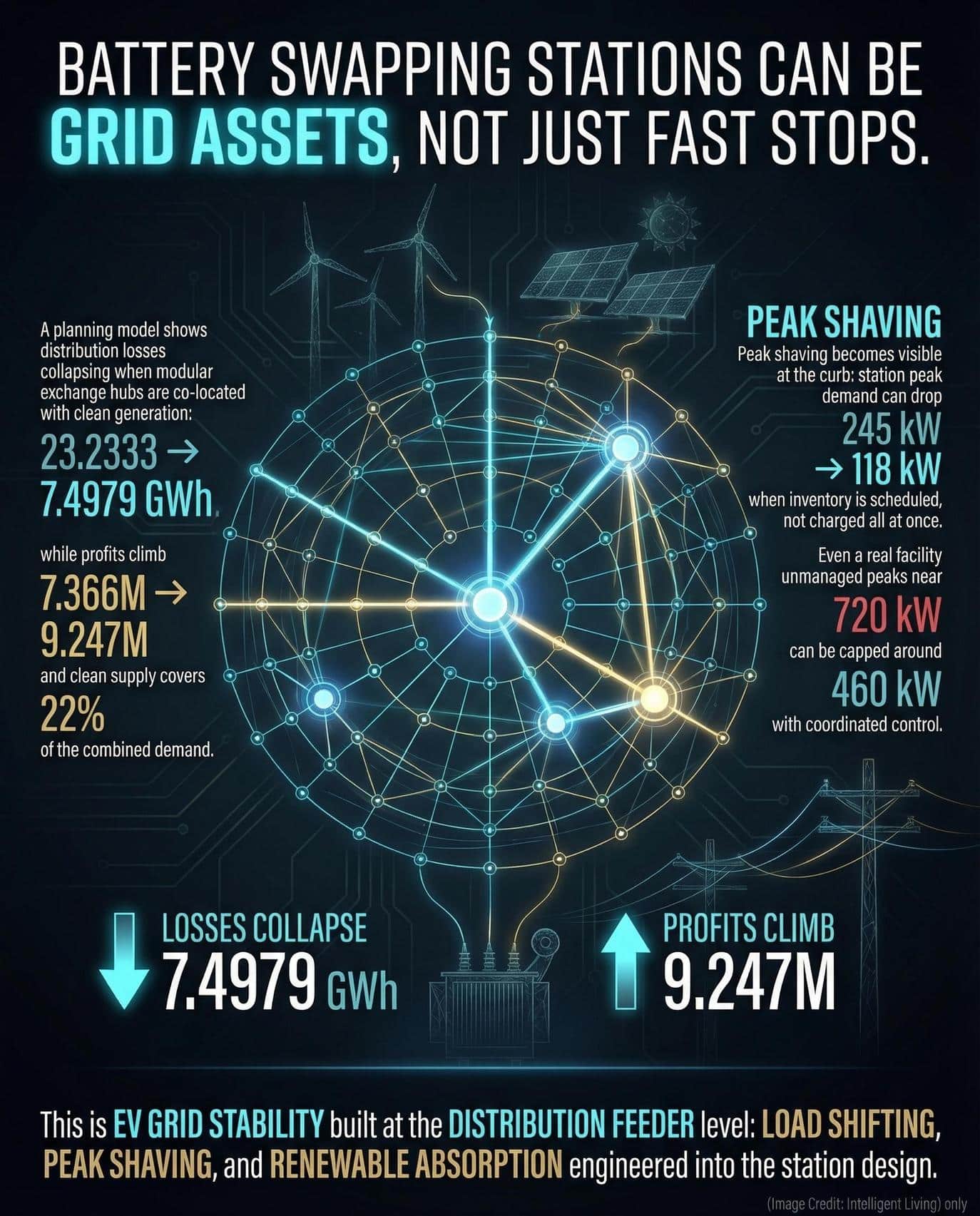
EV Battery Swapping and Grid Stability Quick Facts
- Scale: Electric vehicles consumed approximately 130 TWh of electricity in 2023. Surge projections indicate demand reaching nearly 2,200 TWh by 2035 under current stated policy scenarios.
- Freight Electrification: Rapid fleet electrification, including the arrival of 54,000 electric trucks on U.S. roads, underscores why heavy-duty depot loads create localised distribution challenges.
- Planning: A 2025 Scientific Reports model demonstrates that energy losses decline sharply through renewable energy integration. This occurs when battery swapping is co-located with wind and solar assets instead of operating as a standalone load.
- Economics: Modelling identifies higher profits in the co-allocation scenario over a ten-year horizon. However, this approach requires a longer payback period compared to standalone swapping operations.
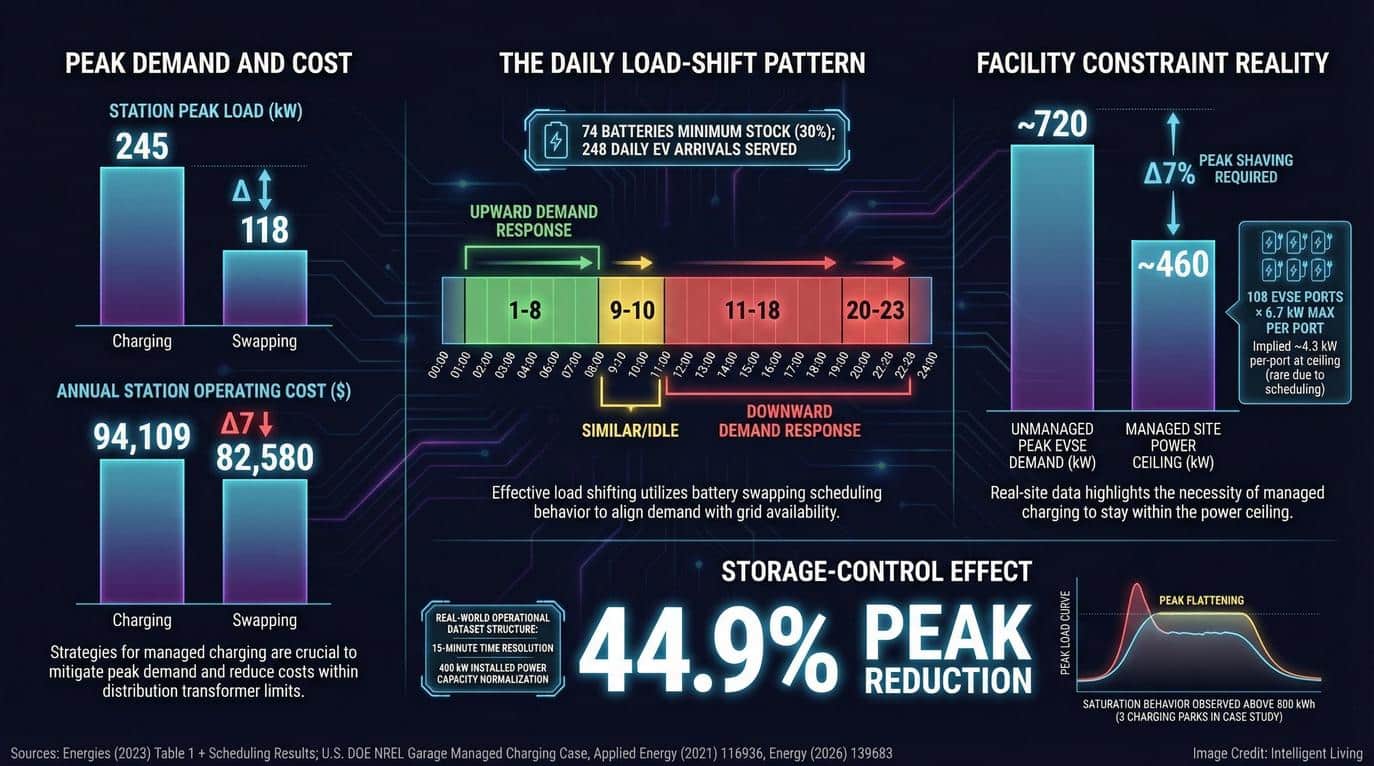
- Peak Load: Case studies comparing EV fast charging to swapping report peak station load dropping from 245 kW to 118 kW when adequate battery inventory is maintained.
- Operations: Empirical data confirms that battery-swapping networks directly influence physical grid health and operational profitability.

Where EV Charging Stresses the Grid and Why Swapping Works Differently
The Problem Nobody Sees: EV Load Hits the Grid Where It Hurts
Electric vehicles seldom strain the grid through total annual consumption; instead, the technical challenge emerges as localised load clusters that overwhelm feeders and transformers during peak hours. Infrastructure expansion to support 2.5 million public charge points identifies distribution-level constraints as the primary hurdle for grid reliability.
Strategic managed charging facilitates infrastructure stability:
- Managed charging protocols allow operators to maintain a collective demand ceiling near 460 kilowatts.
- Coordinated scheduling ensures transformers remain within safe thermal limits.
- Managed charging strategies significantly reduce the need for immediate, expensive hardware upgrades.
Aggressive rollouts of on-street EV charging networks significantly broaden driver access while simultaneously concentrating load on ageing circuits originally designed for residential lighting. This concentration requires rigorous circuit-level planning to prevent transformer overloads in small business districts.
The Renewable Sponge Station (The Reframe)
EV battery swapping fundamentally alters distribution dynamics by decoupling charging intervals from mobility demand. Drivers swap a pre-charged battery while the station charges inventory in calmer hours. Designers are already testing swappable battery trailers as a solution for extending the range of passenger vehicles on long-distance routes. In contrast, a swapping station’s inventory is fixed and tied directly to feeder constraints, making it highly schedulable.
Inherent operational flexibility enables swapping stations to synchronise mobility demand with renewable supply cycles. Community-level selling of rooftop solar power directly to nearby businesses demonstrates how consumption can be synchronised with local solar generation to reduce feeder stress. Projects pairing generation with storage, including offshore solar farms that integrate battery systems, prove that shifting energy in time is as valuable as producing it.
Vehicle-grid integration (VGI) provides the framework for aligning charging behaviour with intermittent renewable output and real-time market signals. Fleet pilots, like the London vehicle-to-grid trial that treated parked buses as a virtual power station, show how storage can become flexible capacity when the system is designed to use it.
The Proof and the Payoff: Co-Allocating Swapping with Wind and Solar
The New Modelling Proof: Co-Allocating Swapping and Wind and PV on the Distribution Grid
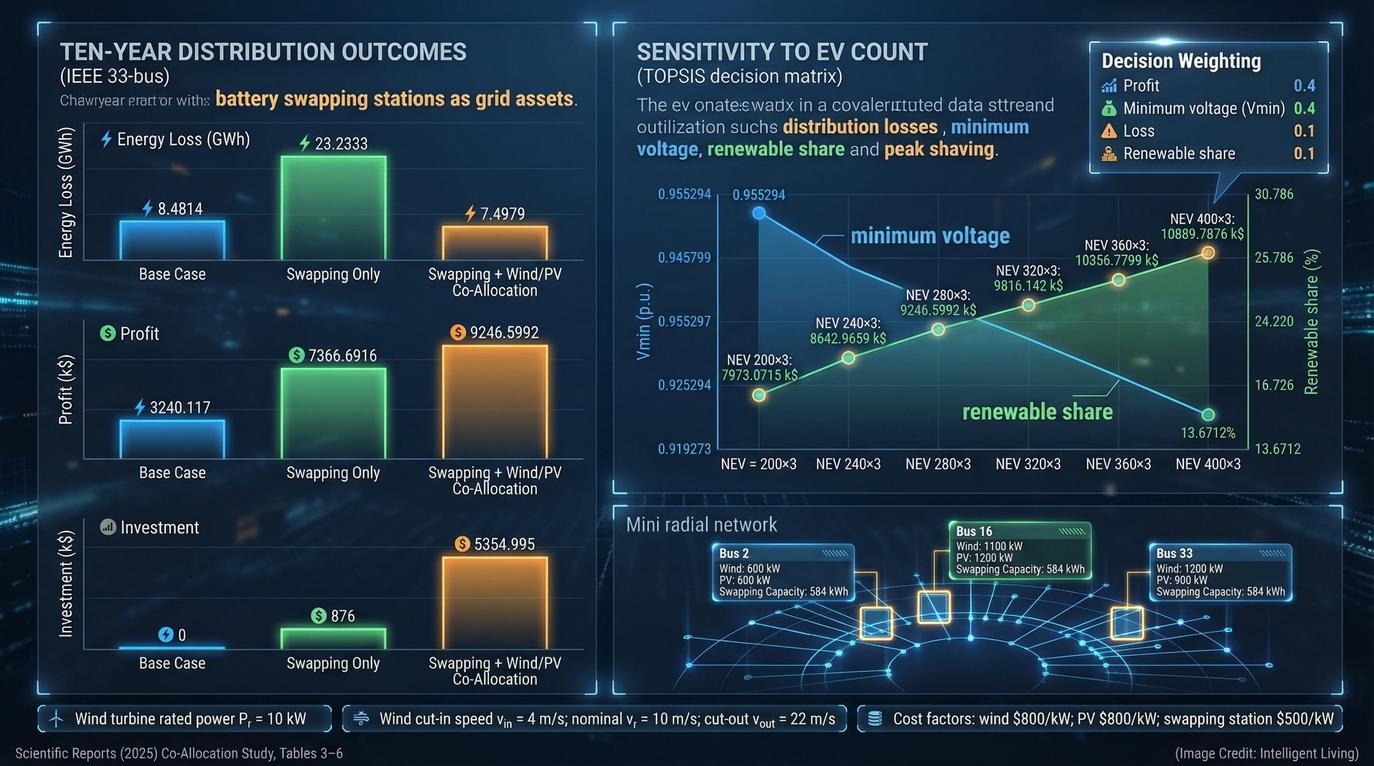
Advanced modelling of co-located swapping and renewables reveals that treating stations as grid infrastructure rather than standalone loads drastically improves physical performance. Researchers utilised an IEEE 33-bus radial network to model energy flows. They compressed a year of hourly data into clusters and optimised station sizing using particle swarm optimisation.
The modelling highlights the physical impact of co-location on energy losses over a ten-year horizon:
- Base case ten-year energy losses: 8.4814 GWh.
- Standalone swapping without renewables: 23.2333 GWh.
- Co-located swapping with wind and solar: 7.4979 GWh.
- Economic performance: Profit rose from $7.36 million to $9.24 million in the co-allocation case, representing a 22 per cent renewable contribution.
Strategic placement and co-location fundamentally improve physical grid performance and reduce energy losses.
Peak Shaving You Can Feel: Why Swapping Changes the Shape of Demand
Planning is half the story. Operations determine whether a station behaves like a flexible node or a new peak-load problem. The broader direction is energy becoming more mobile and more scheduled, from station inventory to experiments like charging robots that bring EV battery waggons to parked cars.
Comparative analysis shows that swapping-based peak shaving can reduce station load from 245 kilowatts to 118 kilowatts when inventory is managed intelligently. Reducing peak demand by 48 per cent effectively alleviates the immediate need for neighbourhood transformer upgrades.
Coordinated control of on-site storage reduces peak load at the grid connection point by up to 44.9 per cent, illustrating how storage flattens grid-facing demand. Large charging hubs with integrated storage show similar physics to swapping stations, proving that energy storage is the primary mechanism for load levelling.
Transforming EV Infrastructure into Managed Grid Assets
Turning Mobility Infrastructure into Grid Infrastructure
Optimising swapping infrastructure requires rigorous planning around feeder strength, voltage limits, and documented interconnection capacity prior to site development. Community pilots already test what it looks like when local energy is routed with software, including algorithm-driven neighbourhood energy-sharing experiments that coordinate supply and demand.
Engineering tools such as NREL’s EVI-DiST distribution system integration tool model transformer and feeder impacts. Simultaneously, the IEA EV charging and grid integration tool helps compare charging patterns against local peak windows.
Managed charging scenarios lead to large reductions in incremental grid component needs, including sizeable reductions for substations, feeders, and service transformers. These findings, from the Department of Energy’s multi-state transportation electrification impact study, justify early investment in smart scheduling.
The Advanced Layer: Frequency Regulation and Grid Stability
Grid disturbances and frequency deviations highlight the critical role of EV battery swapping inventory as a balancing resource. A UK disturbance underscored why large-scale battery energy storage can respond quickly enough to stabilise frequency, even when slower resources cannot ramp in time.
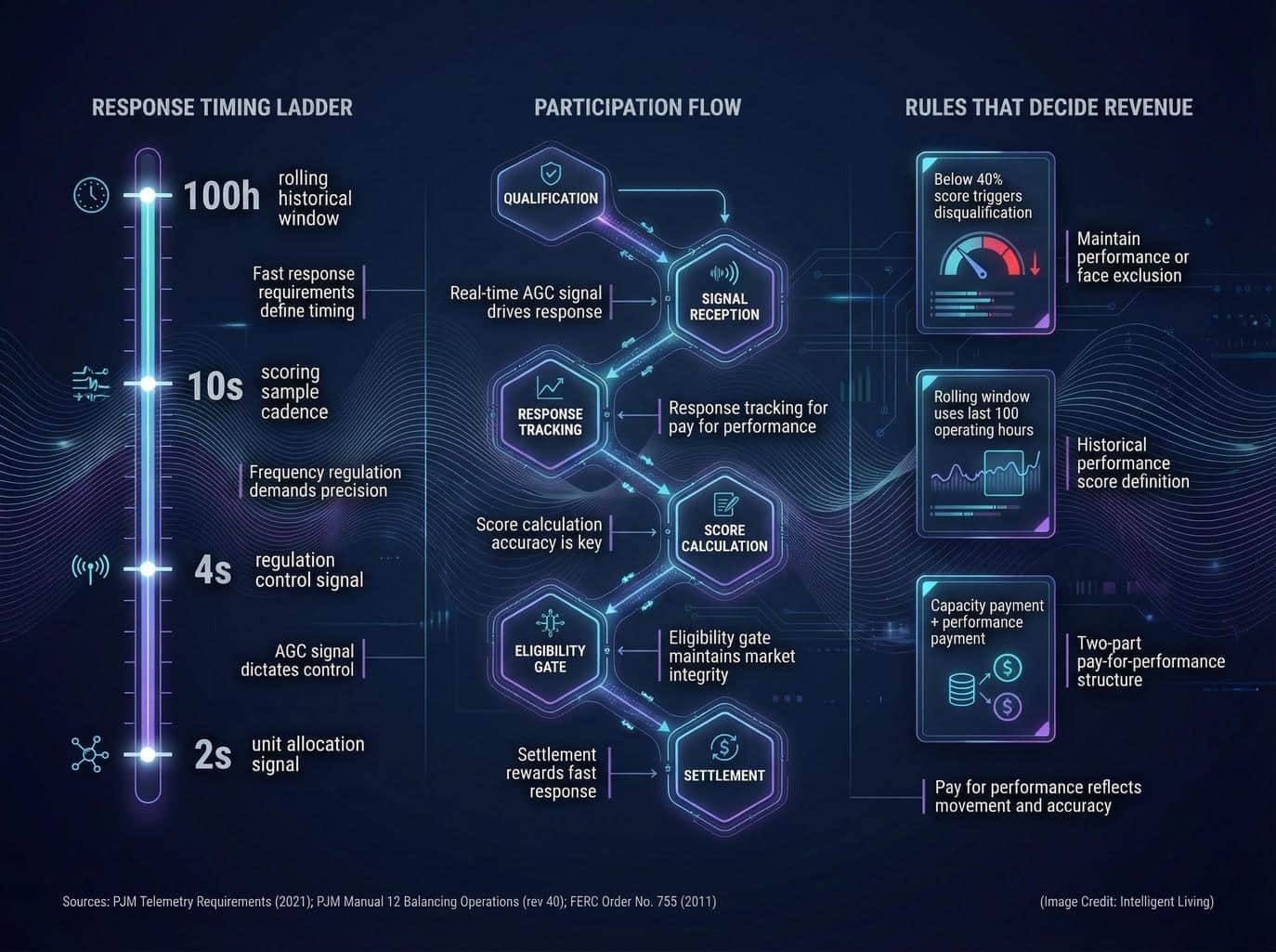
Study in Energy on frequency regulation markets outlines how stations bid into day-ahead participation. This model allows for real-time adjustments even under grid uncertainty. Recent research into deep Q-network scheduling to balance battery inventory with frequency response commitments shows how stations can balance real-time requirements. This approach demonstrates that grid services and customer swaps can be co-optimised through a robust control layer.
Strategic Design Criteria for Grid-Resilient Swapping Networks
Designing EV battery-swapping stations as grid assets requires deliberate coordination across planning, engineering, and operations. The checklist below translates the research into practical steps.
Site Selection and Grid Capacity Assessment
- Analyse feeder capacity, transformer ratings, and voltage constraints using distribution-level models.
- Prioritise interconnection readiness, including realistic upgrade timelines and costs.
- Consider renewable proximity where local generation can supply battery inventory charging, including corridor approaches like off-grid solar highway charging nodes designed for resilience.
Skipping technical assessments often leads to prime retail locations being unviable due to expensive, unforeseen transformer reinforcement requirements. Thorough site selection ensures that local generation can keep essential charging running during outages.
Renewable Co-Location and Sizing Strategy
- Integrate wind and photovoltaic sizing into initial swapping demand models to ensure renewables are fundamental to the architecture.
- Validate multiple demand scenarios against high EV visit rates to prevent inventory shortages during peak periods.
- Validate outcomes against grid performance metrics such as losses and minimum voltage.
Operational Scheduling and Peak Management
- Implement managed charging for battery inventory so charging occurs in off-peak hours where possible.
- Use price signals and load forecasts to avoid coincident peaks.
- Maintain sufficient battery stock to prevent real-time charging surges during busy periods.
Driver arrivals peak during midday in weekend travel corridors, but stations that intelligently charge inventory during pre-dawn lulls ensure seamless service without creating severe transients. This operational scheduling turns a high-level concept into actionable design criteria.
Advanced Grid Services Readiness
- Confirm eligibility for frequency regulation or other ancillary services.
- Ensure telemetry, communications, and response-time requirements can be met.
- Separate a safety buffer of inventory so grid services do not compromise customer swaps.

Strengthening Grid Resilience through Scalable Battery Swapping
The transition to a renewable-powered transport sector hinges on the ability to manage energy as a mobile and flexible resource. Current modelling and operational data underscore a definitive shift: EV battery swapping networks serve as a dual-purpose solution for both driver convenience and grid stability. When co-located with wind and solar assets and sited with distribution constraints in mind, these stations drastically reduce feeder stress and energy losses. Storage serves as the bridge between intermittent supply and constant demand, as evidenced by a utility plan to add 1 GW of battery storage across a US renewables fleet.
Integrating these technologies ensures the rise of electric vehicles strengthens regional infrastructure rather than creating new distribution vulnerabilities. Beyond lithium-ion, long-duration options like iron-air battery deployments designed for long-duration grid storage and home-scale hydrogen storage will join swapping stations in a multi-layered flexibility ecosystem. Strategic deployment today ensures a reliable energy future where transport demand actively supports the clean energy transition.
Frequently Asked Questions: Battery Swapping and Grid Stability
How do battery-swapping stations help stabilise the power grid?
Swapping stations act as flexible storage nodes that charge battery inventory during off-peak hours and discharge energy—or provide swaps—during peak times, reducing strain on local transformers.
Can battery-swapping stations store renewable energy?
When paired with wind and solar generation, swapping stations operate as ‘renewable sponges’ that absorb clean energy for later distribution to electric vehicles.
Is battery swapping better for the grid than fast charging?
Fast charging creates sudden, massive spikes in demand on distribution feeders, whereas swapping allows for ‘managed charging’ of batteries at a slower, more grid-friendly pace.
What are the economic benefits of co-locating swapping with solar?
Research indicates that co-allocating swapping with renewables can increase profit margins by up to 25% and reduce energy losses on the grid by nearly 60% over a ten-year period.
Do swapping stations participate in frequency regulation?
Technically, yes. Because they hold large amounts of battery storage, swapping stations can bid into markets to help maintain the grid’s balance between supply and demand in real time.


