
The quest to replicate the intricate flight mechanics of nature’s smallest aviators has long challenged the boundaries of modern engineering. Miniature insects, capable of executing gravity-defying somersaults and instantaneous aerial pivots, exhibit a degree of agility that current fixed-wing or quadcopter platforms fail to replicate.
Researchers at the Massachusetts Institute of Technology have now bridged this technological chasm by developing a robotic bumblebee capable of mimicking these complex biological movements with staggering precision.
Replicating Biological Flight: The MIT Micro-Robot Achievement
This MIT micro-robot represents a pivotal shift in insect-scale flight, weighing less than a gram yet exhibiting the resilience required for real-world deployment. By moving beyond traditional rigid programming, the team has implemented an AI robot control system that allows the machine to adjust its wing beats mid-flight. This advancement, described in aerobatic insect-scale aerial robots research and a bumblebee-like aerial microrobot report, is more than just a laboratory stunt. It provides a blueprint for future microrobots designed to navigate environments once considered inaccessible to human-made machines.
To grasp the magnitude of this AI control breakthrough, one must examine the synergy between soft robotics actuators and machine learning flight models. Engineers utilized dielectric elastomer actuators to power four flapping wings, creating a platform that responds to air disturbances with insect-level agility. This fusion of hardware and software brings us closer to a future where autonomous micro-robots can perform critical roles in disaster response and infrastructure inspection.

Quick Facts: The Micro-Robot that Mimics Nature’s Flight
The technical specifications of this microrobotic platform reveal a startling convergence between electronic engineering and biological efficiency. By quantifying the robot’s performance, researchers have demonstrated that it is possible to achieve insect-level agility within a synthetic framework. These metrics underscore the leap in capability that this new generation of flyers represents:
- Weight and Size: Approximately 750 milligrams and 4 centimeters wide, about the size of a large bumblebee.
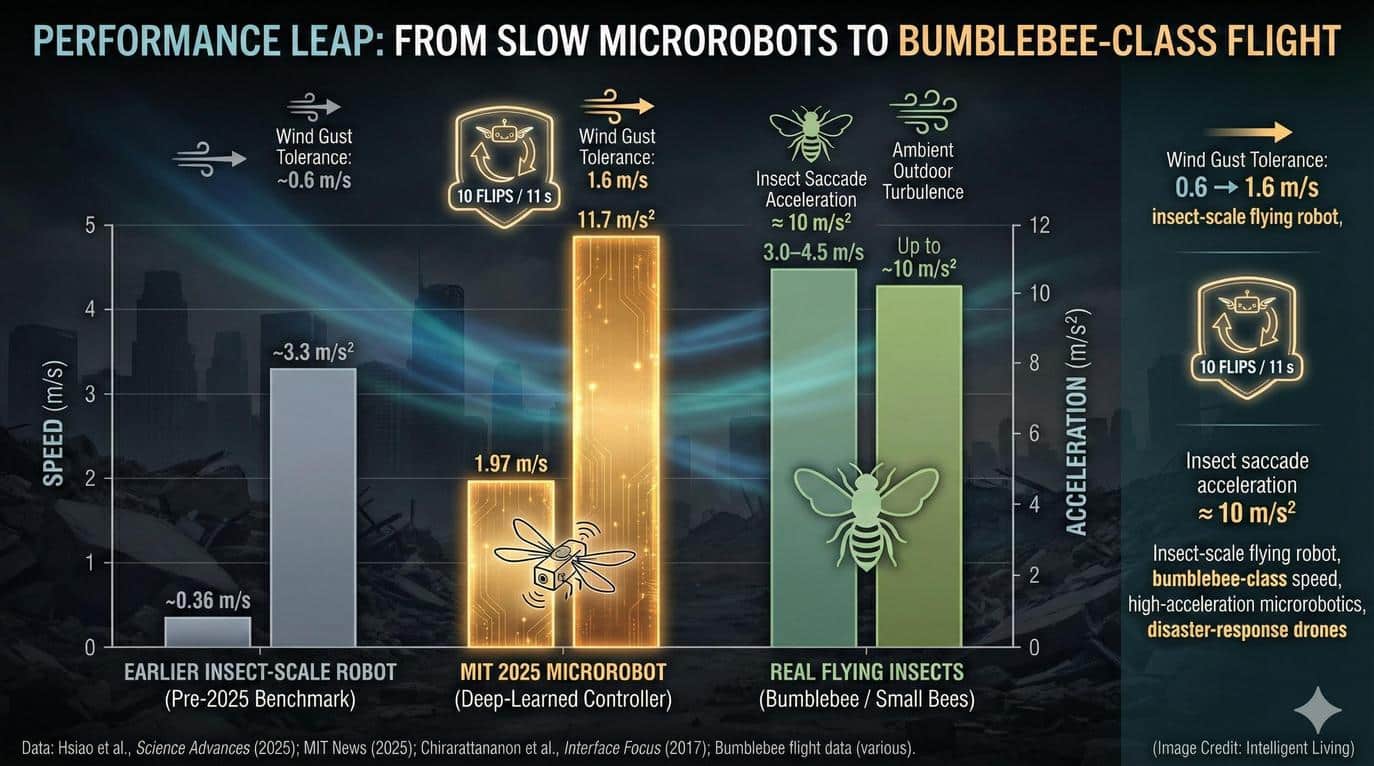
- Speed: Reaches up to 1.97 meters per second, or roughly 197 centimeters per second, comparable to insect-level agility.
- Acceleration: Achieves 11.7 meters per second squared, a 255% improvement over previous models.
- Aerobatics: Completes 10 flips in 11 seconds, showcasing both power and precision.
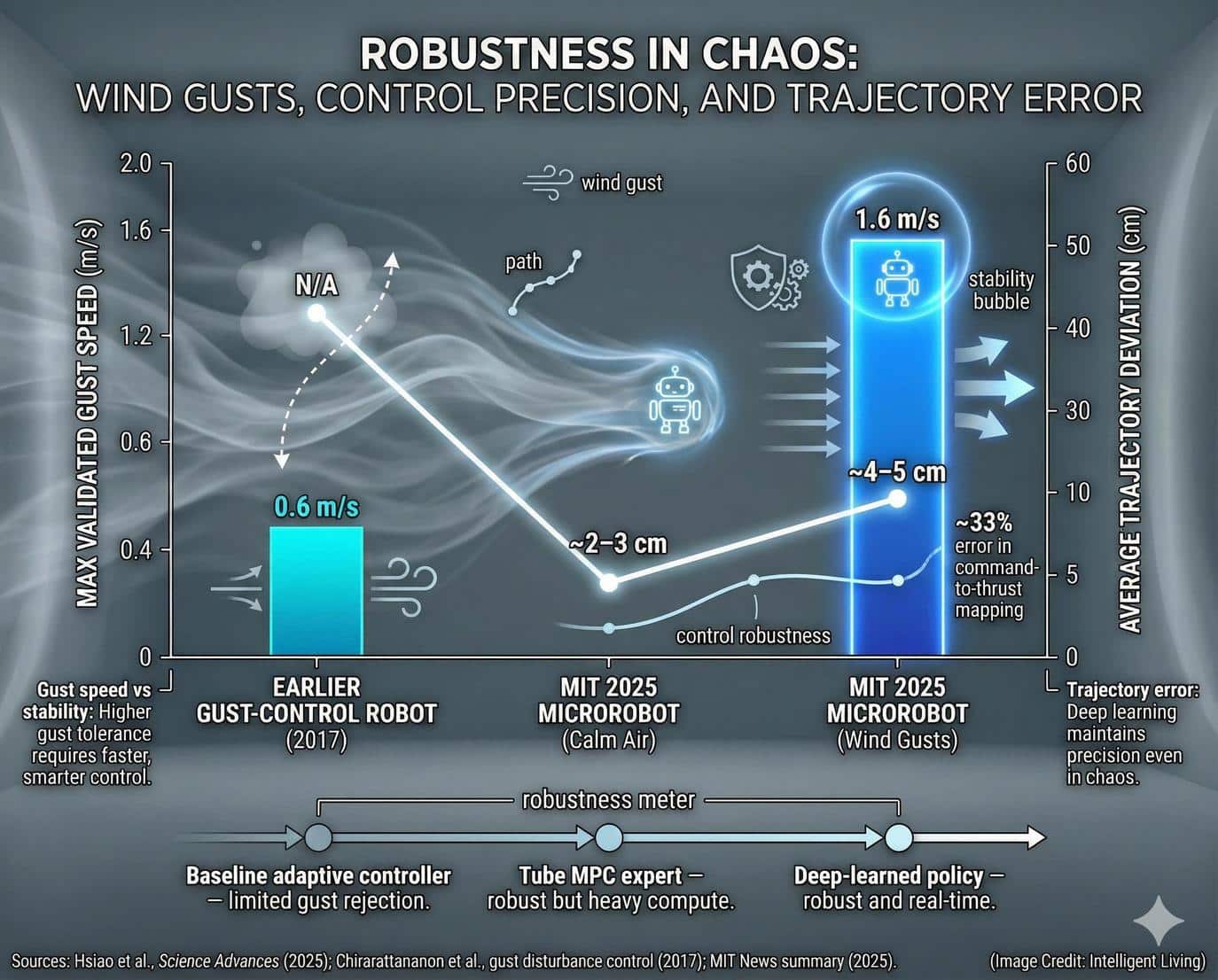
- Durability: Maintains performance in wind disturbances up to 1.6 meters per second.
- Power and Control: Currently tethered for energy supply and controlled externally, but demonstrates robust maneuvering that sets the stage for future onboard autonomy.
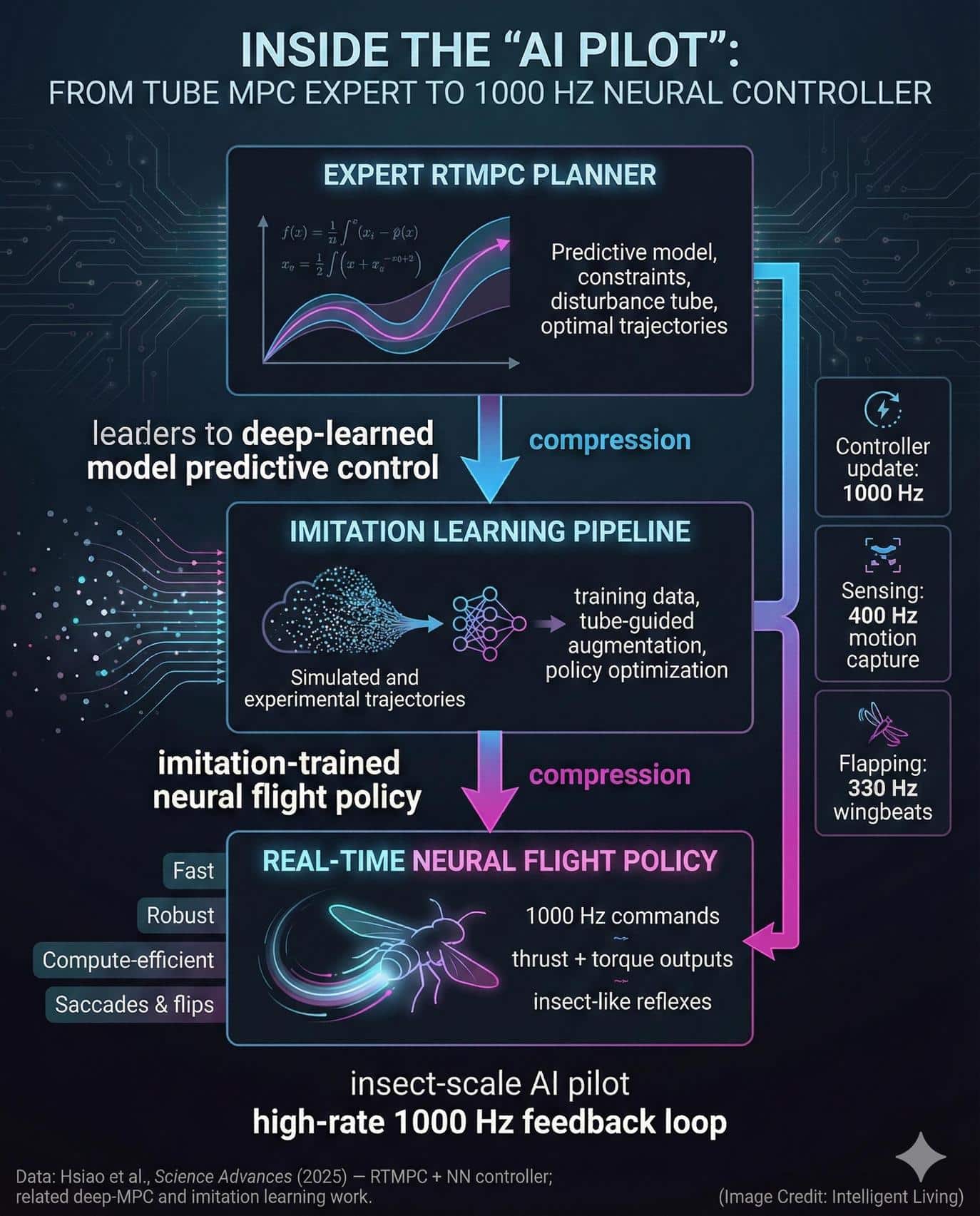
- Core Innovation: A hybrid AI system combining robust model predictive control (MPC) with deep-learning imitation models that allow the robot to adjust instantly to changing airflow and manufacturing imperfections.
The platform exists within an emerging robotic ecosystem featuring nature-inspired seed-planting gliders and AI-guided aquatic waste collection units, emphasizing specialized autonomy for environments beyond human reach. By achieving such high acceleration and durability, the MIT micro-robot moves from the realm of static laboratory testing into the domain of dynamic, real-world utility.
Engineering the Robotic Bumblebee: Soft Actuators and Synthetic Muscles
Architecture of Soft Muscle Actuators
While the MIT robotic insect initially resembles a miniature hybrid of a microchip and a dragonfly, the underlying architecture replicates biological flight mechanics with unprecedented accuracy. Minor inconsistencies in material thickness or fabrication processes often compromise a robot’s equilibrium or propulsion; however, the integrated AI controller in MIT’s platform autonomously neutralizes these discrepancies. Unlike traditional drone propellers which spin to generate lift, these actuators flex and snap back rapidly. This motion creates dynamic wing beats that closely mirror real insect flight.
Precision Tuning and Flapping Dynamics
To the human eye, these wings blur into motion, flapping around 330 times per second. That frequency allows the robot to produce the complex aerodynamic forces necessary for hovering, darting, and even flipping. What sets this project apart is how precisely these tiny actuators are tuned. Small variations in material thickness or fabrication could easily throw off the robot’s balance or thrust, but MIT’s system compensates automatically through its AI controller.
Stability Amidst Environmental Uncertainty
The design goal was not merely to mimic insect flight but to achieve insect-like stability under uncertainty. In the real world, a guest of wind, a manufacturing imperfection, or a change in temperature could destabilize such a lightweight flyer. Yet the robot continues flying smoothly, guided by a predictive model that helps it anticipate changes before they happen, a kind of mechanical intuition born from machine learning.
Benchmarking Performance: Insect-Level Agility and High-Speed Maneuvers
While flying at 1.97 meters per second mirrors the natural cruising speed of real bumblebees, this velocity represents a staggering leap in performance for a machine that weighs barely more than a paperclip. During rigorous testing, the machine successfully performed ten consecutive somersaults in only eleven seconds, demonstrating robust robotic insect flight maneuvers under unpredictable conditions while maintaining perfect orientation recovery.
The platform sustained its agility through wind gusts reaching 1.6 meters per second, a velocity comparable to the airflow of a high-powered indoor fan. Achieving this level of environmental resilience overcomes a historical barrier in insect-scale robotics, where even marginal air disturbances typically induce catastrophic flight failure. These feats prove that flapping micro-robots can now sustain high-speed maneuvers with both accuracy and resilience, a hallmark of biological flight. It is this combination of speed, agility, and adaptability that elevates the MIT robot beyond previous prototypes and into a new class of performance entirely.
The Breakthrough isn’t Just Hardware, it’s the Control Stack
Limitations of Traditional Robotic Control
While the robot’s hardware is impressive, the real magic lies in how it is controlled. Traditional robotic control systems rely on rigid programming that assumes predictable environments. Conventional methods prove insufficient at the micro-scale, where even microscopic atmospheric shifts can throw the robot into an unrecoverable tumble.
Neural Learning and Model Predictive Control Synergy
To resolve this instability, MIT engineers combined model predictive control (MPC) with a neural imitation learning algorithm trained to mirror the MPC’s decision-making. The MPC functions as a virtual expert pilot, continuously calculating optimal wing trajectories by forecasting future states through complex mathematical models of flight dynamics. The neural model, by contrast, acts as a student, watching the expert’s behavior and learning to replicate it in real time. Once trained, this AI “pilot” can respond almost instantaneously, freeing the robot from the heavy computational burden of full MPC calculations.
Developing Artificial Reflexes for Erratic Atmospheres
This hybrid approach gives the robot a sort of artificial reflex. Integrating learned reflexes mirrors a broader industry shift toward neural-style computation for organic machines, enabling more flexible and context-aware decision-making in erratic atmospheres. When it encounters a sudden gust of air or a mechanical inconsistency, it does not wait for complex computations to finish. Instead, the AI controller adjusts the wing force on the spot, keeping flight smooth and stable. Researchers describe it as a balance between predictive precision and reactive agility, a partnership of physics and learning that allows the robot to operate under uncertainty with remarkable grace.
Advancing Biohybrid and Soft Robotic Systems
Ultimately, the MIT team has engineered a system that transcends simple command-following, mastering the intrinsic cadence of flight. This progress connects the work to advancements in biohybrid robotic control, where designers increasingly merge biology and soft robotics to handle fragile environments. This union of soft materials, smart algorithms, and control theory brings us closer than ever to creating autonomous micro-robots that could one day work alongside humans in dangerous or inaccessible environments.
Why Agility Matters for Real Life: Rubble Gaps, Smoke, and Tight Infrastructure
The unique agility of these microrobots enables them to perform critical tasks in spaces where traditional equipment fails. By navigating restrictive environments, these tiny flyers offer solutions across several vital industries:
- Disaster Recovery: Navigating structural crevices to locate survivors or assess stability in post-earthquake zones.
- Industrial Inspection: Slipping between complex machinery to monitor hidden components for wear or failure.
- Ecological Monitoring: Exploring delicate habitats to gather scientific data without disrupting the natural environment.
Navigating Disaster Zones and Industrial Crevices
Deploying swarms of these flyers leverages extreme microrobot agility to penetrate debris gaps, enabling rescuers to pinpoint survivors or evaluate structural integrity in dangerous insect-scale flight operations without endangering human personnel. MIT’s achievement also lays the foundation for disaster-response robotics where weight, speed, and maneuverability are critical. The ability to perform flips and sharp turns means these robots can correct themselves in unstable airflows, such as smoke-filled environments or wind tunnels, where quadcopters often fail.
Synergy with Sustainable Agriculture and Conservation Drones
Technological convergence is already visible in hybrid driving and flying drones and the expansion of autonomous sustainable farming platforms. These insect-scale agents could eventually complement vertical and precision farming infrastructure by accessing the tightly cluttered spaces of modern agriculture. Researchers envision a future where fleets of micro-robots could gather data in environments hazardous to people, bridging the gap between human-scale drones and immobile sensors.
The Hard Part: Autonomy (Sensing, Compute, and Power)
Overcoming the Weight-to-Power Triad
Engineering success hinges on the precarious equilibrium between energy density, computational throughput, and structural mass. Since every additional milligram of hardware necessitates a corresponding increase in lift, this technical triad dictates the current limits of micro-aerial performance. Today’s prototype remains dependent on external motion-capture cameras for positioning and a physical tether for energy.
Integrating Next-Generation Micro-Sensing Pipelines
The path to untethered flight requires integrating specialized insect-scale sensors and low-power embedded compute pipelines capable of processing data without excessive mass. Once integrated, these technologies could eliminate the tether and make fully autonomous flight possible. Progress in autonomous humanoid endurance indicates that self-sufficient robotic capabilities are rapidly moving beyond lab environments. Each component adds mass, which in turn demands more lift and power. Solving this equation is what will transform today’s proof-of-concept robot into a self-sufficient explorer.
Swarm Intelligence: Coordinating Fleets of Insect-Scale Flyers
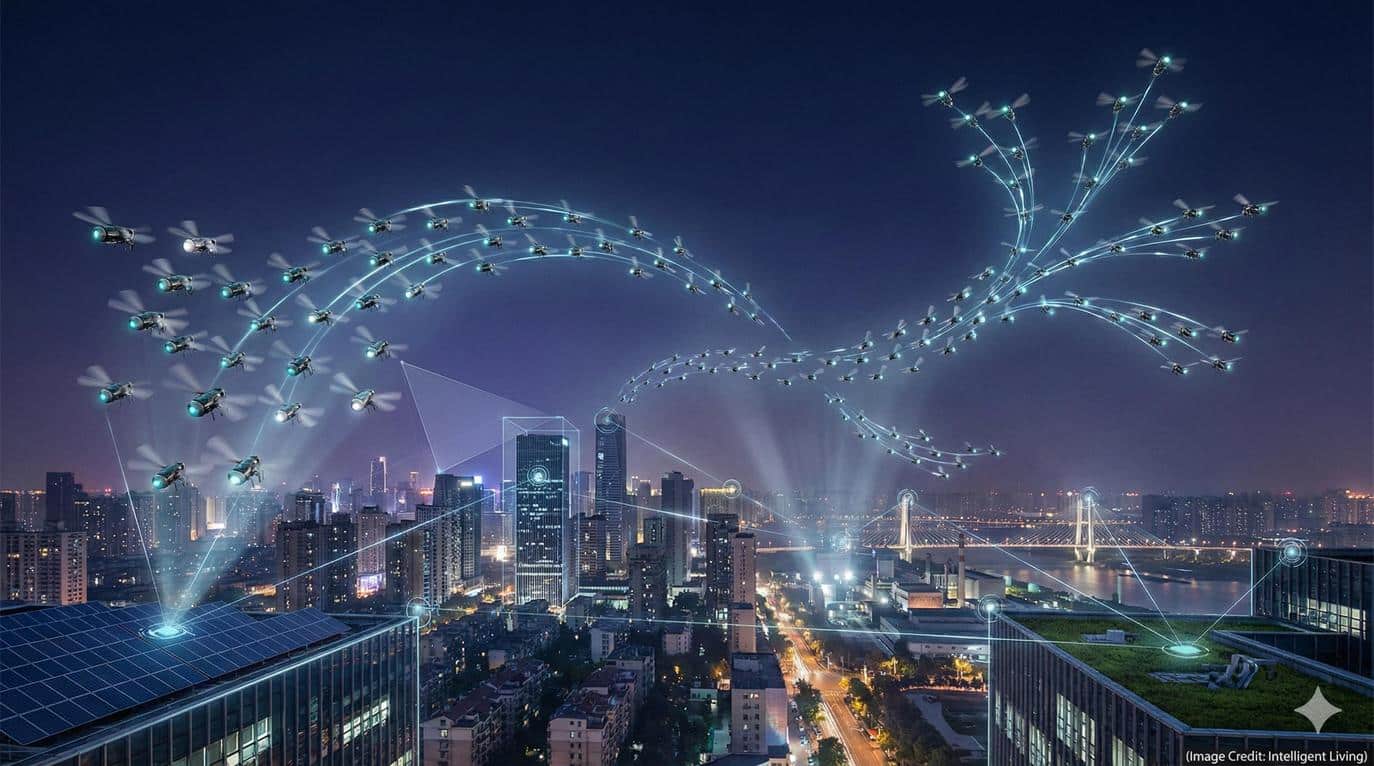
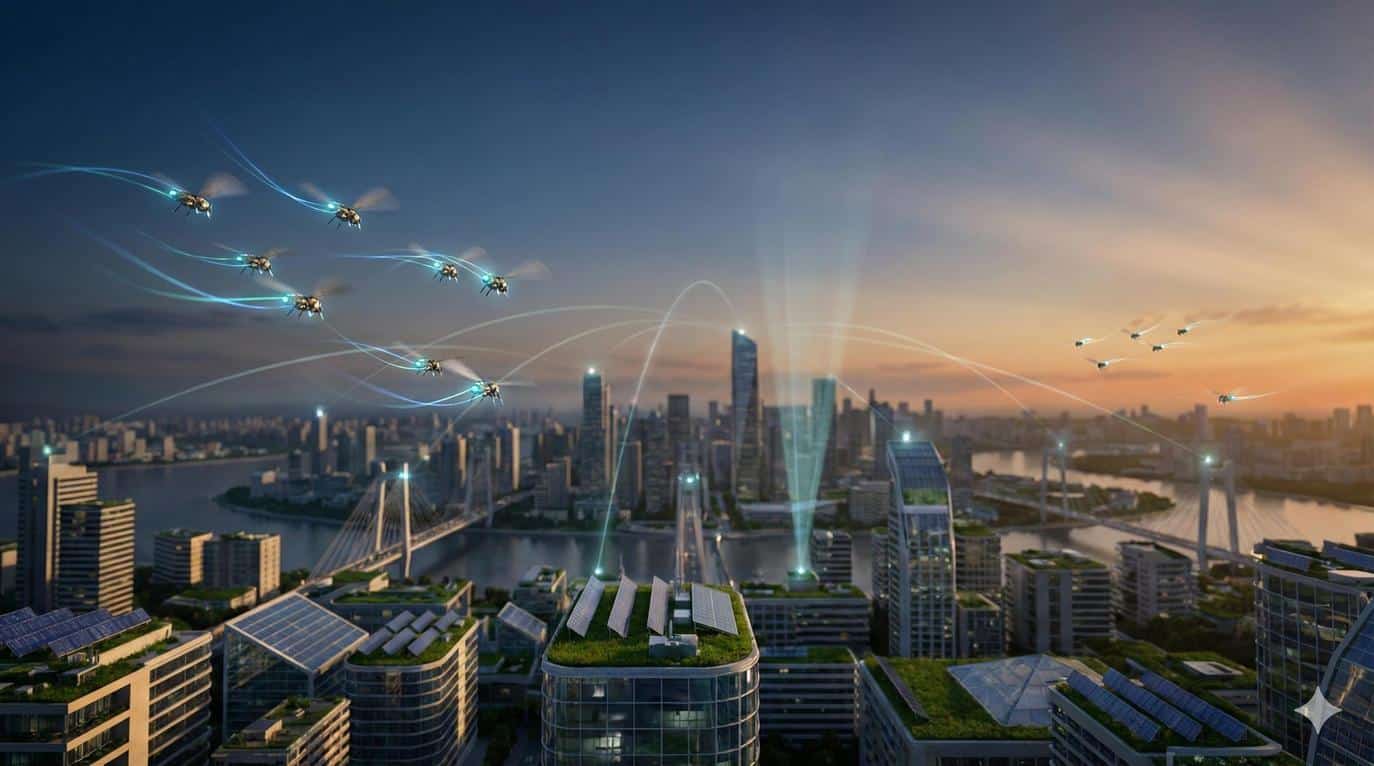
Scaling from a single micro-robot to a coordinated swarm introduces new levels of complexity, requiring each unit to maintain awareness of its peers to avoid collisions and share sensor data without the need for centralized control. The MIT research aligns with global efforts toward swarm intelligence, where collective behavior emerges from simple rules. Future applications include fleets of flyers capable of midair structural reconfiguration, allowing them to transition seamlessly through restrictive gaps in disaster zones. Advancements in micro-robotics shift the focus from individual mechanical perfection toward the emergent collective capabilities of massive, decentralized swarms.
Governance and Ethics: Regulating Miniature Aerial Technology
As flying machines shrink in size, new questions arise about privacy, airspace safety, and governance. While current remote identification regulations target larger drones, the emergence of insect-sized flyers necessitates a new tier of public accountability. The widespread adoption of insect-sized flyers will necessitate the development of robust regulatory frameworks that balance public accountability with the need for continued technological innovation.
From a safety perspective, micro-drones must meet rigorous reliability standards to prevent harm. The entry of these robots into confined spaces mirrors the privacy considerations surrounding autonomous odor-tracking sensors, requiring transparent guidelines for data collection and use. Upholding ethical standards requires total transparency and clear communication regarding the deployment, control, and data-collection protocols of these micro-robotic systems. Proactive governance will ultimately determine if these micro-robotic tools evolve into essential emergency aids or remain subjects of public concern.
Technical Resilience and the Future of Robotic Flight
The synthesis of dielectric elastomer actuators and neural imitation learning has produced a resilient machine capable of thriving within the chaotic turbulence of natural environments. This validated achievement in miniature engineering proves the application of nature-inspired design to solve complex stabilization problems. While current versions remain tethered for power, the underlying control stack provides the necessary intelligence for future autonomous operation in high-stakes environments.
Successfully scaling flight technology necessitates a rigorous optimization of mechanical output against limited onboard computational resources. As these insect-scale aerial robots evolve, they will likely become indispensable tools for searching through earthquake rubble or monitoring delicate ecosystems. The transition from lab-bound prototypes to field-ready agents hinges on our continued refinement of these AI control systems. The dissolving boundary between hardware and biology, exemplified by living robots made from stem cells called xenobots, suggests a future where machines operate as integral parts of the ecosystems they explore.
Essential Insights into MIT Robotic Insect Technology
How Fast Can the MIT Micro-Robot Fly?
The robotic bumblebee achieves speeds of 1.97 meters per second, matching the natural cruising velocity of real insects during flight.
What Role Does AI Play in Robotic Bumblebee Stability?
This AI robot control system integrates biomimetic engineering principles, utilizing predictive models and deep learning to neutralize manufacturing inconsistencies and atmospheric turbulence through real-time wing adjustments.
Are These Insect-Scale Aerial Robots Fully Autonomous?
Currently, the prototypes utilize external motion-capture cameras and a power tether, though research is ongoing to integrate onboard sensing and batteries.
Why Are Soft Robotics Actuators Used in the Wings?
Dielectric elastomer actuators act like biological muscles, allowing the wings to flap 330 times per second with extreme durability and lightness.
How Will Swarm Intelligence Benefit Microrobot Missions?
Swarm coordination allows tiny flyers to cover disaster zones with an efficiency that complements the deployment of eVTOL rescue aircraft in emergency response scenarios.


