
China’s industrial-scale rollout of polyolefin elastomer (POE) represents a significant materials milestone. This development has direct consequences for solar panel longevity and the long-term reliability of next-generation modules. Inside every panel, a clear polymer encapsulant serves as the primary barrier against environmental stress. This layer isolates cells from moisture and mobile ions, directly determining if an array maintains peak output beyond the standard 25-year lifecycle.
A CNPC subsidiary in Xinjiang transitioned POE from laboratory development to industrial-scale output in 2025, utilising a domestic gas-phase polymerisation route. Industrial value stems from measurable performance rather than branding. Success is measured through optical transmittance under standardised IEC procedures, which separates measurable durability from marketing claims.
Global dominance of n-type architectures and bifacial modules has forced a strategic pivot towards supply chain stability. Reliable access to high-quality POE resins ensures that manufacturers can meet stringent damp-heat and PID resistance requirements without facing the volatility of imported raw material shortages.
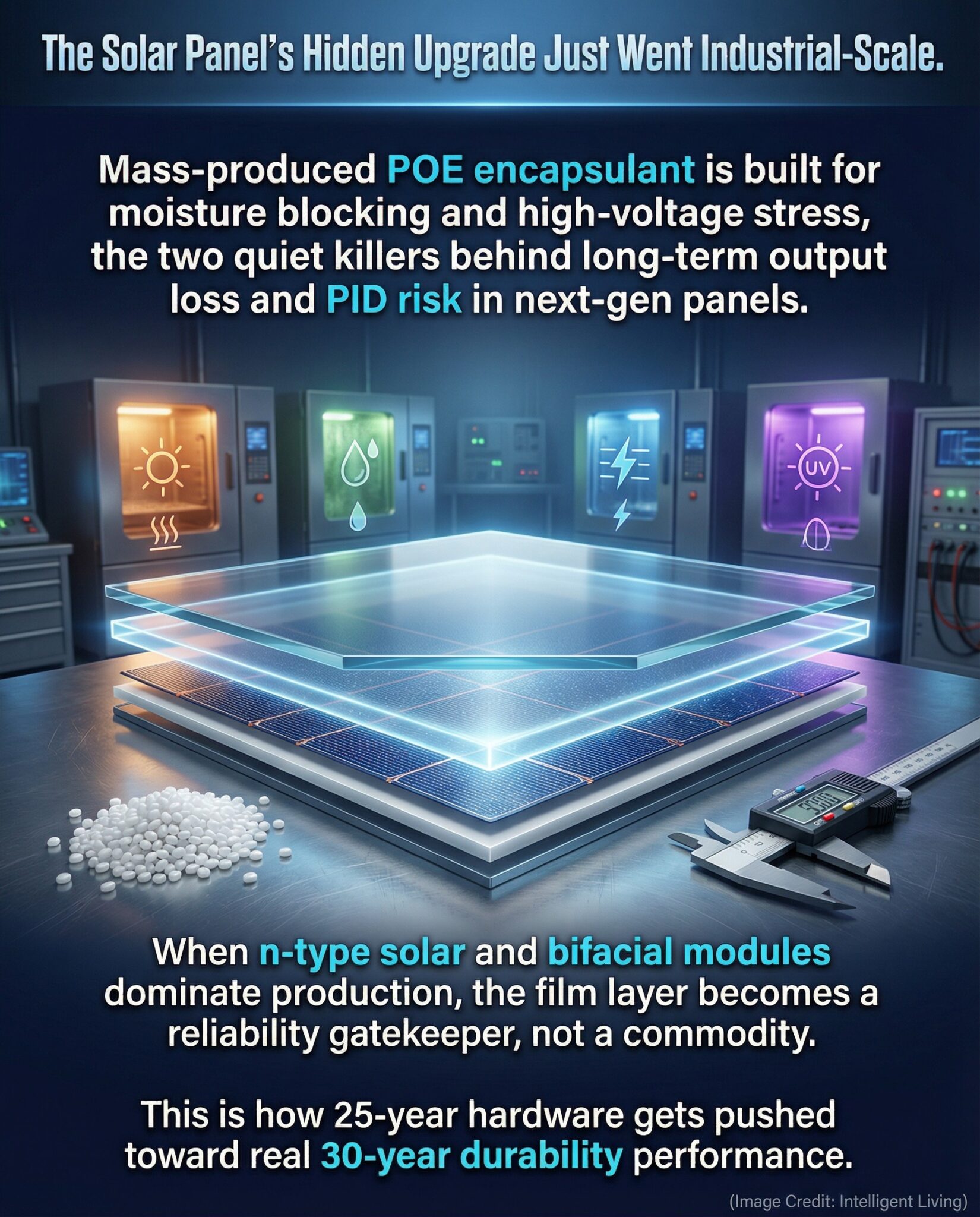
Critical Metrics: Xinjiang POE Scale-Up and Solar Reliability Benchmarks
Xinjiang’s current industrial trajectory includes several key milestones:
- Production capacity reached approximately 60,000 metric tonnes in 2025, securing domestic capacity for critical solar supply chains.
- Encapsulants are precision-engineered materials.
- Accelerated weathering cycles frequently trigger optical loss, degrading performance over time.
- NREL benchmarks on transmittance degradation across EVA, TPO, and POE demonstrate how transparency drifts as polymers age under thermal and UV stress.
- Manufacturing shifts towards global PV manufacturing trends show n-type technologies accounting for 70% of production, with bifacial modules exceeding 75%.
- Stress comparisons now include modern n-type designs including damp-heat TOPCon performance evaluations of EVA, POE, and EPE encapsulants, which helps put competing materials in the same test frame.
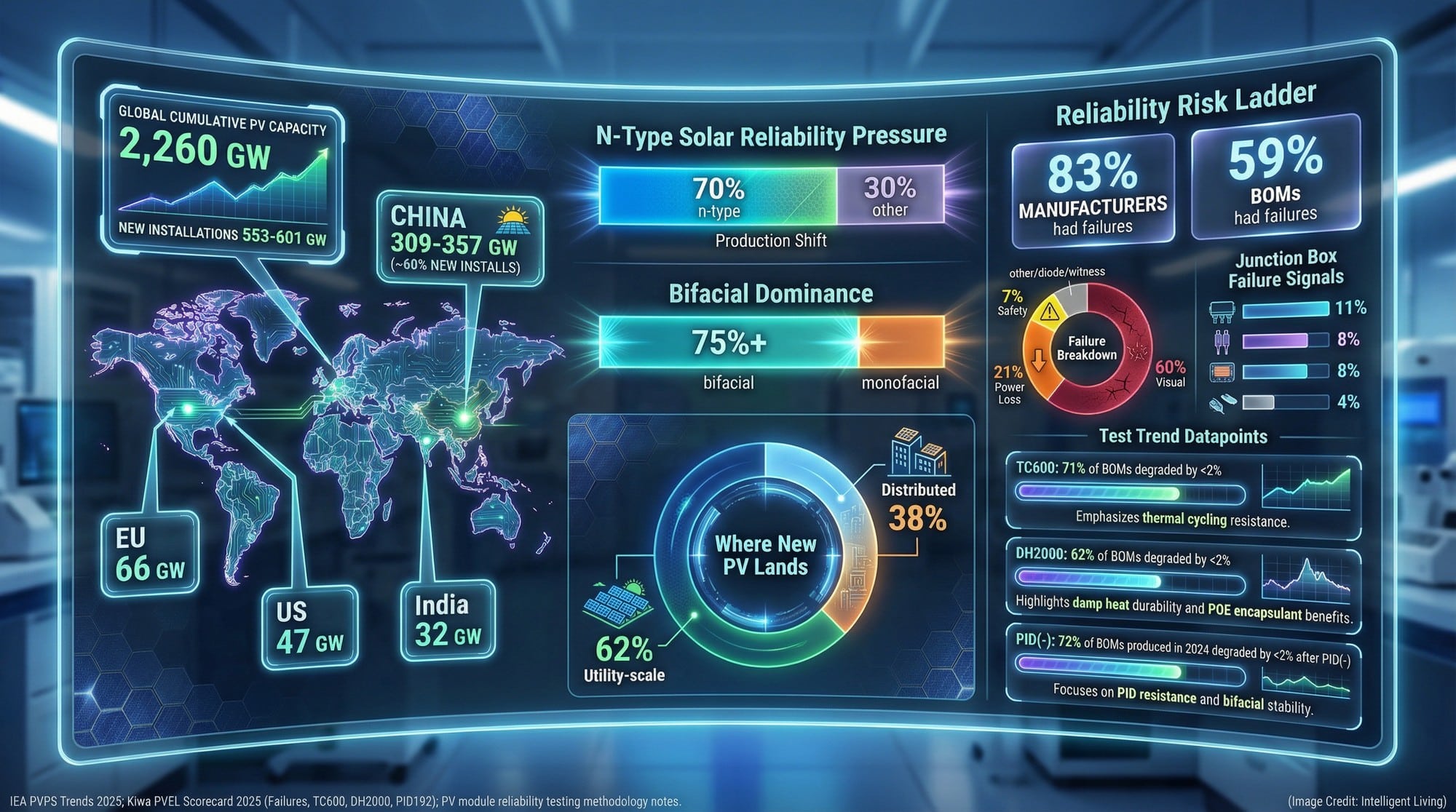
POE Encapsulants and the Reliability Shift in N-Type and Bifacial Solar
What is POE, and Why is it Inside So Many Next-Gen Solar Panels?
Polyolefin elastomer (POE) is a high-resistivity thermoplastic encapsulant that cushions mechanical stress while blocking moisture ingress and ion migration. Research on PV encapsulant degradation summarises why moisture, UV, and chemical by-products can matter as much as cell efficiency.
Encapsulant materials must meet rigorous operational standards:
- Maintain optical transparency and adhesion stability.
- Provide high electrical insulation and resistivity.
- Resist degradation from thermal and ultraviolet (UV) exposure.
Encapsulant Architecture: Protecting Crystalline Silicon from Environmental Stress
Encapsulants sit between the glass and the cells. Technically, the glass provides structural defence against mechanical impact, while the encapsulant mitigates chemical and electrical stressors that manifest over decades.
UV exposure, humidity, and thermal cycling do not crack a module overnight. These environmental factors quietly alter material properties over several years. Moisture remains a primary root cause for many common module failures observed in the field.
Studies of moisture ingress in photovoltaic modules reveal why even small permeability differences can cascade into larger performance losses over time.
Field monitoring often reveals subtle performance drifts after seasonal storm cycles, even when modules appear visually intact, highlighting the impact of internal material degradation. Over time, small changes inside the encapsulant layer can turn into measurable energy-yield loss, especially in hot or humid climates.
Performance Advantages: Moisture Resistance and Ion Migration Prevention
By reducing ion migration and enhancing moisture resistance, POE mitigates potential-induced degradation (PID). This voltage-driven failure pathway remains a focal point in the Energy & Environmental Science review of PID mechanisms and prevention. encapsulant materials for PV modules and environmental stress also clarify common engineering terms like resistivity, permeability, and adhesion.
The Reliability Arms Race: Why N-Type And Bifacial Designs Push Encapsulants Harder
Rapid transitions to n-type and bifacial designs have exposed new material stress pathways in recent field data. N-type architectures can operate under different electrical conditions than older p-type designs. Those conditions change how materials behave electrically, mechanically, and chemically.
Market Adoption: Why N-Type Solar Efficiency Demands Superior Protection
N-type solar adoption forces a procurement shift: long-term durability now outweighs simple nameplate efficiency. Bifacial modules generate power from both sides of a panel, creating back-side environmental stressors that vary widely based on mounting height, ground reflectivity, and local climate.
Emerging module designs, such as perovskite tandem solar cells, introduce new stability requirements that will continue to reshape encapsulant material selection.
Material Selection: Mitigating Degradation Pathways in Extreme Climates
Independent reliability testing has recorded frequent stress test failures across modern bill-of-materials combinations, and module reliability scorecard results provide a snapshot of how often manufacturers and BOMs show at least one failure across their test suite.
Subtle material ageing often masks performance issues, causing site managers to misdiagnose string failures. Effective protective stacks prevent these voltage-driven losses.

Supply Chain Evolution: Xinjiang’s Role in Global POE Production
EVA Vs POE Vs EPE: The Tradeoffs Manufacturers Are Actually Managing
Manufacturers typically evaluate three primary encapsulant options based on technical performance and cost-efficiency:
- EVA (Ethylene-Vinyl Acetate): Widely adopted and cost-effective, though durability depends heavily on specific formulation and material interactions.
- POE (Polyolefin Elastomer): Offers superior advantages in moisture resistance and voltage-driven stress conditions.
- EPE Hybrids: Combine layers to balance the benefits of both EVA and POE.
These material choices directly impact the long-term electrical and mechanical stability of the module stack.
Durability testing of encapsulant films for bifacial heterojunction photovoltaic modules confirms that polymer selection dictates yellowing resistance, adhesion stability, and electrical integrity.
In high-throughput lamination lines, minor adhesion or curing inconsistencies escalate into costly rework. These financial risks necessitate a phased approach to encapsulant transitions.
Manufacturing Precision: Lamination Parameters and Adhesion Stability
POE often requires different lamination parameters and supplier qualification steps to achieve consistent adhesion. Hybrid adoption is visible in commercial procurement, including orders tied to TOPCon-era module procurement that reflects how buyers sometimes blend materials to manage risk.
Adhesion is not a side issue. Bonding behaviour between encapsulants and steel shows how lamination temperature and surface preparation can change bonding outcomes for specialised BIPV modules.
China’s POE Milestone In Xinjiang: What Was Announced, And What It Changes
A CNPC subsidiary in Xinjiang moved a domestically developed gas-phase POE polymerisation process from lab to industrial scale in 2025, alongside rapid plans for capacity growth.
Industrial Reports: Xinjiang’s Domestic POE Production Capacity
The reported headline is simple: industrial-scale POE output is now happening domestically. Industrial-scale POE production capacity ramp-ups were described in state reporting, including claims about the specific domestic gas-phase route.
Strategic Implications: Reducing Global Supply Chain Volatility
Technical validation must now verify initial state claims. Robust domestic scaling will resolve supply bottlenecks for encapsulant film manufacturers. This shift provides module manufacturers with a more stable domestic resin base. It also fits a broader pattern where engineering milestones translate into scale quickly through China’s high-speed scaling model across clean-tech manufacturing in clean-tech manufacturing, a dynamic that can compress timelines for new materials adoption.
Operational demand correlates directly with environmental severity. In regions with high material stress, durability functions as a core engineering requirement rather than a stylistic choice.
Environmental Stability in Extreme Climates
Offshore and coastal projects expose material weaknesses through corrosion, humidity, and thermal swings. These operating realities are visible in China’s 1-GW HG14 offshore solar farm using millions of bifacial modules. In such environments, long-term stability determines the actual project economics.

Manufacturing Innovation: Gas-Phase POE Production and Sustainability Metrics
Green Chemistry: Energy Efficiency in Gas-Phase Polymerisation Routes
Gas-phase polymerisation offers a low-energy, solvent-free alternative to traditional solution-based routes. Minimising solvent handling and process energy reduces the total upstream environmental footprint of polymer resins.
What the Claims Mean for Sustainability
Gas-phase routes that eliminate solvent emissions and reduce energy consumption significantly lower POE’s upstream carbon footprint. Energy-savings estimates appear in recent state reporting, providing an initial baseline for life-cycle assessments.
The Bigger Picture: POE isn’t One Plant; It’s A Capacity Race and A Feedstock Puzzle
POE scale-up is happening in several places, and national capacity figures matter in aggregate. Building a domestic POE industry requires resin plants, steady co-monomer supply, and film converters who can turn resin into module-ready encapsulant film.
Global Capacity: Feedstock Logistics and POE Conversion Infrastructure
Rapid industrial scaling at a single facility requires synchronised downstream adaptation. Polymer market dynamics depend on feedstock availability and conversion infrastructure constraints. POE capacity tracking flags co-monomer constraints such as 1-octene, which is a reminder that supply chains can be limited by one missing input.
Procurement stability often outweighs marginal cost savings. Mid-size manufacturers frequently prioritise reliable delivery timelines over minor resin price discounts to avoid production stoppages.

Investment Strategy: POE’s Impact on Solar Costs and Procurement Cycles
Economic Impact: Lowering LCOE through Material Durability
Superior material durability directly lowers the levelized cost of energy (LCOE) by reducing project downtime and end-of-life waste. Encapsulant selection remains a primary factor in maintaining long-term energy yields and optimising maintenance cycles.
Asset Performance: Predictable Energy Yields for Utility and Residential Solar
System owners prioritize predictable energy yield and long-term asset stability over a 30-year operational life. Comprehensive system planning typically involves:
- Evaluating how solar panels generate electricity to optimize array sizing.
- Assessing resilience through solar battery backup systems for outages and peak demand management.
For smaller installations and remote use cases, a grounded overview of solar power kits helps explain why inverters, charge controllers, and wiring quality can matter as much as the panel itself.
Costs are shaped by equipment choices, installation complexity, and policy friction. The budgeting side comes into focus through factors that impact the cost of solar panels and becomes more concrete when duties shift, as reflected in solar panel tariff effects.
Long-term maintenance strategy dictates lifecycle economics. Adhering to solar panel cleaning practices ensures energy yields remain protected in high-particulate regions.
Waste matters when systems reach the end of life. Circular recovery is becoming more relevant as fleets age, as seen in solar panel recycling facilities. Materials science is also shaping disassembly itself, including research on encapsulant delamination forces, which connects polymer choice to end-of-life processing.
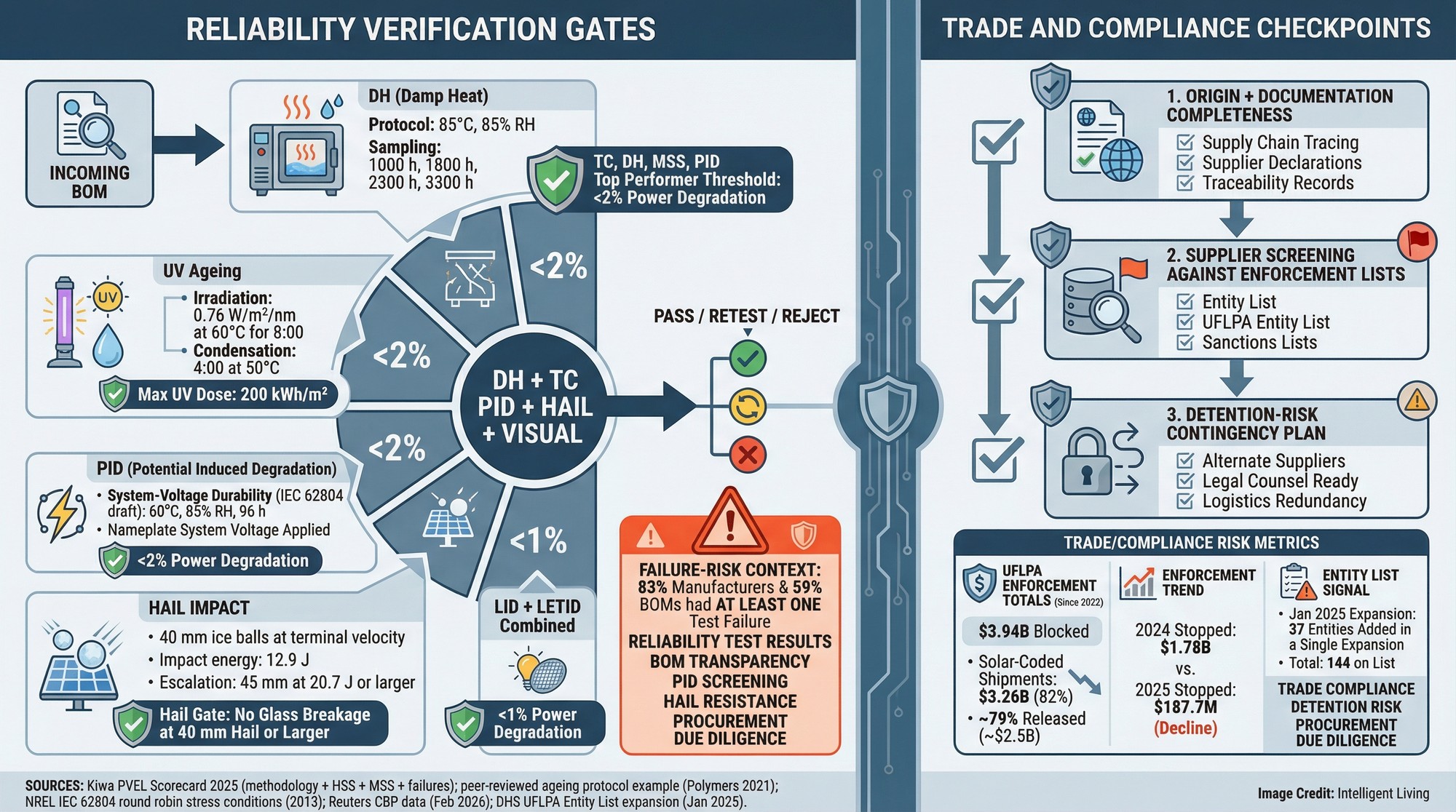
Procurement Guide: Navigating Reliability Tests and Trade Compliance (2026–2027)
What follows the announcements matters more than the headlines. Resin alone does not make film. It is critical to monitor which film converters sign offtake deals and how quickly they ramp production. Early batches must also be evaluated for consistent adhesion and optical performance. Track these four practical items.
- Independent Reliability Test Outcomes: Look for third-party damp-heat, ultraviolet exposure, and PID testing results from accredited labs and test programmes. Baseline qualification often starts with PV module design qualification procedures, while voltage-stress screening can use PID detection test methods to compare sensitivity under controlled conditions.
- Filmmakers And Conversion Capacity: Resin alone does not make film. Watch which film converters sign offtake deals, how fast they ramp production, and whether early batches show consistent adhesion and optical performance. Process control matters at the polymer level too, and optimising POE lamination shows why film qualification is more than a paperwork step.
- Procurement Practices And Contract Clauses: Buyers may request stronger bill-of-materials transparency, and insurance underwriters will pay attention to tested module architectures. Even in residential contexts, home solar setup choices often come down to warranty terms, installer documentation, and whether a system is built for long-term stability rather than lowest upfront cost.
- Trade And Compliance Monitoring: Even when a material is not the direct focus of enforcement, regional supply-chain scrutiny can affect logistics, financing, and procurement requirements. Customs detention reporting indicates how strongly solar supply chains can be affected, including UFLPA-related detentions. The enforcement structure is rooted in a rebuttable presumption and Entity List mechanisms described by the U.S. Department of Homeland Security.
Separately, n-type designs can show sensitivity in certain stress categories, and one practical signal for buyers is the ultraviolet-induced degradation test notes when comparing module bills of materials.
Maximising PV Asset Longevity with Industrial-Scale POE
Xinjiang’s POE scale-up integrates material science with industrial strategy. Verified technical data and transparent procurement protocols must now demonstrate that increased domestic supply correlates with measurable durability gains.
Future utility-scale solar projects will rely on these polymer advancements to hit 30-year production targets in extreme environments. As n-type and bifacial designs continue to dominate global production, the shift towards localised, high-performance encapsulant resin represents a critical step in stabilising the global clean-energy transition. Secure supply chains allow for predictable maintenance cycles and lower levelled costs of energy across the entire solar ecosystem.
Solar Reliability and POE FAQ
What does POE do inside a solar panel?
POE acts as an encapsulant, bonding cells to glass while blocking moisture and ion movement to prevent degradation.
Is POE always better than EVA?
Not always; POE excels in moisture resistance and PID prevention, while EVA remains a cost-effective standard for less demanding environments.
Why does n-type solar require POE?
N-type architectures are more sensitive to moisture and voltage-driven stress, making POE’s superior resistivity essential for long-term stability.
Will Xinjiang production lower global costs?
Domestic resin scale-up reduces supply bottlenecks for filmmakers, though final module prices reflect broader conversion capacity and demand.
How should buyers manage performance risk?
Success depends on verifying accredited test results, supplier transparency, and documented bill-of-materials choices rather than relying on manufacturer claims.


