
On a freezing night or during a record-breaking heatwave, the difference between a tarp and an insulated, lockable space can mean the difference between survival and crisis for those suffering homelessness. Across the United States and parts of Europe, cities are quietly experimenting with a new layer of emergency housing that moves beyond tents and crowded cots. These solutions include insulated sleeping pods, modular micro-homes, and flat-pack shelters designed to provide privacy, thermal protection, and structured service outreach.
The 2024 Point-in-Time count from the U.S. Department of Housing and Urban Development shows that more than 771,000 people were homeless on a single night in January. Of those, more than 274,000 were living in unsheltered conditions. This overwhelming scale forces a difficult question: does micro-housing truly offer a path forward, or is it just a polished version of the same temporary fixes?
Evaluating non-congregate shelter models—from Ulmer Nests in Germany to modular pod communities in the United States—clarifies where these approaches succeed, where they struggle, and how they avoid the grey zone between emergency aid and long-term stability.

Homeless Shelter Innovation: Vital Facts on Micro-Housing Efficiency
- In January 2024, 771,480 people were experiencing homelessness in the U.S., with over 274,224 living unsheltered.
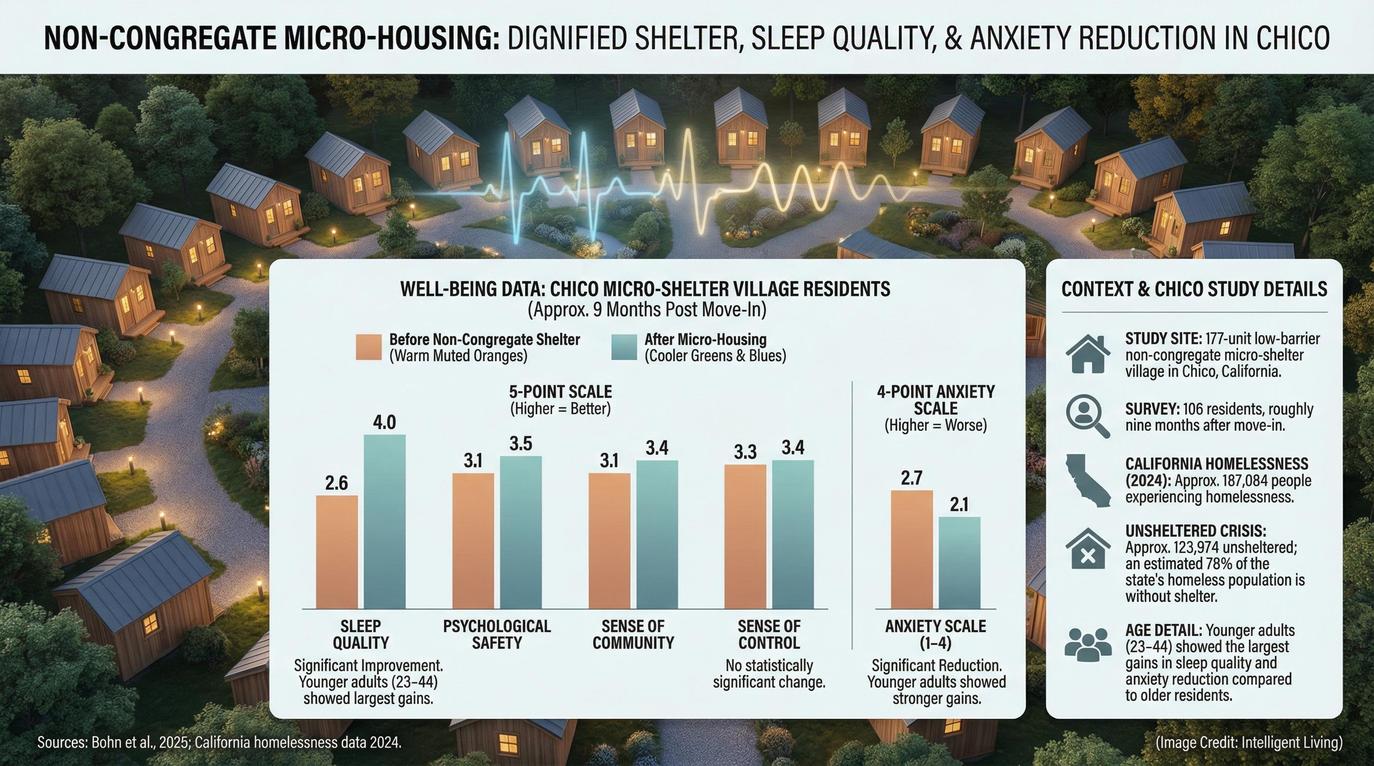
- Research on low-barrier, non-congregate shelter in Chico, California, found measurable improvements in sleep quality, psychological safety, and anxiety after residents moved from unsheltered conditions into private units.
- Cities such as Lansing, Michigan, have approved modular pod projects with upfront costs in the hundreds of thousands of dollars plus ongoing annual operational expenses.
- Germany’s Ulmer Nests are designed as insulated night shelters integrated into an outreach system that connects occupants to social services the following morning.
- HUD defines non-congregate shelter as temporary shelter in private units or rooms that do not require a lease and are not shared dorm-style spaces.
Modular models redefine homeless shelter innovation by fusing modular construction and automated factory-built housing with high-performance insulation and real-time service coordination.

The Biological Cost of Unsheltered Living: Why Tents and Cots Fail
While emergency tents and communal shelters prioritise speed and scale, they rarely account for biological stability. People living outdoors face direct exposure to cold snaps, heat waves, wind, and precipitation. Medical research has shown that people experiencing homelessness have significantly higher rates of heat-related emergency department visits compared with the general population, highlighting how temperature exposure becomes a health risk multiplier.
Physiological Impacts of Chronic Sleep Disruption
Crowded dorm-style shelters introduce a different set of stressors that directly impede recovery. Noise, lack of personal space, and constant proximity to strangers disrupt sleep cycles and spike cortisol levels. This environment makes it nearly impossible for the human body to engage its natural repair mechanisms.
The physical consequences of chronic sleep disruption in these settings are well-documented:
- Heightened risks for heart disease and metabolic disorders.
- Significant decline in immune system function and resilience.
- Impaired cognitive clarity and reduced emotional regulation.
- long-term cognitive decline and metabolic disorders result from chronic rest deprivation.
Prioritising sleep in emergency architecture is not a luxury; it is a clinical requirement for stability. When residents achieve consistent rest, they are far better equipped to engage with social services and housing navigation.
Shelter design that ignores thermal insulation, ventilation, and privacy might offer protection from rain, but it leaves the occupant physiologically strained and physically vulnerable. That strain can manifest as heightened conflict, mental health instability, and repeated emergency system contact.
Privacy as a Medical Necessity: Evidence from Non-Congregate Environments
Privacy is The First Medicine
Critics often dismiss ‘dignified shelter’ as a cosmetic luxury, but data indicates that privacy serves as a practical medical necessity. In California, residents reported a peer-reviewed study of a low-barrier non-congregate shelter in Chico, California, found that residents reported sleep quality increasing from 2.6 to 4.0 on a five-point scale after moving into private units. Simultaneously, psychological safety improved while anxiety scores significantly decreased. These are not abstract sentiments. They are quantifiable shifts in well-being.
Non-congregate environments also appear to reduce system friction. Emergency housing in Washington showed mixed-methods study on hotels as non-congregate emergency shelters reported substantial reductions in emergency dispatch activity at certain locations. While context matters and results vary by city, the pattern suggests that when people have a private, controlled environment, crises may decrease.
Privacy offers something tents cannot: a door that closes, a predictable temperature range, and the psychological signal of personal space. That signal can stabilise behaviour and make it easier for outreach workers to engage residents in services.
Defining Non-Congregate Shelter: Clarifying Emergency Aid Terminology
Policy discussions often blur important definitions. Under current HUD HOME-ARP guidance on eligible costs for non-congregate shelter, these facilities must provide private rooms that do not require traditional leases.
Structural Differences and Personal Autonomy
The distinction is vital: while a gymnasium filled with cots defines congregate shelter, a lockable pod or modular unit provides a non-congregate environment. This structural shift fundamentally alters the experience of safety and personal autonomy.
Grasping these technical distinctions empowers readers to evaluate headlines regarding micro-housing, sleeping pods, and tiny home villages with greater accuracy. Numerous facilities function as explicitly transitional sites, serving as a vital bridge toward more stable, permanent arrangements.
Modular Designs Redefining Modern Emergency Architecture
Together, these examples show that micro-housing for homelessness is not one product. It is a category of approaches. Some focus on cold-weather survival. Others emphasise modular scalability. The most promising models integrate insulation, privacy, and structured service engagement. The ultimate measure of success, however, remains whether residents move from temporary safety into stable, long-term housing.
Ulmer Nests: Insulated Night Protection with Service Linkage
In Ulm, Germany, the city introduced Ulmer Nests as insulated sleeping capsules intended for individuals who cannot or do not want to use traditional overnight shelters. The official city description emphasises cold protection, ventilation, and integration into the broader housing support system. Sensors notify social service providers when a pod has been used so outreach teams can follow up the next morning.
The Ulmer Nest model is not marketed as permanent housing. It functions as a protective layer during extreme weather and as an entry point into services. That service linkage is critical. Without it, a pod is just a box. With it, the pod becomes part of a coordinated pathway.
ModPods and Micro-Shelter Villages in The United States
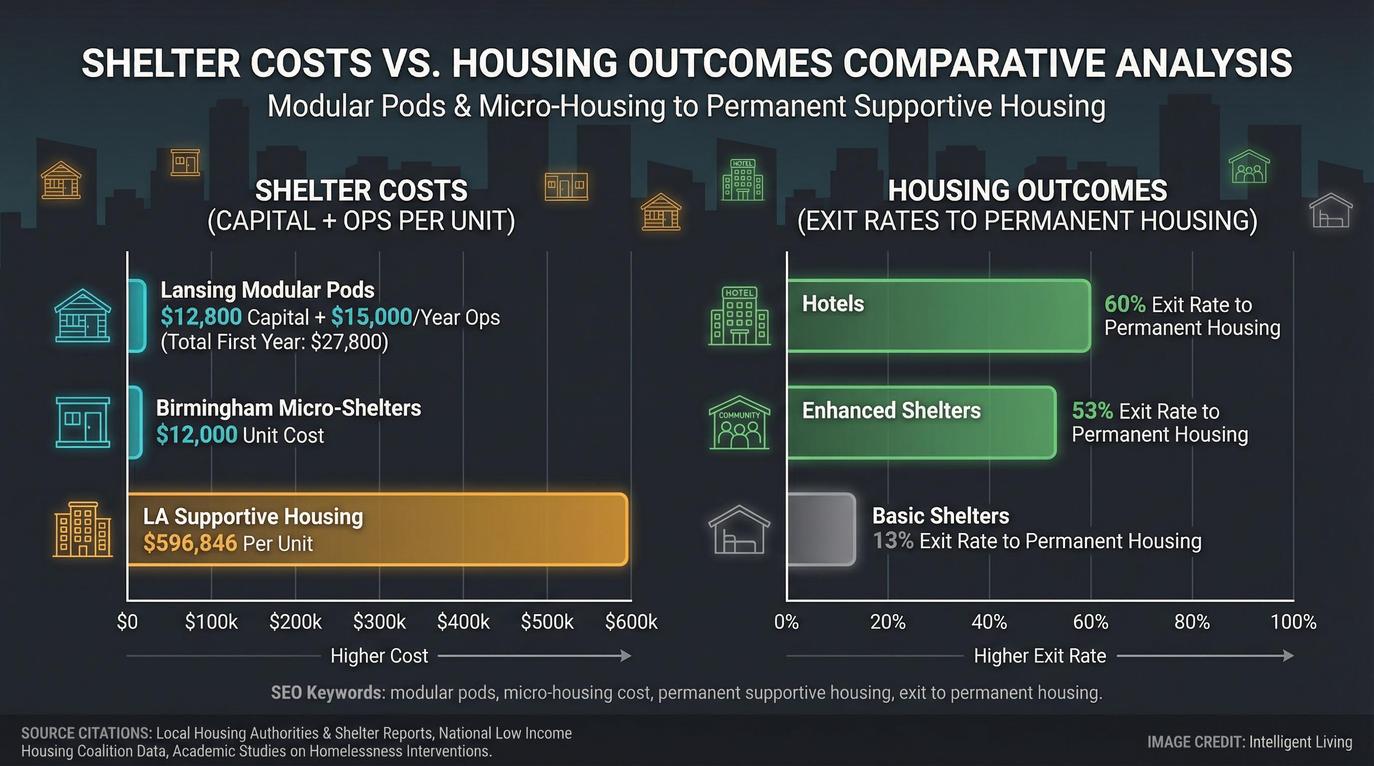
In Lansing, Michigan, city officials approved 50 modular pods with an upfront cost of $640,000. In Michigan, recent projects highlight how ongoing operational costs can exceed upfront capital investment. Birmingham, Alabama, approved a pilot plan that included approximately 50 small shelters costing around $12,000 per basic unit, plus additional facilities and wraparound services.
The pilot plan in Birmingham emphasised that wraparound services and additional facilities are as vital as the units themselves. Staffing, sanitation, utilities, and case management drive long-term costs. Successful outcomes are often seen in tiny home villages built on abandoned land for chronically homeless residents.
Hex House and The Climate-Ready Shelter Concept
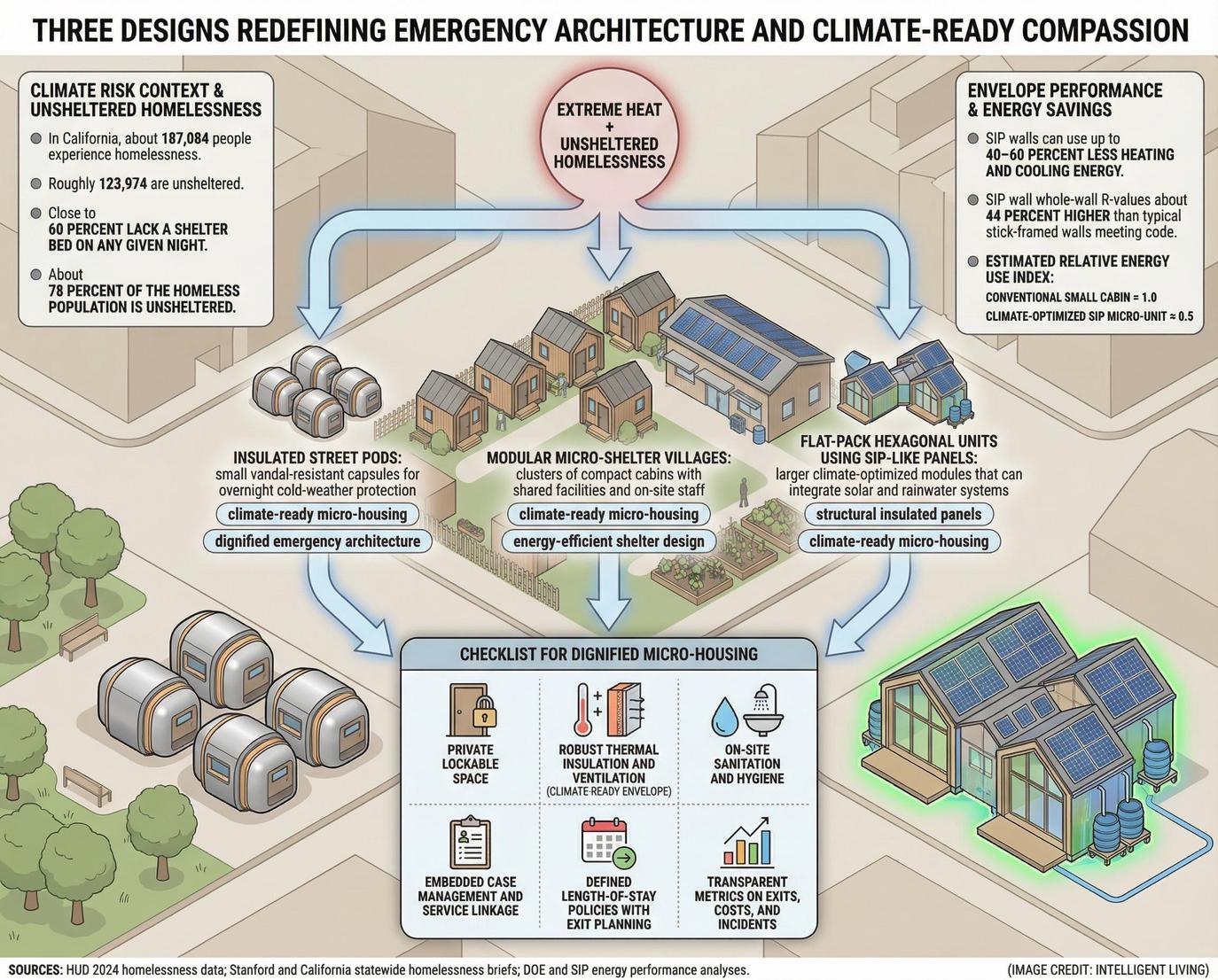
Originally designed for disaster response and displacement, the Hex House concept serves as a blueprint for modern emergency aid. It illustrates how flat-pack modular design and structural insulated panels used in high-performance passive homes create rapidly deployable, thermally competent housing. MIT Solve describes Hex House as modular, off-grid capable, and designed with passive cooling, solar integration, and rainwater harvesting features.
Insulation is not an aesthetic upgrade. It determines how well a structure retains warmth in winter and resists overheating in summer. Compared with standard tent materials, panelised systems can provide substantially higher whole-wall thermal performance. Innovation in this sector includes tiny homes made from recycled wind turbine blades, creating stable environments with minimal footprints.

Climate-Ready Compassion: Thermal Protection as Public Health Infrastructure
Climate-Ready Compassion
Emergency shelter is also climate infrastructure.
People experiencing homelessness face disproportionate exposure to extreme heat and cold. Medical data highlights PubMed-indexed study of heat-related illness among people experiencing homelessness for unsheltered populations during temperature spikes. This reinforces that thermal protection is a public health necessity rather than a design preference.
Insulation, ventilation, and moisture control are the fundamentals of climate-ready shelter. Structural insulated panels, often called SIPs, are factory-made wall and roof sections with insulation sandwiched between rigid boards. Continuous insulation layers allow SIP assemblies to achieve superior whole-wall performance compared to typical framed walls plagued by gaps and thermal bridging.
Panelised systems reduce heat loss and dramatically improve energy efficiency. This is supported by guidance from the U.S. Whole Building Design Guide on structural insulated panels and whole-wall performance, which emphasises whole-wall performance.
The Hex House concept illustrates how these principles translate into deployable emergency architecture. In the MIT Solve description of the Hex House rapid-deployment shelter system, the design is presented as modular, flat-pack, and capable of integrating passive cooling and solar features, showing how insulation and envelope design can be scaled quickly when displacement occurs.
Climate-ready compassion means asking a simple question: does this shelter meaningfully reduce heat and cold exposure risk? If the answer is no, then it is not innovation. Applying climate-adaptive colour-changing exterior paint can further reduce thermal loads in compact dwellings.
The Service Gateway Model
Modular housing achieves its highest potential only when fully integrated into the wider ecosystem of support services. A private unit can stabilise sleep and reduce anxiety, but without service linkage it does not automatically create long-term housing exits.
These insulated night capsules are part of the City of Ulm’s Ulmer Nest housing support programme to ensure every use triggers a follow-up. In the United States, similar lessons emerge. Tiny home villages and modular pod sites that include on-site case managers, hygiene facilities, and referral pathways tend to report stronger stabilisation outcomes than sites that simply provide a bed behind a door.
Rather than warehousing individuals in smaller boxes, the primary objective is to facilitate a safer night that transitions into a structured morning conversation about housing, employment, and healthcare.
The Governance Gap: Ensuring Micro-Housing is A Bridge, Not A Trap
Bridge or Trap? The Governance Layer that Decides Outcomes
A dangerous friction exists within every temporary intervention: without efficient exit pathways, emergency homelessness relief can quickly solidify into a semi-permanent trap.
Local reporting on modular pod projects highlights how operational costs accumulate over time. In Lansing, Michigan, recent projects highlight how ongoing operational costs can exceed upfront capital investment. Similarly, Birmingham, Alabama’s plan emphasised the need for wraparound services and additional facilities.
Analysing Long-Term Operational Costs and Success Metrics
Effective governance ultimately determines whether these units create reliable exit pathways to permanent housing or merely serve as a temporary trap. Key metrics include average length of stay, rate of exits into permanent housing, incident reduction, and whether governance structures utilise circular housing-as-a-service models that treat homes as ongoing infrastructure.
Quick Reality Check: Costs, Speed, and The Permanent Housing Question
Permanent supportive housing projects in high-cost markets can require significant capital investment. In high-cost markets, audit by the Los Angeles City Controller on Proposition HHH project costs and timelines and rising per-unit expenses.
Strategic Integration with Permanent Housing Pipelines
Micro-housing serves as a supplement, rather than a substitute, for permanent supportive housing. Sophisticated plans for urban garden strategies that cool overheated neighbourhoods to address both housing and microclimate risks. Micro-housing can address the immediate risk layer if it is paired with credible housing production strategies and measurable exit pathways.
The critical metric lies in the choice between exposure and protection. Success is found in moving residents from stagnant survival into a structured, dignified transition.

Evidence-Based Solutions: Quality Control and Strategic Outcomes
A Checklist for Dignified Micro-Housing that Doesn’t Backfire
Implementing these units requires more than just securing a site and a structure. A well-designed micro-housing programme must adhere to specific criteria to ensure long-term stability and safety for residents.
The following checklist identifies the essential pillars of a successful model:
- Private, Lockable Space: Residents need control over entry and exit to reduce anxiety and improve sleep stability.
- Thermal and Ventilation Safety: Units should adhere to principles of high-performance building envelopes that drastically cut heating and cooling loads to ensure thermal stability.
- Access to Hygiene and Sanitation: Toilets, showers, and waste management systems are essential for health.
- On-Site or Coordinated Case Management: Outreach and service linkage should be embedded into daily operations.
- Defined Length-of-Stay Policies: Clear expectations and housing navigation prevent indefinite drift.
- Transparent Metrics: Cities should publish data on exits, costs, and incident reduction.
Municipalities that adhere to these rigorous standards successfully avoid the common pitfalls of disorganised encampments. These protocols turn a temporary shelter into a reliable platform for life transformation. Modular housing solutions become a measurable success for the entire community when they meet these criteria.
Micro-Housing For Homelessness: What The Evidence Really Shows
Micro-housing for homelessness is not a silver bullet. It does not eliminate the structural causes of housing instability, nor does it replace the need for deeply affordable permanent units. What it can do, when designed and governed carefully, is reduce immediate exposure risk, improve sleep and psychological safety, and create structured entry points into services.
The evidence suggests that privacy and thermal protection matter. Utilising solar container dorms that track comfort, energy use, and carbon metrics provides the feedback needed to verify design efficacy. The debate should move beyond whether pods look better than tents and toward whether they measurably reduce harm and accelerate pathways into stable housing.
If the answer to those questions is yes, then micro-housing is not cosmetic reform. It is targeted harm reduction with a housing strategy attached. Dignified micro-housing, from Ulmer Nests to modular pods, shows how insulated, private, non-congregate shelters can cut harm and stabilise unhoused lives.
Homeless Shelter Innovation FAQ: Micro-Housing, Pods, and Non-Congregate Shelter Explained
What is Non-Congregate Shelter?
Non-congregate shelter refers to temporary housing in private units or rooms that are not shared dormitories. Residents do not typically sign long-term leases. This model contrasts with large congregate shelters where many people sleep in the same room.
Do Tiny Home Villages and Pods Actually Work?
Modular projects have successfully created tiny homes for homeless veterans in Calgary and compact dwellings. Long-term success still depends on exit rates into permanent housing and the quality of embedded services.
Are Micro-Shelters Safe in Extreme Weather?
Safety depends on insulation quality, ventilation, and maintenance. Structures built with insulated panels and proper airflow design provide significantly more thermal stability than tents or tarps.
Is Micro-Housing Cheaper than Permanent Housing?
Upfront construction costs are often lower than large permanent housing projects, but operational expenses can be substantial. Micro-housing should be evaluated as a bridge solution, not a permanent substitute.
What Should Cities Publish to Prove Success?
Cities should release data on average length of stay, housing exits, total programme cost per resident, and reductions in emergency incidents. Transparent reporting builds public trust and clarifies whether micro-housing is fulfilling its intended role.


