
While quantum computing headlines often promise wholesale revolutions, the most significant shifts happen in specialized labs where theory finally meets clinical reality. The Wellcome Leap Q4Bio challenge adopts a tactical approach by shifting the focus toward measurable medical benchmarks. By requiring teams to test against classical high-performance computing (HPC) and demonstrate value on real quantum hardware, the program signals that the era of hybrid quantum healthcare has arrived.
Strategic pivots from speculation toward concrete metrics suggest that near-term medical breakthroughs will debut as pragmatic hybrid systems rather than standalone miracles. Integrating quantum computing convergence across hardware, GPUs, and HPC stacks creates a specialized accelerator within the clinical compute stack. This hybrid infrastructure allows researchers to tackle biomedical quantum applications—like drug discovery or protein folding—without abandoning the reliability of classical systems. The result is a resilient compute environment where quantum routines solve specific bottlenecks while high-performance clusters handle heavy data lifting.
In one lab, a technician started tracking why overnight genomic feature-selection jobs kept finishing hours later than scheduled. The result was not a dramatic breakthrough, just a spreadsheet of wasted cycles that quietly changed how the team prioritized optimization.
To prove this concept, one modeling team recently distilled a patient dataset into a curated feature set using classical preprocessing. This specific category of everyday frustration mirrors the challenges Q4Bio pushes teams to quantify and resolve. It highlights the same cost-and-latency tradeoffs that already shape decisions about local AI versus cloud AI for personal computing workloads in real clinics and labs.

Q4Bio Prize Overview: Setting a $5M Proof Standard for Quantum Healthcare
Essential Q4Bio Program Details: Benchmarks, Timeline, and Milestone Funding
To verify these benchmarks, the Wellcome Leap initiative employs a staged framework designed to bridge the gap between quantum theory and clinical utility:
- Program Scope: The Quantum for Bio program built around healthcare benchmarks accelerates quantum-enabled applications in biology and medicine to test performance against classical standards.
- Phases and Durations: The challenge uses a staged pipeline with explicit evaluation gates, and the phase structure and funding limits in the Q4Bio FAQ provide a clear snapshot of how teams progress toward real-device implementation.
- Prize Structure: A $5 million grand prize is reserved for a team that meets the program’s defined proof bar, consistent with a Q4Bio briefing that lists the $2M milestone prizes and the $5M grand prize for healthcare-relevant demonstrations.
- Why this is Different: The goal is not to “show quantum works” but to show it improves a healthcare-relevant task under transparent constraints and reproducible measurements—the same kind of accountability expected when major health systems test quantum research contracts tied to real clinical questions.
These gates ensure that only the most promising hybrid medical quantum work moves forward. By establishing these milestones, the challenge creates a roadmap for researchers to navigate from theoretical modeling to clinical validation.
Defining Success: What the $5 Million Wellcome Leap Prize Actually Measures
Wellcome Leap designed the Q4Bio challenge to verify whether quantum methods offer a measurable advantage on specific biomedical tasks. The prize is not about flashy demos. It is about taking a real problem, defining an identical task a classical algorithm can attempt, and then proving a quantum-enabled approach performs better under comparable conditions. That proof mindset is baked into the challenge’s 3–5-year horizon and reinforced by a Q4Bio phase-by-phase research perspective that outlines fast, milestone-driven timelines.
Success in clinical research often hinges on whether a result survives a skeptical baseline test—the moment it moves from ‘interesting’ to ‘useful.’ This cultural habit of insisting on comparable benchmarks is exactly what Q4Bio rewards. The same logic applies to chronic disease management analytics, where patient outcomes matter far more than algorithmic novelty.

Clinical Proof Standards: Understanding the Explicit Q4Bio Evaluation Bar
The Benchmark Gate: Requiring Comparable Classical HPC Baselines
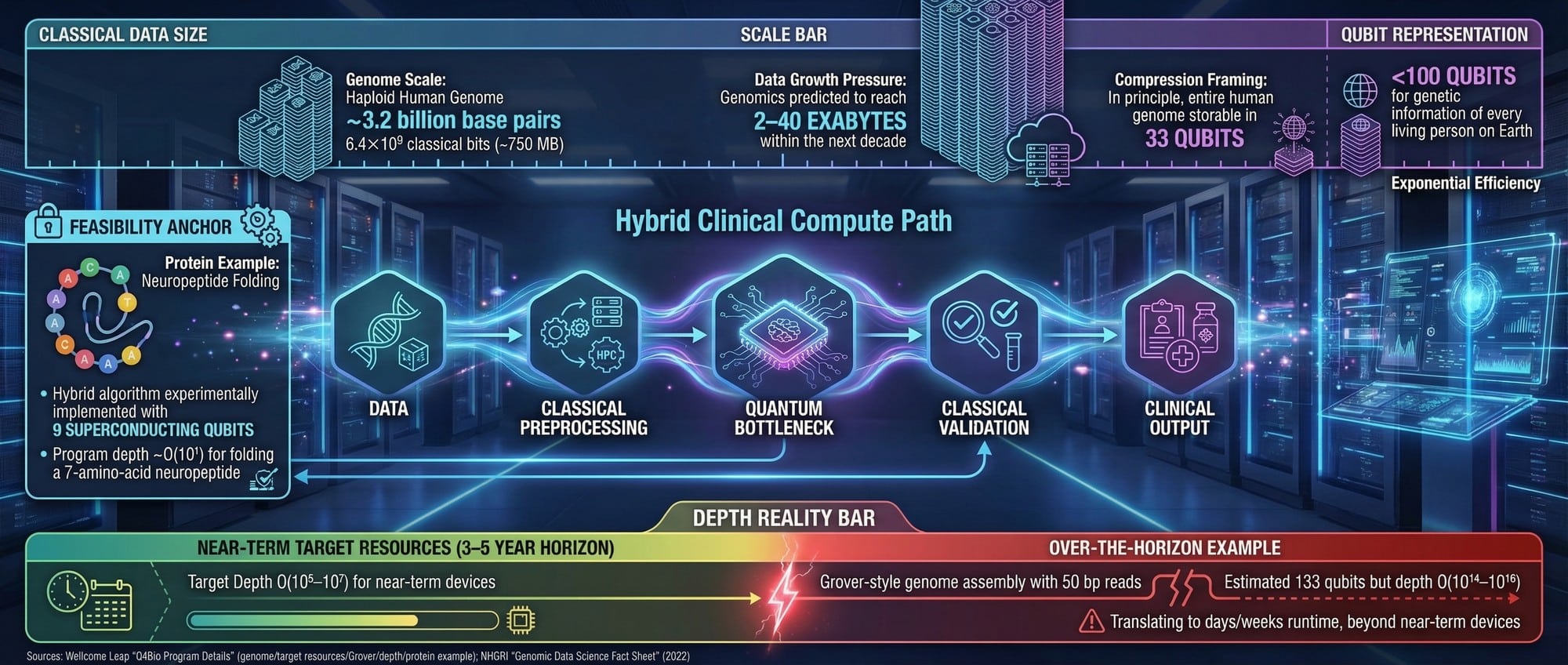
Proof in Q4Bio is not a vibe. It is a reproducible comparison against an accepted classical method on the same dataset and the same evaluation metric, and Phase 2 formalizes that requirement with a 30-to-40-qubit classical HPC simulation compared to a standard classical approach for the same application. That is why the program forces teams to demonstrate credibility before they are taken seriously as “better than classical.”
Standard patterns in biomedical computing demonstrate that algorithms often appear impressive only until tested against identical cohorts and scoring methods. Analytical history provides examples of models that ‘improved’ accuracy simply because training data was cleaned differently than the baseline. That kind of subtle mismatch is what structured benchmark gates are meant to prevent.
The Resource Gate: Validating Qubit Counts, Circuit Depth, and Scaling Paths
Q4Bio distinguishes between small demonstrations and resource-constrained proofs. The program’s published target resources for qubits and circuit depth function like an engineering box that teams must eventually fit inside, with a credible scaling plan from today’s prototypes to near-future systems.
The Reality Gate: How Hardware Constraints Shape Quantum Validation
Even strong algorithms can fail on today’s noisy hardware, where errors and limited circuit depth can erase gains. Field reviews exploring clinical quantum impact stress that broader medical success will depend on hardware improvements and careful validation.
Reliable engineering dictates that error correction remains a primary focus rather than a secondary concern. It marks the difference between a promising theoretical curve and a result that survives in practice. These engineering pressures drive error correction that keeps qubits stable, ensuring fragile quantum states remain usable for longer, more complex computations. Advances in materials and fabrication, including ultra-pure silicon that reduces qubit noise, matter because reliability is ultimately an engineering problem.
Pragmatic Adoption: Why Hybrid Quantum Healthcare is the Immediate Future
Operational Realities: Why the Hybrid Model is the Most Strategic Path
Healthcare pipelines will likely remain classical at scale for years, utilizing quantum processors only for highly specialized subroutines. Adopting this hybrid model represents a strategic choice rather than a retreat from ambition. Variational and optimization-style approaches offload heavy lifting onto classical processors, a pattern driven by practical resource requirements for biochemistry algorithms.
Demonstrating this approach, one modeling team recently distilled a patient dataset into a curated feature set using classical preprocessing. They then tested a quantum routine only on those compressed features. The workflow mirrored a careful extension of standard analytics rather than a leap into science fiction, proving that modern labs optimize data pipelines to reduce wasted cycles.
Infrastructure Integration: Deploying Quantum Modules within Classical Stacks
Engineers are increasingly adopting hybrid infrastructure as a core design pattern for clinical systems. Scaling pathways now prioritize the close coupling of quantum processors and accelerators, often treating quantum processors like GPU-class accelerators. Global initiatives are similarly integrating quantum modules into broader compute stacks, as seen in the national push to build a quantum platform ecosystem.
Technical Workflow: Integrating Quantum Routines into Clinical Data Pipelines
Quantum workflows create superposition and entanglement across qubits, apply gate sequences, then measure outcomes to extract a result. Standard quantum operations and measurement cycles are framed as repeatable loops of state preparation and readout in real devices.
Qubits serve as powerful but inherently fragile tools, necessitating the careful engineering seen in smaller quantum chips built for real systems. This hybrid push eventually hits data-movement limits. Consequently, photonic networking that eases data-center bottlenecks is gaining significant attention as AI and quantum workloads scale.

Phase 3 Case Studies: Validating Quantum Value in Real Clinical Settings
Precision Oncology: Hybrid Quantum Feature Selection for Cancer Biomarkers
Infleqtion’s Phase 3 effort demonstrates the practical application of hybrid routines to complex clinical challenges. The team is testing whether quantum-in-the-loop feature selection can surface biomarker sets that forecast treatment response in head-and-neck cancers, moving from simulations to experiments on real processors in a Phase 3 precision oncology biomarker discovery effort with head-and-neck cancer cohorts.
Establishing a standard for proof in oncology requires more than a new algorithm; it requires a reliable method for distinguishing patient outcomes:
- A biomarker serves as a measurable indicator to separate likely responders from nonresponders.
- High-signal features allow teams to prioritize which biological markers are trustworthy enough to act on.
- Quantum-enhanced selection helps clinicians move beyond the limitations of standard statistical signals.
This practical focus explains why even a modest improvement in feature selection feels consequential. Researchers are now looking toward breath-based biomarkers for early disease detection as a way to further reduce clinical uncertainty.
Genomics and Pangenomes: Solving Scale Bottlenecks with Quantum Optimization
The Wellcome Sanger Institute’s Phase 3 collaboration targets intense pangenome processing and genomics workflows. These pangenome-scale genomic computations explore search spaces that classical workflows cannot traverse efficiently. These tasks go far beyond pattern matching, involving vast search spaces where optimization becomes the primary limiting factor.
Computational biology has exponentially increased the number of molecular structures and regulatory switches that researchers must map. This scale forces teams to explore new approaches, such as mapping protein shapes and DNA regulatory switches at scale. Single-cell immune profiling adds another layer of complexity. For example, sharpening drug development through immune profiling demonstrates why datasets often become compute-bound. These biomedical assets frequently stall long before they become clinically actionable.

Evaluating Performance: A Proof Checklist for Quantum Healthcare Claims
The Quantum Health Hype Filter: Seven Criteria for Empirical Proof
You do not need a physics degree to evaluate quantum healthcare claims. The same standards for clarity apply to arguments that advanced computing makes care accessible. This objective aligns with how AI can make healthcare affordable worldwide by minimizing waste and refining clinical triage.
To navigate the noise of early industry claims, this checklist provides a rigorous framework for assessing quantum breakthroughs:
- Is there a Clear Classical Baseline? The quantum result should be compared against a strong classical method on the same task and dataset.
- Is the Dataset and Metric Identical? A change in cohort selection or scoring can create fake “wins.”
- Are Qubit Count and Circuit Depth Reported? Without resource disclosure, performance claims are difficult to interpret.
- Was the Result Run on Real Hardware or Only Simulated? Hardware runs matter because noise and calibration can dominate outcomes.
- Is the Advantage Reproducible Across Runs? One favorable run is not proof.
- Does the Improvement Change a Clinical Decision? A tiny accuracy bump can be irrelevant if it does not alter diagnosis or treatment.
- Is there a Credible Scaling Path? The method should plausibly scale as devices improve.
Researchers formalize empirical conditions for quantum advantage to ensure all performance claims remain testable and reproducible. Health analytics teams often find that models only “beat the benchmark” when metrics are outdated. Employing a robust checklist mitigates the risk of accidental self-deception caused by outdated benchmarks.
Sustainability Outlook: Assessing Potential Compute Efficiency Gains
Hybrid pipelines potentially reduce unnecessary compute by distilling datasets into high-signal features before the most resource-intensive steps. Realizing these efficiencies depends heavily on managing cooling overhead and optimizing workload scheduling. These thermal realities are evident in data-center cooling constraints for AI-scale workloads during peak demand spikes.
- Compute Efficiency Possibility: Better feature selection could reduce total compute hours in selected pipelines.
- Operational Caveat: Net energy impact must consider demand shifting, regional grids, and operational dashboards used in carbon-aware FinOps and GreenOps dashboards in production settings.
- Watch Item: Phase 3 outputs will clarify whether any efficiency gains are theoretical or practically achievable.
The long-term environmental impact will be determined by how these systems integrate into existing green data infrastructures. This oversight is vital as the industry moves toward high-utilization production environments.

Conclusion: Proof Beats Promises
The Q4Bio challenge effectively reframes how we measure progress in quantum medicine. By pressuring teams to demonstrate clear, reproducible gains against classical HPC baselines, the program ensures that human health remains the central priority. This rigorous approach creates a transparent record of what quantum techniques can achieve in clinical contexts, moving beyond the noise of speculative experiments toward the reality of useful medical tools.
Meaningful progress now depends on results that survive real-device noise. The shift toward deploying Phase 3 projects on real hardware establishes a new proof standard for the industry. As these hybrid quantum healthcare systems mature, they will likely become the foundational architecture for the next generation of precision medicine, validating that verified clinical breakthroughs require rigorous benchmarking.
FAQ: Quantum Healthcare Benchmarks, Qubits, and Real-World Proof
How does the Q4Bio prize work?
Wellcome Leap awards the $5 million grand prize to teams that outperform classical HPC baselines on verified biomedical tasks using real quantum hardware.
What is hybrid quantum computing in medicine?
Hybrid models combine classical high-performance computing with quantum processors to solve specific subproblems, such as protein folding or biomarker selection, more efficiently.
Can quantum computers help treat cancer?
Yes, projects like Infleqtion’s Phase 3 effort use quantum-in-the-loop feature selection to identify oncology biomarkers that predict how patients respond to treatment.
Is quantum computing better than classical for biology?
Quantum systems excel at simulating molecular interactions, but the Q4Bio challenge requires teams to prove this advantage through reproducible benchmarking against classical methods.
Who can win the Wellcome Leap Q4Bio challenge?
Multidisciplinary teams from academia and industry can win by meeting explicit gates for qubit count, circuit depth, and clinical relevance during Phase 3.


